Introduction
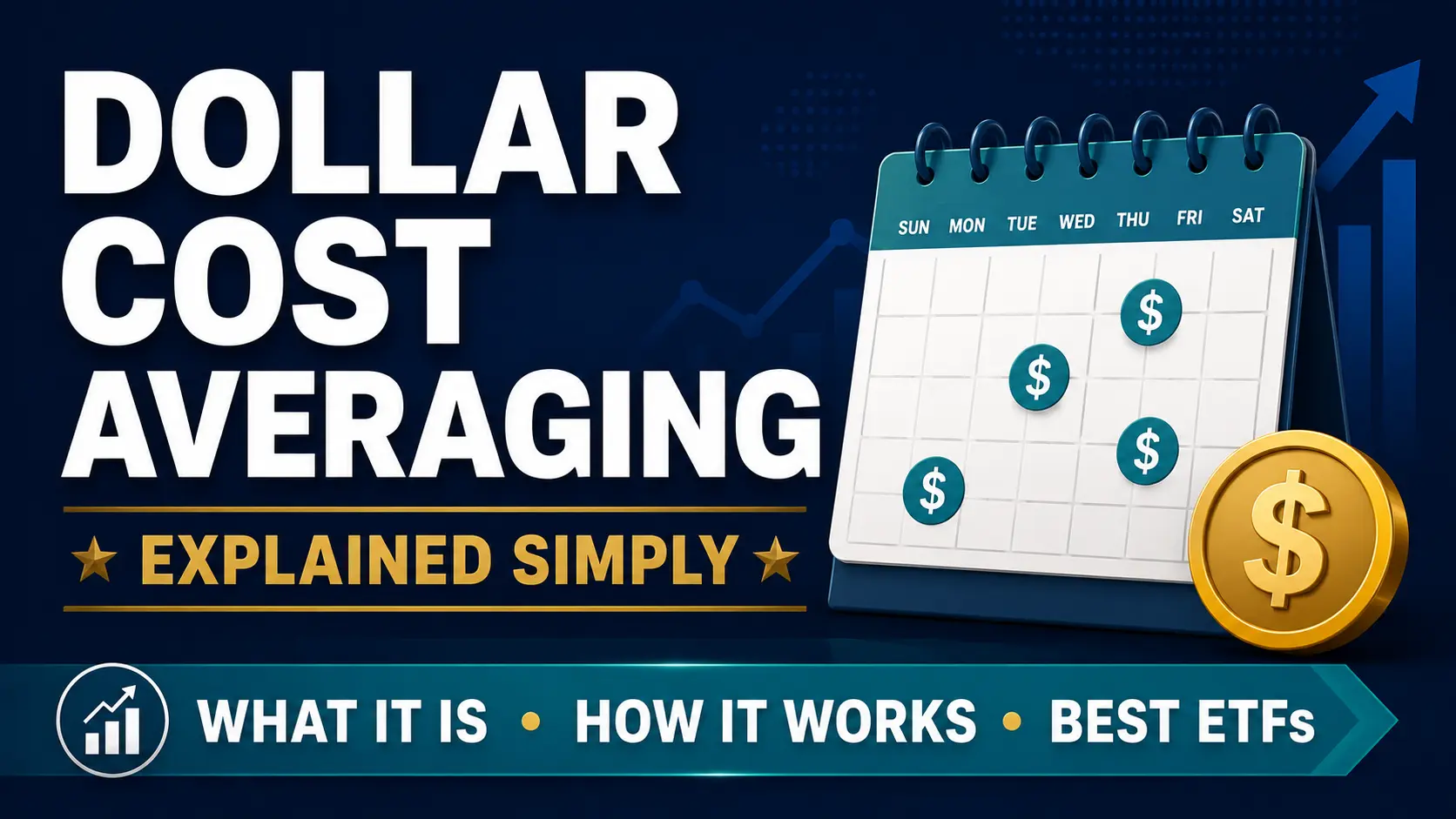
Dollar cost averaging is an investment strategy where you invest a fixed amount of money at regular intervals — such as $100 every month — regardless of whether the market is up, down, or flat. When prices are high, your fixed amount buys fewer shares. When prices drop, it buys more. Over time, this naturally lowers your average cost per share without requiring you to predict anything.
Most investors spend years trying to find the “perfect moment” to invest. Dollar cost averaging removes that pressure entirely — and the data backs it up.
Disclaimer: This article is for informational and educational purposes only. It does not constitute personalized financial advice. Please consult a licensed financial advisor before making investment decisions.
What Is Dollar Cost Averaging?
<cite index=”8-1″>Dollar cost averaging is the practice of investing a fixed dollar amount on a regular basis, regardless of the share price.</cite> That is the textbook definition. But here is what it actually means for you.
Imagine you get paid every two weeks. Instead of saving up and investing a big lump sum once a year — and stressing about whether the market is at a good price — you invest $200 automatically every payday. Some months the market is up. Some months it drops. You invest the same amount either way.
That consistency is exactly what makes this strategy so powerful in practice. You build wealth steadily, avoid emotional decisions, and let math do the heavy lifting over time.
“Already thinking about putting your first $1,000 to work? Read our complete guide on how to invest $1,000 for beginners.”
How Does Dollar Cost Averaging Work? — Real Example
The best way to understand what is dollar cost averaging and how does it work is through a real number example.
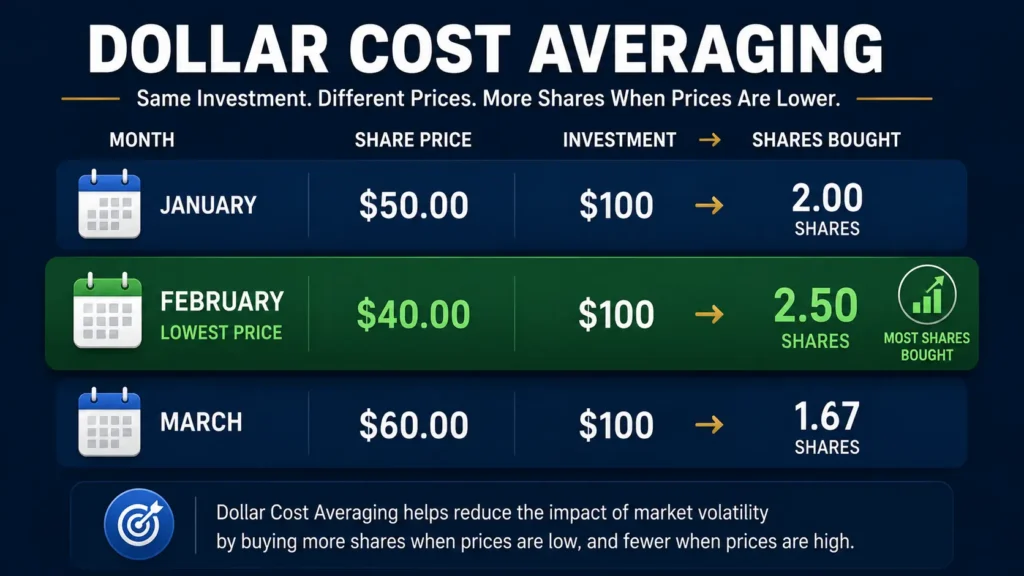
Suppose you invest $200 per month into a broad market ETF. Here is what three months might look like:
| January | $50/share | 4.0 shares | $200 |
| February | $40/share | 5.0 shares | $200 |
| March | $55/share | 3.6 shares | $200 |
| Total | — | 12.6 shares | $600 |
Your average cost per share = $600 ÷ 12.6 = $47.62
Notice that the average share price across those three months was $48.33. However, by investing consistently, your actual average cost was only $47.62 — slightly lower, because you automatically bought more shares when prices dipped in February.
<cite index=”6-1″>When prices are low, your fixed amount buys more shares. When prices are high, it buys fewer. Over time, your average cost per share smooths out.</cite>
This is what makes DCA so effective for everyday investors — no guesswork required.
Dollar Cost Averaging vs. Lump Sum — Which Wins?
This is the most debated question among investors who want to understand what is dollar cost averaging and how does it work compared to alternatives.
<cite index=”11-1″>Historically, lump sum investing outperforms dollar cost averaging about 66% of the time because markets tend to rise over time.</cite> So why does dollar cost averaging remain so popular?
The answer comes down to human psychology and real-world circumstances.
Lump sum wins when:
- You already have a large amount saved and are ready to invest it all
- You have a long time horizon and strong emotional discipline
- Market conditions are clearly favorable and trending upward
Dollar cost averaging wins when:
- You receive income in regular paychecks and invest as you earn
- You are new to investing and nervous about market volatility
- You want to remove emotion and automate your wealth-building habit
- You cannot afford a large lump sum investment upfront
For most Americans investing from a regular paycheck, <cite index=”9-1″>dollar cost averaging works by investing in consistent intervals instead of a lump sum — allowing you to buy more shares when prices are low and fewer when prices are high, effectively averaging out your investment cost.</cite>
The bottom line: if you are choosing between dollar cost averaging vs lump sum, the better question is which one you will actually stick with. A consistent DCA strategy that you follow for 20 years will always beat a lump sum strategy you abandon after the first market dip.
“Pairing dollar cost averaging with the best S&P 500 index funds is one of the most proven approaches for long-term investors.”
Best ETFs for Dollar Cost Averaging in 2026
Dollar cost averaging ETFs work best when the underlying fund is diversified, low-cost, and designed for long-term holding. Here are the top picks for 2026:
| VOO | S&P 500 (500 US companies) | 0.03% | Most trusted — buy consistently and forget |
| VTI | Total US Stock Market (~3,600 companies) | 0.03% | Broadest diversification — ideal for DCA |
| SCHB | Broad US Market | 0.03% | Schwab users’ best DCA option |
| QQQ | Nasdaq-100 (tech-heavy) | 0.20% | Higher growth potential — higher volatility |
| VT | Global Total Market | 0.07% | International diversification in one ETF |
Expense ratios verified July 2026. Past performance does not predict future results.
For most beginners applying dollar cost averaging, VOO or VTI are the strongest starting points. Both charge just 0.03% annually and give you instant ownership across hundreds of US companies.
“FINRA explains the benefits and limitations of dollar cost averaging in detail for new investors.”
Dollar Cost Averaging vs. Index Fund — What’s the Difference?
This is one of the most commonly misunderstood questions among new investors.
Here is the simplest explanation: they are not competing strategies — they work together.
- An index fund (like VOO or FXAIX) is the investment vehicle — what you buy
- DCA is the investment strategy — how you buy it
Think of it this way. An index fund is the car. DCA is how you drive it — steadily, consistently, over a long journey rather than flooring the gas all at once.
| What it is | A buying strategy | An investment product |
| Controls | When and how much you invest | What you invest in |
| Can be combined? | ✓ Yes — most investors use both | ✓ Yes — DCA into an index fund |
| Requires market timing? | No | No |
The most effective approach is to use DCA as your strategy and invest those regular amounts into a low-cost index fund. That combination — two separate concepts working powerfully together — is exactly what millions of 401(k) investors already do automatically every paycheck.
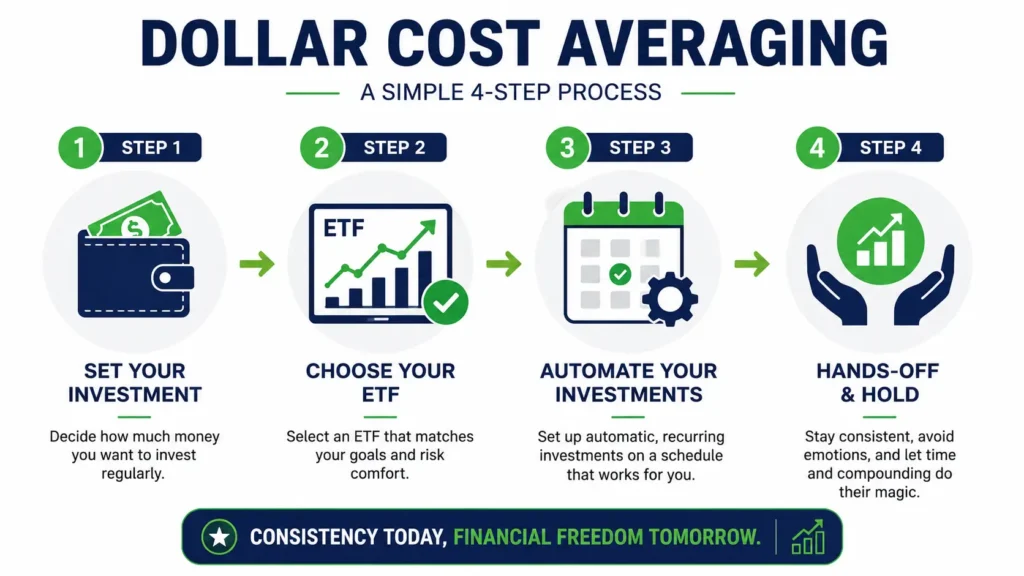
How to Start Dollar Cost Averaging Today — 4 Steps
Understanding what is dollar cost averaging and how does it work is only the first step. Here is exactly how to put it into practice starting today.
Step 1 — Choose your investment amount Pick a fixed dollar amount you can invest consistently every week, two weeks, or month. It does not matter if it is $50 or $500 — consistency is what matters most. Start with whatever fits your budget.
Step 2 — Choose your investment vehicle For most beginners, a low-cost S&P 500 ETF like VOO or a total market fund like VTI inside a Roth IRA is the ideal starting point. Dollar cost averaging ETFs work best when they track broad, diversified indexes.
Step 3 — Open an account and automate Open a Roth IRA or brokerage account at Fidelity, Schwab, or Vanguard. Then set up automatic recurring investments on your chosen schedule. This is the most powerful step — automation removes the temptation to skip contributions during market downturns.
Step 4 — Do not touch it <cite index=”10-1″>Dollar cost averaging does not promise overnight riches, but it offers something more valuable: peace of mind, discipline, and a proven path to building wealth over time.</cite> The strategy only works if you let it run. Resist the urge to pause contributions when markets drop — those are the months when dollar cost averaging buys the most shares at the lowest prices.
“Charles Schwab explains how to set up automated dollar cost averaging contributions step by step.”
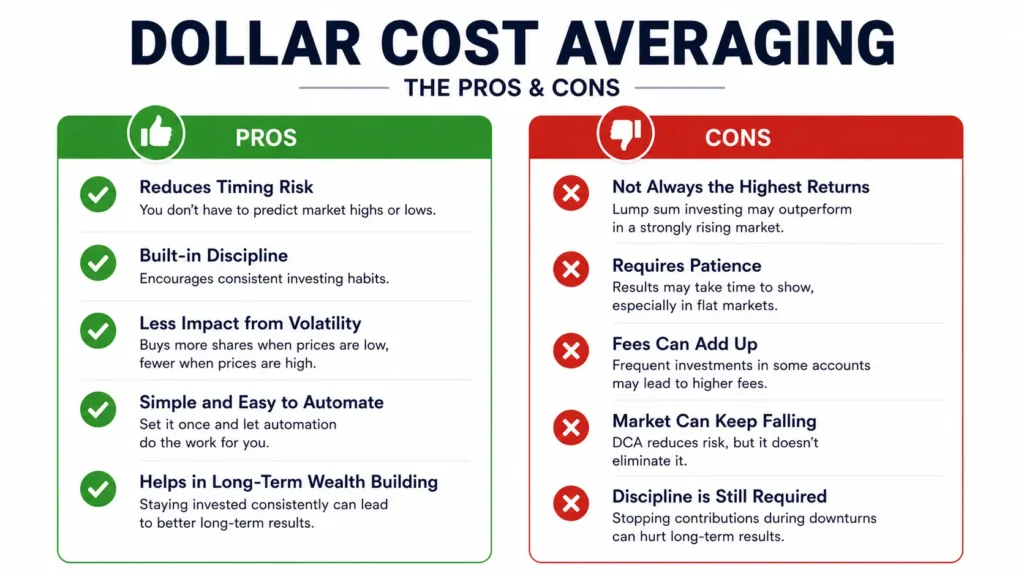
Pros and Cons of Dollar Cost Averaging
No strategy is perfect. Here is an honest look at the strengths and weaknesses of consistent investing.
| Removes emotion from investing | Underperforms lump sum ~66% of the time |
| Works on any budget — start with $50 | Requires long-term commitment to see full benefit |
| Automatically buys more shares when prices drop | Transaction fees can add up (use commission-free platforms) |
| Builds a consistent wealth-building habit | Does not protect against prolonged market declines |
| Perfect for regular paycheck investors | Requires discipline to not stop during downturns |
| Reduces risk of investing at market peak | Slightly more complex to track vs. lump sum |
FAQ — What Is Dollar Cost Averaging and How Does It Work?
Q1: What is dollar cost averaging and how does it work in simple terms?
Dollar cost averaging means investing a fixed amount — like $100 — at regular intervals, regardless of the market price. When prices are low, you automatically buy more shares. When prices are high, you buy fewer. Over time, this lowers your average cost per share and removes the stress of trying to time the market perfectly.
Q2: Is dollar cost averaging better than lump sum investing?
Research shows lump sum investing outperforms DCA roughly 66% of the time in rising markets. However, for investors who receive regular paychecks, lack a large lump sum, or struggle with emotional investing decisions, DCA is the more practical and psychologically sustainable strategy.
Q3: What are the best ETFs for dollar cost averaging?
The best ETFs for dollar cost averaging are low-cost, broadly diversified funds — VOO (S&P 500, 0.03%), VTI (Total US Market, 0.03%), and SCHB (Broad US Market, 0.03%). These funds are available commission-free at Fidelity, Schwab, and Vanguard, making them ideal for regular automated contributions.
Q4: How much money do I need to start dollar cost averaging?
You can start DCA with as little as $1 at Fidelity or Schwab using fractional shares. Most financial experts suggest committing to a fixed amount you can sustain consistently — even $50 per month invested for 30 years at 10% average annual return grows to over $100,000.
Q5: Does dollar cost averaging work in a bear market?
Yes — DCA actually works best during bear markets. When prices fall, your fixed investment amount buys more shares at lower prices. Investors who continue DCA through downturns like 2022 (when the S&P 500 dropped approximately 18%) were positioned to benefit significantly when markets recovered.
Q6: What is the difference between dollar cost averaging vs index fund investing?
Dollar cost averaging is a strategy — it describes how and when you invest. An index fund is the investment vehicle — what you put your money into. Most long-term investors combine both: they use DCA as their method and invest those regular contributions into a low-cost index fund like VOO or VTI.
Conclusion
Understanding what is dollar cost averaging and how does it work is one of the most valuable things a new investor can learn. The concept is simple: invest a fixed amount on a regular schedule, automate it, and let time and compounding do the rest. No market timing. No stress. No guesswork.
The best part? You can start today with whatever amount fits your budget — even $50 per month makes a real difference over decades.
Your next step: Now that you know how DCA works, the next question is — where should you hold those investments for maximum tax-free growth?
📌 Read Next: [Roth IRA for Beginners 2026 — Everything You Need to Know]
📌 Also Read: [Invest $1,000 for Beginners — 5 Smart Moves That Actually Work ]

Financial enthusiast with 5 years of experience in the US market trends and personal wealth management