
IRS $3000 Tax Refund: Is It Real, Who Qualifies, and When Will You Get It?
If you are staring at your tax software or waiting for your W-2, wondering if a $3,000 IRS tax refund is actually possible this year—you are not alone. Millions of Americans chase this exact benchmark every spring.
But here is the funny thing: according to the latest IRS processing data, an average refund this season is hovering right around $3,275. That means a $3,000 payout isn’t a rare government bonus; it is actually a very standard reality for the average worker.
However, the money doesn’t just slide into your bank account by luck. Getting to that $3,000 mark—and making sure it hits your account without massive delays—depends entirely on your paycheck setup and the specific tax credits you claim. Let’s break down how the math actually works for your household, without the confusing tax jargon.
The Secret Behind a $3,000 Refund: It’s Already Your Money
The most important thing to understand is that the IRS never hands out free money without a reason. If you land a $3,000 check, it usually happens because of two very common scenarios:
Tax credits did the heavy lifting: This is where you actually win. Refundable credits like the Child Tax Credit (CTC) or the Earned Income Tax Credit (EITC) act like cash injections. Even if you paid very little in taxes all year, these family credits can single-handedly push your final refund past the $3,000 line.
You gave the government an interest-free loan: If you didn’t update your W-4 form after getting married, shifting jobs, or having a baby, your employer likely took too much money out of your weekly paychecks. That $3,000 refund is simply the IRS giving your own hard-earned money back to you.
What Drives a $3,000 Refund
A $3000 IRS tax refund doesn’t appear randomly. It reflects a specific combination of withholding and credits that pushed your prepayments above what you owed. Most people hit this number through one of two paths.
Path 1 — Excess withholding: Your employer withheld more from each paycheck than your actual tax liability. This is common among W-2 earners who didn’t update their W-4 after a life change. The $3,000 comes back because it was always your money — the IRS is returning the over payment.
Path 2 — Refundable credits: Credits like the Child Tax Credit (CTC) and the Earned Income Tax Credit (EITC) can push your refund into $3,000 territory even if your withholding was modest. Refundable credits pay out as a refund even when the credit exceeds your total tax bill.

In many cases, a $3000 IRS tax refund combines both — some over-withholding plus a partial credit.
Credits That Get You to $3,000
Child Tax Credit (CTC)
For the 2025 tax year (returns filed in 2026), the Child Tax Credit is worth up to $2,200 per qualifying child under age 17. The refundable portion — called the Additional Child Tax Credit — is capped at $1,700 per child, per IRS inflation adjustments for tax year 2025.
A family with one child, modest withholding, and $1,700 in ACTC can easily land near $3,000. With two children, the math gets even more favorable.
Income phase-outs apply: the credit reduces by $50 for every $1,000 over $200,000 (single filers) or $400,000 (married filing jointly). Below those thresholds, most families with children qualify for the full amount.

Earned Income Tax Credit (EITC)
The EITC is fully refundable and designed for low-to-moderate-income workers. For 2025, the maximum EITC is $8,046 for filers with three or more qualifying children, per IRS Revenue Procedure 2024-40.
Even at lower income levels and with fewer children, the EITC alone can account for $1,000–$3,000 of a refund. Combined with other withholding, it’s one of the most direct paths to a $3000 IRS tax refund for working families.
One important restriction: If your return claims EITC or ACTC, the IRS must hold the refund until mid-February, regardless of when you filed. This is a statutory rule, not a processing delay.
Standard Deduction and Withholding Gap
The 2025 standard deduction increased to $15,000 for single filers and $30,000 for married filing jointly, a $400–$800 jump from 2024. Filers who switched to the standard deduction from itemizing, or who had significant income changes, often find a larger-than-expected gap between withholding and actual liability—which shows up as a $ 3,000 IRS tax refund or larger.
$3,000 IRS Tax Refund Eligibility: Who Qualifies
There is no single IRS program that pays out exactly $3,000. The $3000 IRS tax refund eligibility question is really about whether your tax situation produces a net over payment near that amount. The most common profiles:
- W-2 earners with unchanged W-4s who had life changes (job switch, new child, pay raise or cut)
- Families with one child claiming both CTC and ACTC
- Lower-to-middle income filers claiming EITC with at least one qualifying child
- Dual-income households where each spouse’s employer withheld assuming they were the sole earner
The IRS $3000 refund amount is not a special category — it’s just where the math lands for a large slice of American filers. The 2026 season average of $3,275 confirms it.
How to Calculate Your Estimated Payout
Once you file your return, you can track your $3000 IRS tax refund using the IRS “Where’s My Refund” tool at IRS.gov/refunds or the free IRS2Go mobile app.
To check your $3000 IRS tax refund status, you need three things:
- Your Social Security Number or IT IN
- Your filing status (single, married filing jointly, etc.)
- The exact refund amount shown on your return
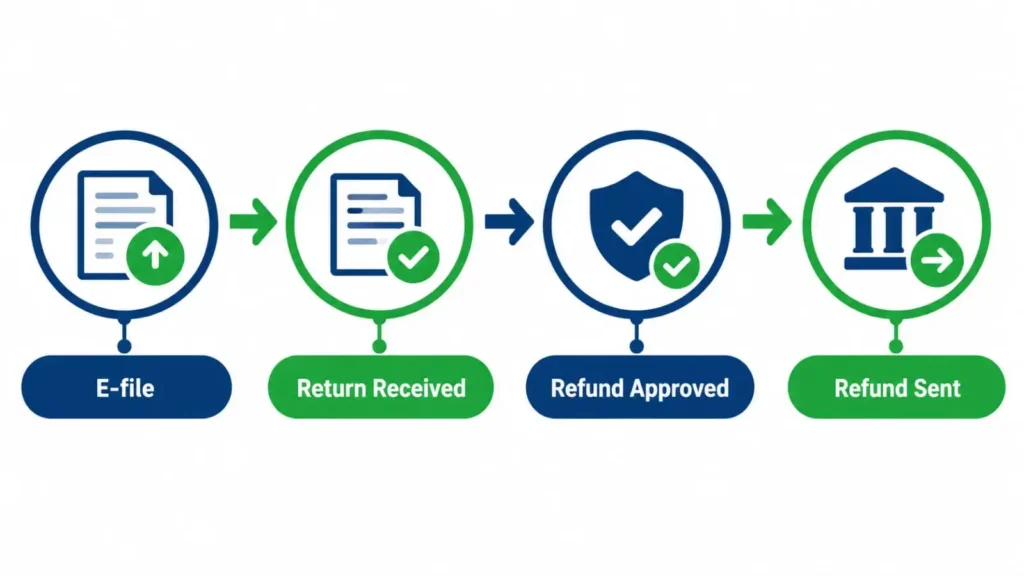
The tool updates once per day, overnight. Checking multiple times in a day returns the same result. Your refund moves through three stages:
- Return Received — the IRS has your return and is processing it
- Refund Approved — processing is complete; an estimated deposit date appears
- Refund Sent — the money is on its way to your bank or mailed
You can check your $3000 IRS tax refund status starting 24 hours after e-filing, or four weeks after mailing a paper return.
$3,000 IRS Tax Refund Timeline
How fast your $3000 IRS tax refund arrives depends almost entirely on how you filed and how you receive payment:
| Filing Method | Payment Method | Typical Timeline |
| E-filed | Direct deposit | 8–21 days |
| E-filed | Paper check / debit card | 3–4 weeks |
| Paper return | Direct deposit | 4–6 weeks |
| Paper return | Paper check | 6–8 weeks or more |
2026 update: The IRS discontinued paper checks for most individual refunds. Taxpayers without direct deposit now receive a prepaid debit card or digital payment by default. If your return claims EITC or ACTC, add at least two weeks — those refunds are legally held until mid-February regardless of filing date.
The fastest path to your $3000 IRS tax refund is e-filing with direct deposit. The IRS processed 90.4 million refunds totaling $296 billion through April 17, 2026, with most direct deposit refunds landing within two weeks of filing.
IRS: Where’s My Refund— official IRS tool, most authoritative source for real-time refund status]
$3,000 IRS Tax Refund Calculator
There is no dedicated $3000 IRS tax refund calculator. What most people search for is an estimated refund amount — and several free tools calculate this accurately before you file.
Free options:
- IRS Free File (irs.gov/freefile) — for AGI under $84,000; includes guided tax prep
- TurboTax TaxCaster — free estimator, no filing required
- H&R Block Tax Calculator — free tool, updates annually for the current tax year
- NerdWallet Tax Calculator — straightforward, no account needed
These tools apply your income, credits, deductions, and withholding to estimate your refund. Running your numbers before filing tells you whether you’re on track for a $3000 IRS tax refund or whether adjusting your W-4 makes more sense than waiting.
Should You Aim for a $3,000 Refund?
A $3000 IRS tax refund feels like a windfall, but it’s an interest-free loan to the federal government. Every dollar you overpay in withholding is money you could have kept in your paycheck — or put into a high-yield savings account at 4–4.5% APY — throughout the year.
That said, for many filers, a refund this size is intentional. It functions as a forced savings mechanism — a lump sum that arrives in spring before summer expenses hit. Whether to optimize withholding or let the over payment ride is a personal decision, not a financial mistake with one right answer.
Disclaimer: This article is for educational and informational purposes only. It does not constitute tax or financial advice. Consult a licensed CPA or tax professional for guidance specific to your tax situation.
Conclusion
The $3000 IRS tax refund isn’t a mystery. It’s the result of credits like the CTC and EITC stacking on top of withholding that exceeded your actual liability. For 2026, a $3,000 refund is slightly below the national average — which means most filers who receive anything get close to or more than that.
Track yours using the IRS “Where’s My Refund” tool, set up direct deposit if you haven’t, and expect the money in 8–21 days from an e-filed return.
FAQ Section
Q1. What is the $3000 IRS tax refund?
The $3000 IRS tax refund refers to a refund in that approximate amount, which is slightly below the 2026 national average of $3,275. It typically results from a combination of excess payroll withholding and refundable credits like the Child Tax Credit or EITC. There is no special IRS program that issues exactly $3,000.
Q2. Who qualifies for the $3000 IRS tax refund in 2026?
$3000 IRS tax refund eligibility isn’t a single rule — it’s the outcome of your withholding and credits. Filers most likely to land near $3,000 include W-2 workers with one qualifying child claiming the Additional Child Tax Credit ($1,700), EITC recipients with moderate income, and dual-income households with misaligned withholding.
Q3. How do I check my $3000 IRS tax refund status?
Use the IRS “Where’s My Refund” tool at IRS.gov/refunds or the free IRS2Go app. Enter your SSN, filing status, and exact refund amount. The $3000 IRS tax refund tracker updates once daily and shows three stages: Return Received, Refund Approved, and Refund Sent.
Q4. How long does a $3000 IRS tax refund take?
E-filed returns with direct deposit typically arrive in 8–21 days. Paper returns take 4–8 weeks. If your return claims EITC or the Additional Child Tax Credit, the IRS must hold it by law until mid-February. The 2026 average for direct deposit refunds is around $3,269 delivered within two weeks of approval.
Q5. Is there a $3000 IRS tax refund calculator?
No official IRS calculator targets $3,000 specifically. Free estimators from TurboTax TaxCaster, H&R Block, NerdWallet, and IRS Free File calculate your expected refund before you file. Enter your income, credits, deductions, and withholding to see whether a $3000 IRS tax refund amount matches your situation.
Q6. What credits produce a $3,000 tax refund?
The two most common are the Additional Child Tax Credit (up to $1,700 per child for 2025) and the Earned Income Tax Credit (up to $8,046 for families with three or more children). Combined with even moderate payroll withholding, these credits routinely produce refunds at or above $3,000 for qualifying filers.

Financial enthusiast with 5 years of experience in the US market trends and personal wealth management