
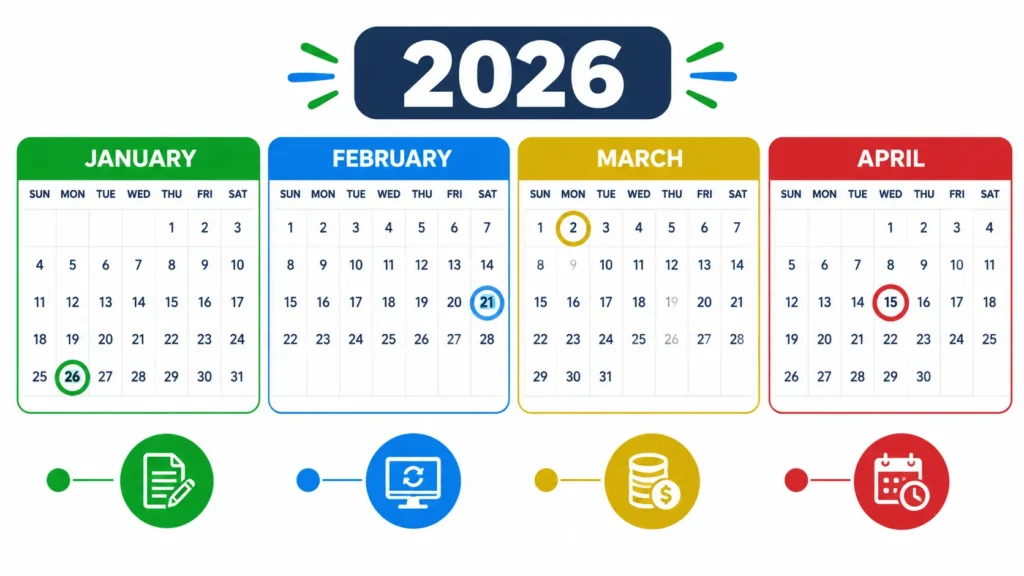
The $3000 IRS tax refund schedule 2026 starts with one fixed date: the IRS began accepting returns on January 26, 2026. From that day, e-filers with direct deposit got refunds in 8–21 days. Filers claiming EITC or Child Tax Credit waited until around March 2, 2026 — a legal hold, not a processing error.
Here’s everything that drives the timing, who qualifies, and what changed under the new Trump tax plan.
2026 Key Dates at a Glance
| Event | Date |
| IRS begins accepting returns | January 26, 2026 |
| Tax filing deadline | April 15, 2026 |
| “Where’s My Refund” shows EITC/ACTC dates | February 21, 2026 |
| EITC/ACTC earliest direct deposit | Around March 2, 2026 |
| Average refund (through April 17, 2026) | $3,275 |
The $3000 IRS tax refund schedule 2026 isn’t published as an official PDF by the IRS — that’s a common search that leads nowhere official. The IRS does publish a clear rule: most e-filed returns process within 21 days. Third-party sites build calendar charts from that window.
Estimated Deposit Dates by Filing Date
For e-filed returns with direct deposit (no EITC/ACTC), the estimated 2026 refund calendar looks like this, per CPA Practice Advisor’s published schedule:
| Return Accepted By | Expected Direct Deposit |
| January 26, 2026 | February 6, 2026 |
| February 2 | February 13 |
| February 9 | February 20 |
| February 16 | February 27 |
| March 2 | March 13 |
| March 16 | March 27 |
| April 1 | April 12 |
| April 15 | April 26 |
These dates assume a clean return with no errors and no identity verification flags. Paper returns add 4–6 weeks minimum. The IRS does not commit to specific dates — these are estimated windows based on the 21-day processing rule.
EITC Refund Schedule 2026: The PATH Act Delay
The biggest timing factor in the $3000 IRS tax refund schedule 2026 for families is the PATH Act. This federal law requires the IRS to hold all refunds that include the Earned Income Tax Credit (EITC) or the Additional Child Tax Credit (ACTC) until mid-February — no exceptions.
For the 2026 tax season:
- The IRS targeted around March 2, 2026 as the earliest direct deposit date for EITC/ACTC filers
- The “Where’s My Refund” tool began showing projected deposit dates for these filers on February 21, 2026
- Paper check recipients for EITC/ACTC refunds waited several additional weeks beyond March 2
Filing on January 26 and claiming EITC does not get you a faster refund than filing on February 15. The hold is the same no matter when you submit.

Who Qualifies for Around $3,000
The $3000 IRS tax refund schedule 2026 is only relevant if your tax situation actually produces a refund in that range. The average refund through April 17, 2026 was $3,275, so $3,000 sits just below the national midpoint. Most filers reaching this number fall into one of these categories:
Families with one child: The Additional Child Tax Credit pays up to $1,700 per qualifying child (2025 tax year). Add standard withholding on a $45,000–$65,000 salary, and a $3,000 total refund is common.
EITC recipients with one or two children: The EITC is fully refundable and can contribute $3,000–$6,000+ on its own for qualifying low-to-moderate income filers. Combined with any withholding, this pushes total refunds well past $3,000 for many.
W-2 workers with outdated W-4s: Workers who didn’t update their W-4 after a raise, a new job, or a household change often over withhold by $1,500–$2,500. That excess, combined with even a modest credit, can total nearly $3,000.
📎 [Internal link: Link “Additional Child Tax Credit” or “W-4 adjustment” to your cluster article on how to adjust tax withholding]
Trump Tax Plan 2026: What Changed
The “One Big Beautiful Bill,” signed into law in 2025 and reflected in the 2026 tax season, introduced several new deductions that affect refund size. These are temporary provisions covering tax years 2025–2028:
New deductions that could increase your refund:
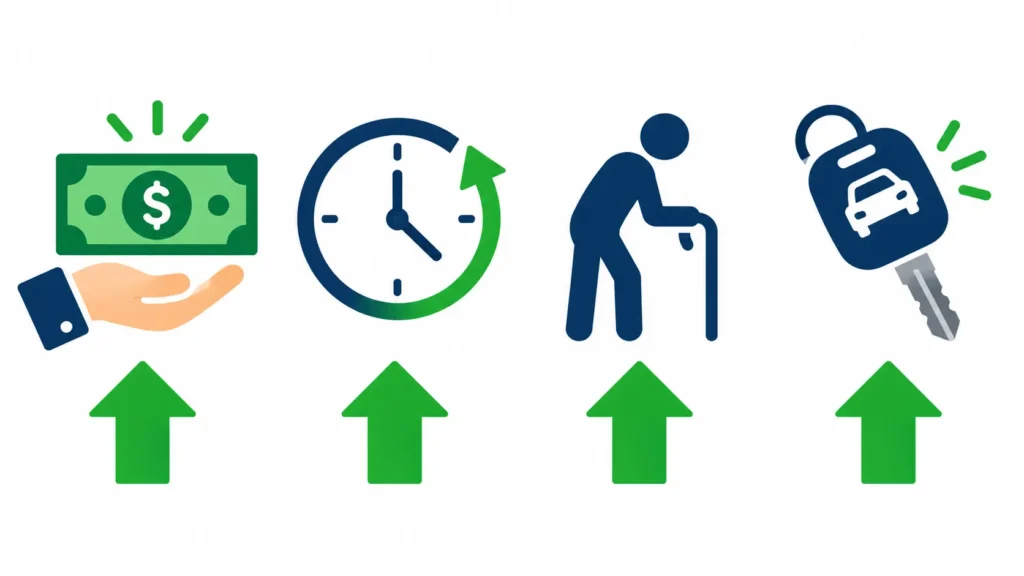
- Tips deduction — Up to $25,000/year for workers in tip-based jobs (servers, bartenders, delivery workers)
- Overtime deduction — Up to $12,500 (single) or $25,000 (joint) on overtime premium pay
- Senior deduction — Additional $6,000 for taxpayers age 65+, phasing out above $75,000 MAGI
- Car loan interest — Up to $10,000 on interest paid for U.S.-assembled vehicles, phasing out above $100,000 income
Standard deduction increases for tax year 2026 returns (filed in 2027):
- Single: $16,100
- Married filing jointly: $32,200
- Head of household: $24,150
These provisions affect returns filed in 2026 only for the tips and overtime deductions. The higher standard deductions apply to 2026 income reported in 2027 returns.
The IRS recommends updating your W-4 using the Tax Withholding Estimator at IRS.gov to reflect these changes before your withholding shifts.
2026 Refund Delays: What the IRS Watchdog Found
Not everyone on the $3000 IRS tax refund schedule 2026 received their money on time. The National Taxpayer Advocate reported that over 1 million taxpayers experienced refund delays beyond normal processing windows, with average wait times stretching to 5.5 weeks for delayed cases.
Contributing factors:
- 14 million returns required manual review and were suspended from automated processing
- 500,000+ identity theft cases remained pending at season’s end
- IRS phone lines answered only 21% of 48.1 million incoming calls — average hold time was 14 minutes
- Staffing cuts reduced processing capacity, particularly for paper returns
If your refund doesn’t appear within 21 days of e-filing, use the “Where’s My Refund” tool before calling. The tool answers the question faster than the phone line in most cases.
Conclusion
The $3000 IRS tax refund schedule 2026 depends on how you filed and what you claimed. E-file with direct deposit and no EITC: expect your money in 8–21 days from January 26 onward. Claim EITC or ACTC: wait until around March 2, regardless of filing date. The new Trump tax deductions for tips, overtime, and seniors may push 2026 refunds higher for qualifying workers.
Disclaimer: This article is for informational purposes only and does not constitute tax or financial advice. Consult a licensed tax professional or CPA for guidance specific to your situation.
Next: Read our full guide on $3000 IRS tax refund eligibility and tracker to understand exactly which credits push your refund to that level.
FAQs Section for $3000 IRS Tax Refund
Q1. What is the $3000 IRS tax refund schedule 2026?
The $3000 IRS tax refund schedule 2026 refers to the timeline for receiving a refund near that amount. The IRS began accepting returns on January 26, 2026, with most e-filed direct deposits arriving within 8–21 days. Filers claiming EITC or ACTC waited until around March 2 due to the PATH Act.
Q2. Does the IRS publish a $3000 IRS tax refund schedule 2026 PDF?
No. The IRS does not publish an official refund schedule PDF. Their guidance states e-filed returns with direct deposit are processed within 21 days. Third-party sites like CPA Practice Advisor and TaxSlayer build estimated calendar charts from that window, but these are not official IRS documents.
Q3. When did the IRS start accepting 2026 returns?
The IRS began accepting e-filed returns for the 2026 tax season on January 26, 2026. The filing deadline was April 15, 2026.
Q4. What is the EITC refund schedule 2026?
The IRS began releasing EITC and ACTC refunds around March 2, 2026, for direct deposit recipients. The “Where’s My Refund” tool began showing deposit dates for EITC filers on February 21, 2026. Paper check recipients waited several additional weeks after that.
Q5. How does the Trump tax plan affect the 2026 refund schedule?
The One Big Beautiful Bill added new deductions for tips (up to $25,000), overtime pay (up to $12,500 for single filers), and senior filers ($6,000 extra deduction). These reduce taxable income for qualifying workers, which can increase refund size. The IRS recommends updating W-4 withholding through its Tax Withholding Estimator to reflect these changes.
Q6. Why is a $3,000 refund common in 2026?
The 2026 national average refund was $3,275 through April 17, according to IRS filing-season statistics. A $3,000 refund reflects slightly below-average over payment, typically from a combination of payroll withholding and refundable credits like the ACTC ($1,700 per child) or EITC.

Financial enthusiast with 5 years of experience in the US market trends and personal wealth management