
Introduction
The smartest way to invest $1,000 for beginners is to open a Roth IRA and put your money into a low-cost S&P 500 index fund. This gives you tax-free growth, instant diversification, and zero commission fees at brokerages like Fidelity or Schwab.
But that’s just the starting point. Depending on your situation — your debt, your goals, and your timeline — the right move for you may look slightly different.
This guide shows you exactly how to invest $1,000 for beginners, step by step. No jargon. No fluff. Just clear, actionable steps you can take today.
Disclaimer: This article is for informational and educational purposes only. It does not constitute personalized financial advice. Please consult a licensed financial advisor before making investment decisions.

Before You Invest $1,000 for Beginners — Do These 3 Things First
Before you put a single dollar into the market, three financial foundations must be in place. Skipping these steps can seriously hurt your results — even if your investments perform well.
1. Build a Small Emergency Fund
An emergency fund protects your investments. If a car repair, medical bill, or job loss hits, you’ll be forced to sell investments at the wrong time without one.
Keep at least $500–$1,000 in a high-yield savings account before investing anything. This protects your portfolio from panic selling when life happens.
2. Pay Off High-Interest Debt First
If you carry credit card debt at 20% APR, paying it off gives you a guaranteed 20% return — something no investment consistently beats.
As a general rule:
- Debt above 8% interest rate? Pay it off before investing.
- Debt below 5% interest rate? You can invest at the same time.
3. Grab Your Full 401(k) Employer Match
Does your employer match your 401(k) contributions? If yes, always contribute enough to get the full match before investing anywhere else. A 50% or 100% employer match is the highest guaranteed return available to anyone.
Once these three boxes are checked, you are officially ready to invest your $1,000.
5 Best Ways to Invest $1,000 for Beginners in 2026
Here are the five best ways to invest $1,000 as a beginner. Each one suits a different goal and risk level.
Option 1: Roth IRA — Best Way to Invest $1,000 for Beginners
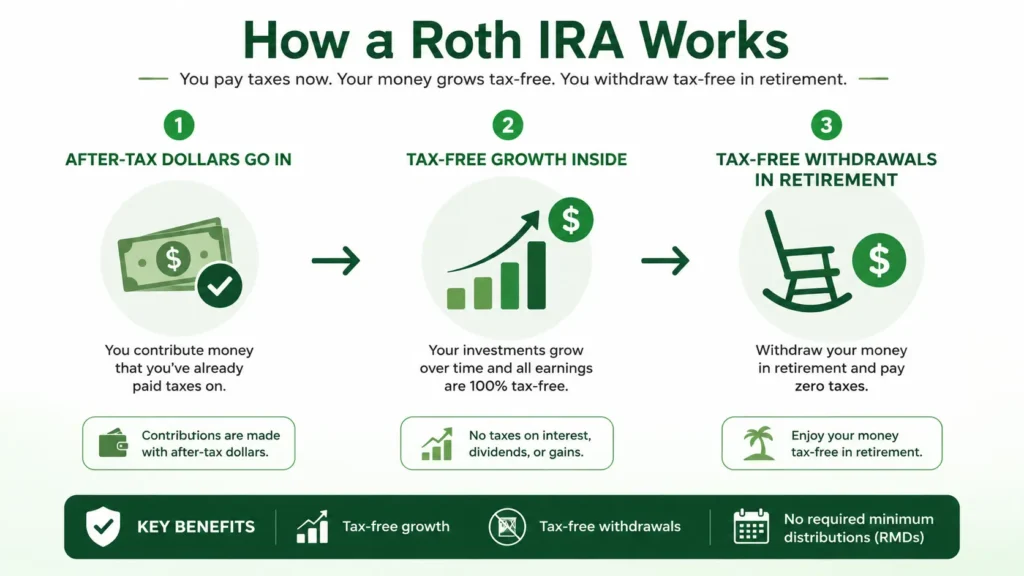
A Roth IRA is the single best account for most beginners to invest $1,000. Here is why.
You contribute after-tax dollars, and your investments grow completely tax-free. Withdrawals in retirement are 100% tax-free as well. In 2026, the annual contribution limit is $7,500 (or $8,600 if you are 50 or older).
2026 Roth IRA Income Limits:
| Filing Status | Income Limit (Full Contribution) | Income Limit (Phase-Out) |
|---|---|---|
| Single | Below $153,000 | $150,000 – $168,000 |
| Married Filing Jointly | Below $242,000 | $236,000 – $252,000 |
Source: IRS.gov — verify current limits at irs.gov/retirement-plans/roth-iras
Where to open a Roth IRA:
- Fidelity — $0 minimum, $0 commissions, fractional shares
- Charles Schwab — $0 minimum, excellent beginner tools
- Vanguard — $0 minimum, best known for low-cost index funds
Read more: Roth IRA for Beginners 2026 — Everything You Need to Know”
Option 2: Invest in S&P 500 Index Funds — Simple, Proven, Powerful
Once your Roth IRA is open, the next step is choosing what to invest in. When you invest $1,000 for beginners, S&P 500 index funds are the single most recommended choice — and for good reason.
An S&P 500 index fund gives you instant ownership in 500 of America’s largest companies — Apple, Microsoft, Amazon, Google, and more — all in one investment. Instead of picking individual stocks, you own a tiny piece of the entire US economy.
Historical Performance of the S&P 500:
| Time Period | Average Annual Return |
|---|---|
| Last 10 years (2015–2025) | ~13.2% per year |
| Last 30 years (1995–2025) | ~10.7% per year |
| Last 50 years (1975–2025) | ~10.4% per year |
Past performance does not guarantee future results.
Top 3 beginner-friendly S&P 500 index funds:
| Fund | Type | Expense Ratio | Available At |
|---|---|---|---|
| VOO (Vanguard S&P 500 ETF) | ETF | 0.03% | Fidelity, Schwab, most brokerages |
| SPY (SPDR S&P 500 ETF) | ETF | 0.09% | All major brokerages |
| FXAIX (Fidelity 500 Index Fund) | Mutual Fund | 0.015% | Fidelity only |
All three are available with zero commissions and fractional shares — so you can start with any dollar amount. For a deeper breakdown of each fund, read our guide on best S&P 500 index funds for beginners VOO vs FXAIX vs VTI compared side by side.
Option 3: Use a Robo-Advisor — Best for Hands-Off Beginners
Another great option when you invest $1,000 for beginners is a robo-advisor. If choosing your own investments feels overwhelming, a robo-advisor does everything for you. It automatically builds a diversified portfolio based on your goals and risk tolerance, and then rebalances it as markets move
Top robo-advisors for beginners in 2026:
| Platform | Annual Fee | Minimum | Best For |
|---|---|---|---|
| Betterment | 0.25% | $0 | Beginners who want fully automated investing |
| Wealthfront | 0.25% | $500 | Slightly more advanced features |
| Schwab Intelligent Portfolios | 0% | $5,000 | Those with a larger starting balance |
On a $1,000 investment, Betterment’s fee works out to just $2.50 per year. That’s an incredibly affordable way to get a professionally managed, diversified portfolio.
Option 4: Open a Taxable Brokerage Account — Best for Flexibility
A taxable brokerage account is another solid choice when you invest $1,000 for beginners. Unlike a Roth IRA, there are no contribution limits and no restrictions on when you can withdraw money.
This account type works well if:
- You want to invest for goals within the next 5–10 years (like buying a house)
- You have already maxed out your Roth IRA contribution for the year
- You want complete control over your investment choices
You can diversify your portfolio across multiple ETF types in one account:
- S&P 500 ETF (large-cap US stocks)
- International index fund (global diversification)
- Bond ETF (stability and income)
Not sure which ETF to pick? Read our detailed guide on what is the best ETF for beginners in 2026 — we ranked the top 10 by fees, returns, and beginner-friendliness.
Option 5: Dollar-Cost Averaging — The Stress-Free Strategy
Dollar-cost averaging (DCA) means investing a fixed amount at regular intervals — for example, $100 every two weeks — instead of investing all at once.
This strategy works because:
- You buy more shares when prices are low and fewer when prices are high
- It removes the stress of trying to time the market
- It creates a consistent investing habit that builds real wealth over time
Research consistently shows that time in the market beats time timing the market. In fact, DCA is one of the most effective techniques when you invest $1,000 for beginners — it keeps emotions out of the equation. To understand exactly how this works, read our full guide on what is dollar cost averaging and how does it work
How Much Can $1,000 Actually Grow? Real Numbers
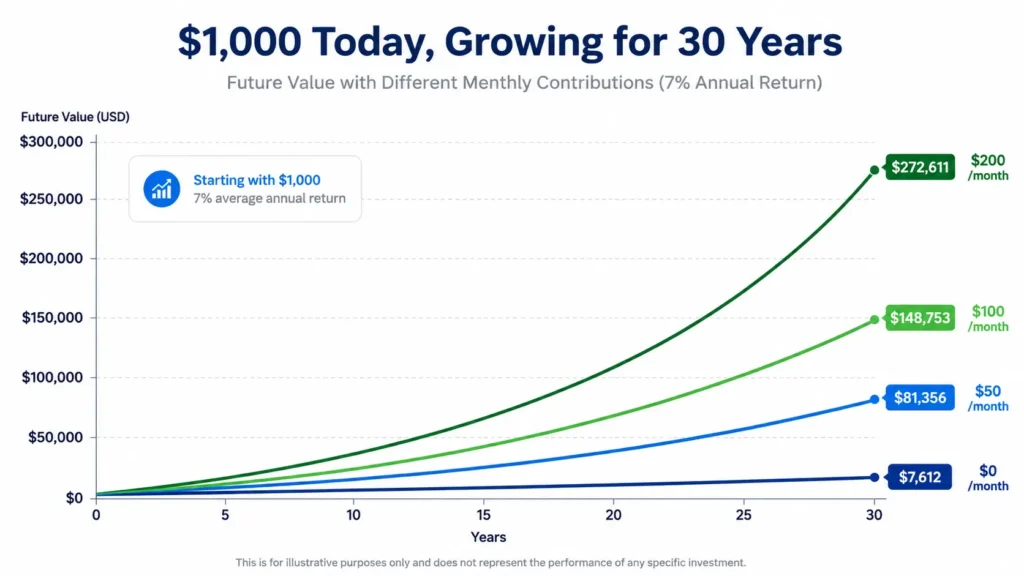
Here is what $1,000 looks like over time with a 10% average annual return (S&P 500 historical average):
| Starting Amount | Monthly Add-On | After 10 Years | After 20 Years | After 30 Years |
|---|---|---|---|---|
| $1,000 | $0/month | $2,594 | $6,727 | $17,449 |
| $1,000 | $50/month | $12,279 | $42,052 | $117,000 |
| $1,000 | $100/month | $22,000 | $77,000 | $217,000 |
| $1,000 | $200/month | $41,000 | $147,000 | $416,000 |
Assumes 10% average annual return. This is for illustration only — not a guarantee of future performance.
The table above shows the real power of combining your initial $1,000 with consistent monthly contributions. Even adding just $50 per month turns $1,000 into over $117,000 in 30 years.
What NOT to Do With Your First $1,000 — Beginner Mistakes to Avoid
Knowing what NOT to do is just as important as knowing the right steps. Here are the four biggest mistakes beginners make when they invest $1,000 for the first time.
❌ Mistake 1: Putting It All Into Crypto
Cryptocurrency is highly volatile. Bitcoin dropped more than 70% in value in 2022 alone. Your first $1,000 should build a stable foundation — not gamble on crypto swings. Once you have a solid base of index funds, you can consider allocating a small percentage (5–10%) to crypto if it fits your risk tolerance.
❌ Mistake 2: Picking Individual Stocks
Even professional fund managers fail to beat the market consistently over the long run. Studies show that more than 85% of actively managed funds underperform the S&P 500 over a 15-year period. Buy the whole market with an index fund instead.
❌ Mistake 3: Waiting for the “Perfect Time” to Invest
Many beginners wait for the “right moment” — when the market dips, when inflation cools, when things feel more certain. However, research consistently shows that time in the market beats timing the market. The best time to invest was yesterday. The second best time is today.
❌ Mistake 4: Selling When the Market Drops
Market downturns are normal and expected. The S&P 500 has experienced corrections of 10% or more in roughly one out of every three years historically. Investors who stay calm and hold their positions consistently come out ahead of those who panic-sell.
Step-by-Step: How to Invest $1,000 for Beginners — Starting Today
Here is exactly what to do if you are starting from zero:
Step 1: Check if you have an emergency fund ($500–$1,000 saved). If not, pause and build that first.
Step 2: Pay off any credit card debt above 8% interest before investing.
Step 3: Go to Fidelity.com, Schwab.com, or Vanguard.com and open a free Roth IRA account. It takes about 10 minutes.
Step 4: Link your bank account and transfer $1,000 to your new Roth IRA.
Step 5: Once funds arrive (usually 1–3 business days), buy a low-cost S&P 500 index fund like VOO, SPY, or FXAIX.
Step 6: Set up automatic monthly contributions — even $50 or $100 per month makes a massive difference over time.
Step 7: Do not check your account daily. Check it quarterly. Let compounding do the work.
That’s it. Seriously. You do not need to be a financial expert to build real wealth — you just need to start.
FAQ Section
Q1: What is the best way to invest $1,000 for a beginner in 2026?
The best way to invest $1,000 for beginners is opening a Roth IRA and putting it into a low-cost S&P 500 index fund like VOO or FXAIX. This gives you tax-free growth, instant diversification across 500 companies, and zero commissions. It is the approach most financial experts recommend.
Q2: Can I really start investing with just $1,000?
Yes. Most major brokerages — including Fidelity, Charles Schwab, and Vanguard — have no minimum to open an account. With fractional shares now widely available, you can buy into any ETF or index fund with as little as $1. Your first $1,000 is more than enough to start building a real portfolio.
Q3: Should I invest $1,000 or pay off debt first?
It depends on your interest rate. If your debt carries a rate above 8% — like most credit cards — pay it off first. That guaranteed return beats most investments. For low-interest debt like federal student loans below 5%, it can make sense to do both at the same time.
Q4: How long does it take to grow $1,000 into $10,000?
With a 10% average annual return and no additional contributions, $1,000 grows to roughly $10,000 in about 24 years. However, adding just $100 per month cuts that timeline to under 5 years — which shows why consistent contributions matter more than your starting amount.
Q5: Is a Roth IRA better than a 401(k) for beginners?
Always grab the full 401(k) employer match first — that is free money. After that, a Roth IRA is often the better choice for most beginners because your money grows completely tax-free, you have more investment choices, and withdrawals in retirement are 100% tax-free. Many financial advisors recommend doing both.
Q6: What is dollar-cost averaging and should beginners use it?
Dollar-cost averaging means investing a fixed amount at regular intervals — like $100 every two weeks — instead of all at once. It reduces the impact of market volatility and removes the stress of trying to time the market. Most financial experts strongly recommend it for beginners, and it is easy to set up automatically on any major brokerage platform.
Conclusion
Now you know exactly how to invest $1,000 for beginners — and the strategy is simpler than most people think. Open a Roth IRA, invest in a low-cost S&P 500 index fund, and add money consistently over time. Stay calm when markets drop. Do not try to time the market. Let compounding do the heavy lifting.
The key is to start — not to be perfect.
Your next step: Learn exactly how to choose the right S&P 500 index fund for your situation and understand the difference between VOO, VTI, and SPY.
Read Next: [Best S&P 500 Index Funds for Beginners in 2026
Also Read: [Roth IRA for Beginners 2026 — Everything You Need to Know

Financial enthusiast with 5 years of experience in the US market trends and personal wealth management