

Introduction
Here’s the hard truth: improving your credit score overnight isn’t actually possible—at least not in the magical sense. Credit bureaus don’t update your score hourly or daily. But here’s what is possible: you can take strategic actions today that create measurable improvements within 24-48 hours or show up on your next credit report cycle. This article breaks down what you can realistically do to improve your credit score overnight, plus the longer-term strategies that build real financial muscle. Whether you’re prepping for a mortgage application, a car loan, or just want to get your finances in order, let’s make it happen.
The Truth About Overnight Credit Score Improvements
Your credit score isn’t calculated in real-time. The three major credit bureaus—Equifax, Experian, and TransUnion—update their records on a monthly cycle, typically in sync with when your creditors report payments and balances.
What this means: If a collection account is removed from your report today, you might see the impact within 1-2 business days if the creditor reports to the bureaus immediately. More realistically? Plan for your next statement cycle (usually 30 days).
The “overnight” expectation: Don’t expect a 50-point jump overnight. But specific actions—like disputing errors, becoming an authorized user, or requesting a credit limit increase—can trigger faster changes than the traditional 6-12 month timeline.
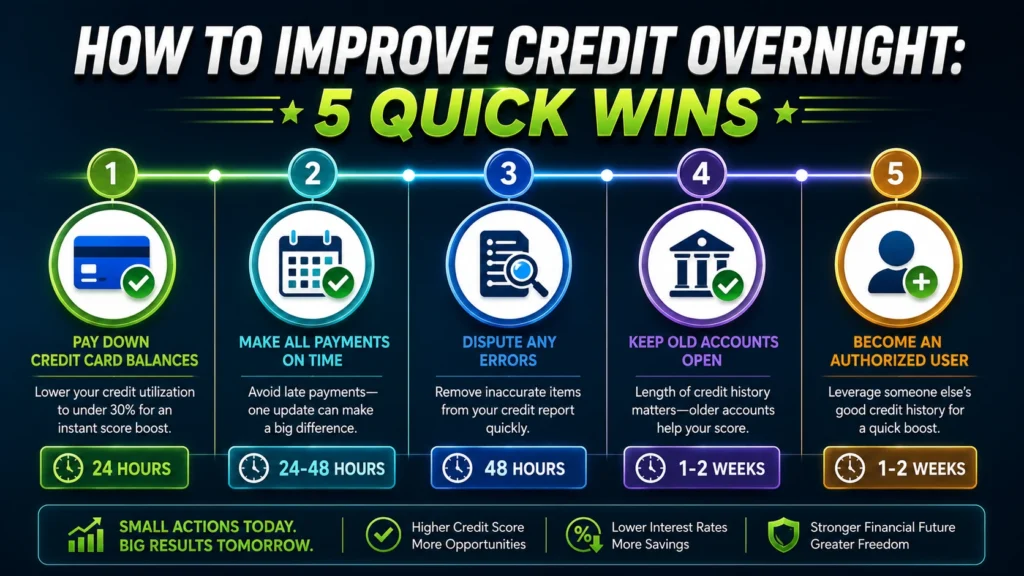
5 Quick Wins to Improve Your Credit Score (Today)
1. Dispute Credit Report Errors (Most Effective Quick Win)
This is your golden ticket. One-third of Americans have errors on their credit reports, according to the FTC. These mistakes don’t just damage your score—they’re completely fixable.
Why it works: When errors exist, credit bureaus have 30-45 days to investigate and remove them. Some disputes resolve in as little as 5-7 days.
How to do it:
- Pull your free credit report from AnnualCreditReport.com (the only official source)
- Look for: wrong name/address, accounts that aren’t yours, incorrect balances, duplicate entries, paid-off accounts still showing as active
- File a dispute online, by mail, or through the bureau’s website (Equifax, Experian, TransUnion all have dispute portals)
- Send documentation proving the error (paid-off statements, proof of identity theft, etc.)
Expected timeline: 10-30 days for removal; score improvement could show up in 1-2 billing cycles.
2. Become an Authorized User on a Healthy Credit Account
This is the “hacker’s move” for quick credit improvements—if you know someone with excellent credit and a clean payment history.
Why it works: When you’re added as an authorized user to someone else’s credit card (doesn’t matter if you use it), their positive payment history and low credit utilization ratio show up on your credit report. This can boost your score by 10-50+ points within days.
Real example: Sarah had a 620 credit score. Her mom added her as an authorized user on a card with 15 years of perfect payment history and only 8% utilization. Her score jumped to 665 in 3 days.
Important note: Not all card issuers report authorized user activity to all bureaus, and some have started limiting this benefit. Call the creditor first to confirm they report authorized users to all three bureaus.
3. Request a Credit Limit Increase (Immediate Impact on Utilization)
Your credit utilization ratio (the percentage of available credit you’re using) accounts for 30% of your credit score. Increase your limit, lower your ratio instantly—even if your balance stays the same.
The math: If you’re carrying $3,000 on a $5,000 limit (60% utilization), you’re hurting your score. Increase to $10,000, and suddenly you’re at 30% utilization.
How to request:
- Call your credit card issuer’s customer service
- Ask for a credit limit increase (“soft pull” doesn’t hurt your score)
- Some issuers approve within minutes; others take 24-48 hours
- No hard inquiry = no score dip
Pro tip: Pay down your balance before the statement closes. If you pay $1,500 of that $3,000 before the monthly statement, only $1,500 reports to the bureaus, dropping your utilization to 15%.
4. Pay Down High-Balance Cards (Strategic Payoff)
Can’t wait 30 days? A smart payment strategy can show results in your next billing cycle.
What most people don’t know: Your credit card issuer reports your balance to the bureaus around your statement closing date, not your payment due date. Timing matters.
The strategy:
- Check your statement date for each card
- Pay down balances before that closing date
- Bonus: Pay to get utilization below 30% (ideal) or even below 10% (excellent)
This won’t instantly boost your score, but it removes a major anchor. If low utilization is the issue dragging your score down, this is your fastest leverage.
5. Negotiate Pay-for-Delete (If You Have Collections/Negative Items)
If a collection account is reporting and destroying your score, a “pay-for-delete” negotiation can remove it faster than waiting for it to age off.
How it works:
- Contact the collections agency in writing (don’t call)
- Offer to pay the full balance if they agree to delete the entire account from your credit report
- Get written confirmation before paying
- Once deleted, the negative item vanishes from your report
Reality check: Not all agencies will agree, especially if the account is relatively recent. But if they do, this is one of the few ways to remove a negative item before the 7-year mark.
Factors That DON’T Change Overnight (But You Should Fix Anyway)
Hard inquiries: Dropping 5-10 points typically, staying on your report for 12 months. You can’t remove them overnight, but there’s a silver lining—they matter less over time.
Late payments: These stay for 7 years, but their impact weakens significantly after 2-3 years. Getting current on late accounts helps long-term.
Negative items (collections, charge-offs, foreclosure): These require dispute or negotiation; they won’t disappear overnight but CAN be accelerated through action.
Credit mix: Building a healthy mix of credit types (credit cards, auto loan, mortgage, installment loans) takes time, but it’s worth doing for long-term score strength.
Understanding Your Credit Score Components
Not all credit score improvements are equal. Here’s what actually moves the needle:
| Payment History | 35% | Low (unless you catch up on late payments) |
| Credit Utilization | 30% | HIGH (credit limit increase or paydown) |
| Credit Age | 15% | None overnight |
| Credit Mix | 10% | Low (takes time to build) |
| Hard Inquiries | 10% | None overnight |
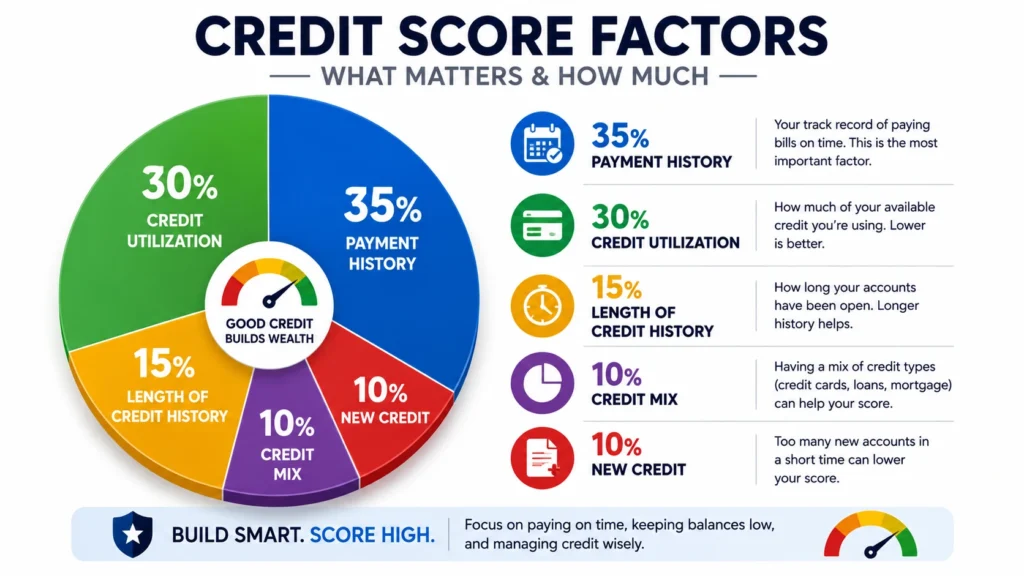
The takeaway: Focus on utilization and dispute errors if you want fast results. These two factors are most responsive to immediate action.
Using Secured Credit Cards as a Long-Term Strategy
If your credit is too damaged for traditional cards, a secured credit card offers a legitimate path to rebuild credit—though it’s more of a 6-12 month play than an overnight fix.
How it works:
- Deposit money ($300-$2,500) with a bank
- They give you a credit card with that amount as your limit
- Use it responsibly, pay on time, and your score gradually climbs
- After 12+ months of perfect payments, graduate to an unsecured card
Best for: People rebuilding after bankruptcy, foreclosure, or major credit damage. It shows lenders you’re serious about change.
What NOT to Do (Common Credit Score Killers)
❌ Don’t close old credit cards — This tanks your credit age and utilization ratio.
❌ Don’t max out new cards — A new card with a zero balance looks great; a new card carrying a balance looks risky.
❌ Don’t apply for multiple credit inquiries at once — Each hard pull drops your score 5-10 points. Space them out by at least 3-6 months.
❌ Don’t ignore errors on your report — They won’t go away on their own.
❌ Don’t ignore debt collection notices — Paying or negotiating is always better than ignoring.
Realistic Timeline: What to Expect
First 24-48 hours:
- Authorized user status might appear ✓
- Credit limit increase processed ✓
- Credit report errors disputed (investigation in progress)
1-2 weeks:
- Paydown impact shows on next cycle ✓
- Some disputes resolved ✓
30-45 days:
- Most disputes completed
- Credit report updated
- Score improvements visible (10-50+ points possible)
6-12 months:
- Secured card strategy shows major gains
- Consistent payment history builds strength
- Authorized user benefits compound
Monitoring Your Progress
You can’t improve what you don’t measure. Here’s how to track your credit journey:
Free tools:
- Credit Karma — Updates daily, shows Equifax and TransUnion scores
- Experian app — Shows Experian score, free credit monitoring
- AnnualCreditReport.com — Official free reports from all three bureaus (pull once yearly)
Paid premium options:
- FICO Score — Official FICO score with detailed breakdowns
- Credit monitoring services — Track changes in real-time
Pro tip: Check your score after each major action (paying down balances, disputing errors, adding as authorized user). Seeing movement is motivating and helps you understand what works.
Disclaimer: This article is educational content, not financial advice. Credit score improvement strategies vary by individual situation. If you’re dealing with serious credit damage, bankruptcy, or legal issues, consult a licensed financial advisor or credit counselor before making moves. The information provided here reflects current best practices as of 2026, but credit bureaus and lenders may update their policies.
Conclusion & Next Steps
Improving your credit score overnight isn’t magic—it’s strategy. The fastest wins come from fixing credit report errors, requesting a credit limit increase, and paying down high balances before your statement closes. These moves can show results in days or weeks, not months.
But here’s what separates good credit from exceptional credit: consistency. One month of smart moves won’t carry you forever. Real, lasting credit improvement comes from these overnight wins plus months of on-time payments, low utilization, and avoiding new debt.
Your future self will thank you for starting today.
FAQ Section
Q1: Can I really improve my credit score overnight?
A: True overnight improvement (24 hours) is rare, but strategic actions today can trigger improvements within 1-2 billing cycles (30-45 days). Credit utilization reductions and authorized user additions are your fastest levers.
Q2: How much can my credit score improve with these steps?
A: Realistic improvements range from 10-50+ points depending on your starting score, what’s dragging it down, and which strategies you combine. Fixing errors often yields the biggest gains.
Q3: Does requesting a credit limit increase hurt my score?
A: A soft inquiry for a limit increase doesn’t affect your score. A hard inquiry (if the bank does one) might drop it 5 points temporarily. Ask the issuer which they’ll use first.
Q4: Can I remove negative items from my credit report?
A: Items older than 7 years fall off automatically. Younger items can sometimes be removed through dispute (errors) or negotiation (pay-for-delete with collections agencies).
Q5: How often do credit scores update?
A: Credit bureaus typically update monthly when creditors submit new account information. Some services (like Credit Karma) show updates more frequently, but official FICO scores reflect monthly cycles.
Q6: Is becoming an authorized user actually effective?
A: Yes, but only if the primary account holder has good credit and low utilization. Results vary by issuer (some don’t report authorized users), so confirm with your creditor first.

Financial enthusiast with 5 years of experience in the US market trends and personal wealth management