A 200-point credit score increase isn’t a fantasy. It’s not a secret loophole. It’s also not something that happens overnight. But here’s what it is: it’s the difference between being denied a mortgage and getting approved at a 2.1% interest rate instead of 5.8%. It’s the gap between paying $15,000 extra in car loan interest and paying $3,000. It’s the space between financial desperation and financial dignity.
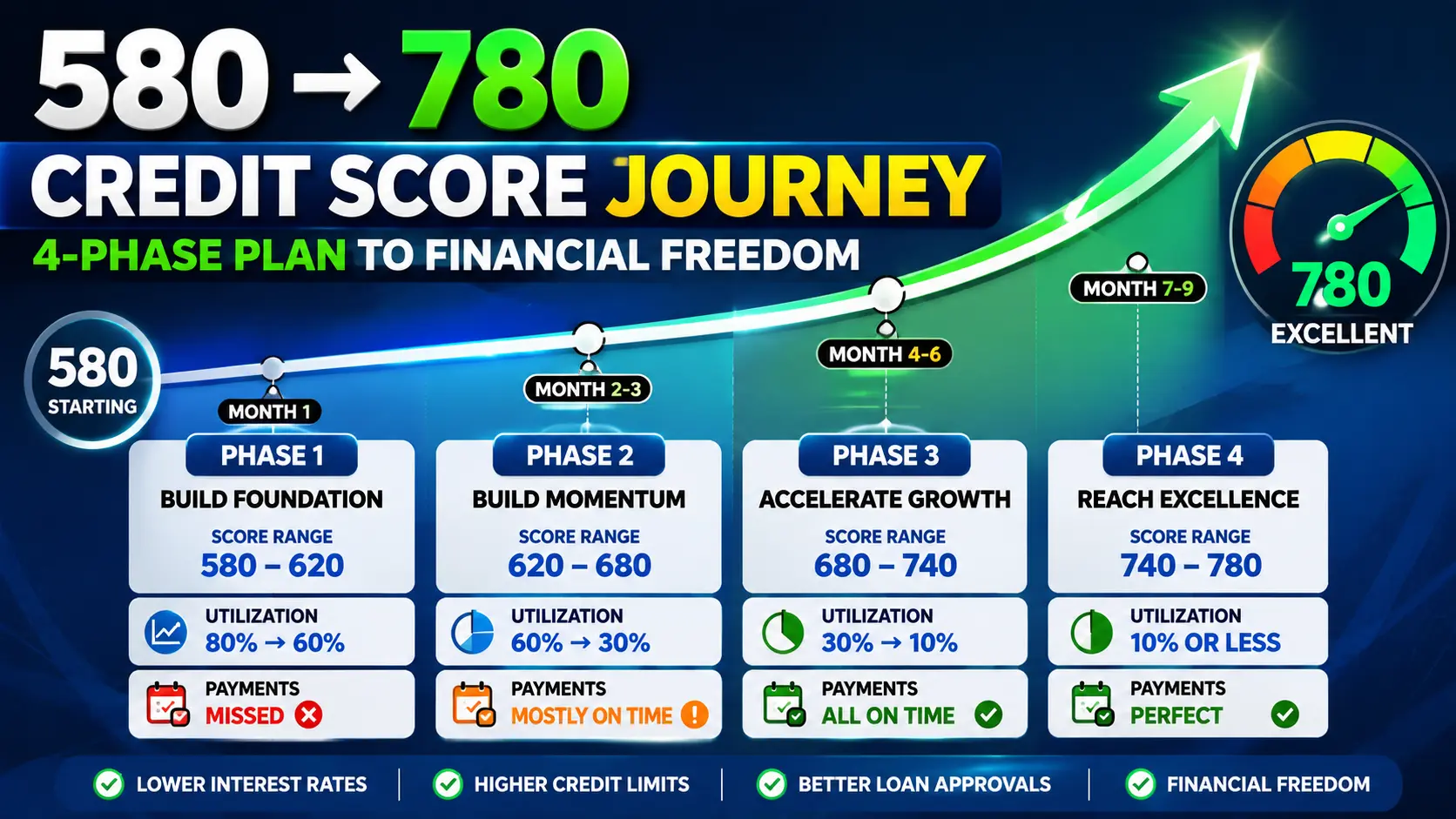
This isn’t a vague “credit improvement” guide. This is the exact blueprint—broken into four phases with specific milestones, realistic timelines, and real-world results—that shows you how to improve your credit score by 200 points. You’ll see exactly what moves the needle, when to expect changes, and how to avoid the mistakes that keep people stuck.
The Math Behind a 200-Point Credit Score Jump
Before we talk strategy, let’s talk reality. A 200-point increase means you’re likely going from one credit tier to another:
- 580-620 (Poor) → 780-820 (Excellent)
- 650-680 (Fair) → 850+ (Exceptional)
What this means in real dollars:
| 580-619 | 6.85% | $432,452 |
| 720-759 | 4.85% | $280,363 |
| 780+ | 4.25% | $243,380 |
The difference between 620 and 780? $189,072 in mortgage interest alone. Now multiply that across car loans, credit cards, and personal loans. A 200-point jump isn’t just about approval—it’s about saving tens of thousands of dollars.
Why 200 points specifically? It’s not arbitrary. This jump typically moves you from “high-risk borrower” to “prime borrower” status, which opens entirely different lending tiers.
Quick Wins: How to Boost Your Credit Score Overnight
1. Dispute Credit Report Errors (Most Effective Quick Win)
This is your golden ticket. One-third of Americans have errors on their credit reports, according to the FTC. These mistakes don’t just damage your score—they’re completely fixable.
Why it works: When errors exist, credit bureaus have 30-45 days to investigate and remove them. Some disputes resolve in as little as 5-7 days.
How to do it:
- Pull your free credit report from AnnualCreditReport.com (the only official source)
- Look for: wrong name/address, accounts that aren’t yours, incorrect balances, duplicate entries, paid-off accounts still showing as active
- File a dispute online, by mail, or through the bureau’s website (Equifax, Experian, TransUnion all have dispute portals)
- Send documentation proving the error (paid-off statements, proof of identity theft, etc.)
Expected timeline: 10-30 days for removal; score improvement could show up in 1-2 billing cycles.
2. Become an Authorized User on a Healthy Credit Account
This is the “hacker’s move” for quick credit improvements—if you know someone with excellent credit and a clean payment history.
Why it works: When you’re added as an authorized user to someone else’s credit card (doesn’t matter if you use it), their positive payment history and low credit utilization ratio show up on your credit report. This can boost your score by 10-50+ points within days.
Real example: Sarah had a 620 credit score. Her mom added her as an authorized user on a card with 15 years of perfect payment history and only 8% utilization. Her score jumped to 665 in 3 days.
Important note: Not all card issuers report authorized user activity to all bureaus, and some have started limiting this benefit. Call the creditor first to confirm they report authorized users to all three bureaus.
3. Request a Credit Limit Increase (Immediate Impact on Utilization)
Your credit utilization ratio (the percentage of available credit you’re using) accounts for 30% of your credit score. Increase your limit, lower your ratio instantly—even if your balance stays the same.
The math: If you’re carrying $3,000 on a $5,000 limit (60% utilization), you’re hurting your score. Increase to $10,000, and suddenly you’re at 30% utilization.
How to request:
- Call your credit card issuer’s customer service
- Ask for a credit limit increase (“soft pull” doesn’t hurt your score)
- Some issuers approve within minutes; others take 24-48 hours
- No hard inquiry = no score dip
Pro tip: Pay down your balance before the statement closes. If you pay $1,500 of that $3,000 before the monthly statement, only $1,500 reports to the bureaus, dropping your utilization to 15%.
4. Pay Down High-Balance Cards (Strategic Payoff)
Can’t wait 30 days? A smart payment strategy can show results in your next billing cycle.
What most people don’t know: Your credit card issuer reports your balance to the bureaus around your statement closing date, not your payment due date. Timing matters.
The strategy:
- Check your statement date for each card
- Pay down balances before that closing date
- Bonus: Pay to get utilization below 30% (ideal) or even below 10% (excellent)
This won’t instantly boost your score, but it removes a major anchor. If low utilization is the issue dragging your score down, this is your fastest leverage.
5. Negotiate Pay-for-Delete (If You Have Collections/Negative Items)
If a collection account is reporting and destroying your score, a “pay-for-delete” negotiation can remove it faster than waiting for it to age off.
How it works:
- Contact the collections agency in writing (don’t call)
- Offer to pay the full balance if they agree to delete the entire account from your credit report
- Get written confirmation before paying
- Once deleted, the negative item vanishes from your report
Reality check: Not all agencies will agree, especially if the account is relatively recent. But if they do, this is one of the few ways to remove a negative item before the 7-year mark.
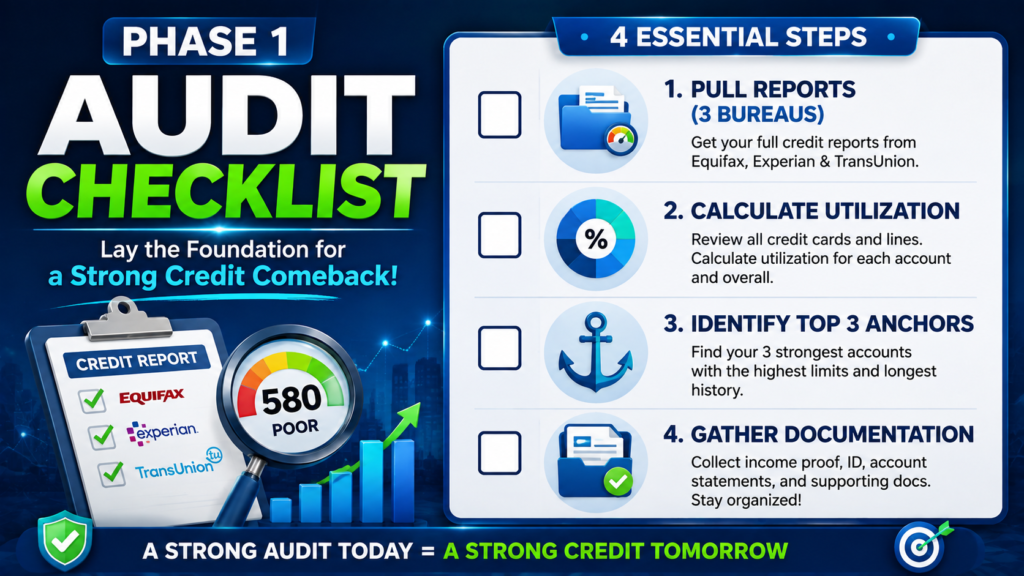
Phase 1: The Foundation Audit (Week 1-4) – Weeks 1-4
Why 30 Days of Preparation Matters
Most people jump into credit improvement without understanding what’s actually holding them back. Then they spin their wheels for months. Phase 1 stops that.
Your goal: Know exactly where you stand and what’s dragging you down.
Step 1: Pull Your Full Credit Picture
This isn’t optional. This is the foundation.
What to get:
- Your free credit report from AnnualCreditReport.com (all three bureaus: Equifax, Experian, TransUnion)
- Your FICO score from MyFICO.com (shows actual score + breakdown)
- Your credit utilization ratio per card
- Your payment history status
Time investment: 45 minutes. Worth every second.
What to look for:
- Are there errors? (Wrong accounts, incorrect balances, accounts that aren’t yours?)
- What’s your current utilization ratio? (Single biggest factor you can control fast)
- How recent are your negative items? (Collections, late payments, charge-offs?)
- What type of credit mix do you have? (Cards only? No installment loans?)
Pro tip: Create a simple spreadsheet tracking your score across all three bureaus. You’re going to watch this number climb, and having baseline data is motivating as hell.
Step 2: Identify the “Anchor” Dragging You Down
Everyone’s anchor is different. Yours might be:
- Collections accounts (typically 50-100+ point hit)
- High utilization (30% penalty, sometimes more)
- Bankruptcy or foreclosure (100+ point hit, slowly weakening)
- Late payments (30-180 point hit depending on recency)
- Short credit history (15-50 point penalty)
Your action: Write down your top 3 score killers. This tells you where to focus your energy first.
Step 3: Gather Documentation
Create a file (digital or physical) with:
- Proof of paid-off accounts (bank statements, creditor letters)
- Proof of identity (for dispute filing)
- Dispute documentation (if you’re challenging errors)
- Payment receipts from late accounts you’re bringing current
This takes 2-3 hours but saves you weeks of frustration later.
Why this matters: When you dispute errors or negotiate with collectors, documentation moves conversations from “he said, she said” to “here’s the proof.”
Phase 2: The Attack (Month 2-3) – Weeks 5-12
The 30-Day Dispute Blitz
If your credit report has errors, this is your fastest leverage. Studies show 1 in 3 Americans have errors. The FTC found that errors can cost 100+ points.
The play:
- File disputes for every error (wrong account, outdated info, accounts not yours)
- File with all three bureaus simultaneously
- Include documentation proving the error
- Follow up in writing after 20 days
Expected result: 10-30 day resolution time. Some items drop immediately.
Real example: Marcus had a charged-off account from 2015 still showing as active (7-year item shouldn’t appear for 2 more years). He disputed it. Removed in 12 days. Immediate 15-point bump.
Template for dispute letter:
[Bureau Name]
Dispute Department

I am writing to dispute the following item on my credit report:
[Account Name/Number/Issue]

Reason for dispute: [Error/Fraud/Not Mine/Incomplete]

Attached documentation: [List proof]

I request this account be investigated and corrected/removed per the Fair Credit Reporting Act.

[Your signature]
Send via certified mail. Keep copies of everything.
The “Authorized User” Speed Play
Remember this from the overnight article? It’s equally important here, but in Phase 2 you’re using it strategically.
Who to ask:
- Parent with excellent credit
- Spouse with perfect payment history
- Business partner or trusted family member
What happens: Their 15+ year payment history + low utilization shows up on your report. This can add 20-50 points immediately.
The 2026 update: Capital One, Discover, and Chase limit authorized user benefits (some don’t report at all). Call first. Ask: “Do you report authorized users to all three credit bureaus?”
If yes → become an authorized user.
If no → skip this card.
Strategic Credit Card Paydown
Credit utilization is 30% of your score. This is your biggest controllable lever in Phase 2.
The strategy that works:
- List all credit cards with balances and limits
- Calculate total utilization (total balances ÷ total limits)
- Get below 30% if possible, ideally below 10%
Example:
- Card A: $2,000 balance / $5,000 limit = 40%
- Card B: $1,500 balance / $10,000 limit = 15%
- Card C: $500 balance / $3,000 limit = 17%
- Total: $4,000 balance / $18,000 limit = 22% utilization
Current score impact: -30 to -50 points from high utilization
If you pay down to $4,500 total (25% utilization): Immediate 10-15 point boost within 30 days.
Timeline advantage: Payment due date vs. statement close date. Your card issuer reports to bureaus on your statement closing date, not your payment due date.
The hack: Pay down balance before your statement closes, even if payment isn’t due for 2 more weeks. A lower balance reports to bureaus;; the higher utilization penalty disappears.
Catch-Up Strategy for Late Accounts
If you have 30, 60, or 90-day late payments:
Week 1: Call the creditor. Get the total amount due.
Week 2: Pay the full amount (or negotiate a settlement if it’s a collection).
Week 3-4: Request a “goodwill adjustment” (ask them to remove the late mark).
Realistic outcome: Maybe 20-30% get approved. But 70% of late accounts brought current show immediate 40-80 point boosts because “payment history” (35% of your score) suddenly improves.
Phase 3: The Climb (Month 4-5) – Weeks 13-20
Build Your Credit Mix
After 2 months of corrections, your credit is cleaner. Now build diversity.
Why it matters: 10% of your score = credit mix. Different credit types signal you’re a responsible borrower who can handle multiple obligations.
The mix you need:
- ✓ Revolving credit (credit cards) — you have this
- ✓ Installment credit (car loan, personal loan, student loans)
- ? Mortgage or retail card (nice to have, not required)
If you don’t have installment credit: Consider a small personal loan ($1,000-$3,000) from your bank. This adds diversity without requiring a major new debt.
If you have student loans or car loans: Just keep paying on time. They’re already working for you.
Timeline: Credit mix improvements show over 60-90 days as payment history builds.
Request Strategic Credit Limit Increases
By Month 4-5, your credit is improving. Issuers notice. Leverage this.
The play:
- Call each credit card issuer
- Ask for a credit limit increase (soft inquiry preferred)
- Ask them to do a soft pull, not a hard inquiry
- Increase limit by 20-50% if possible
What happens: Same balance, higher limit = lower utilization ratio automatically.
Example: $3,000 balance on $10,000 limit = 30% utilization. Increase to $15,000 limit = 20% utilization. Same balance, different score impact.
Expected boost: 10-20 points per card increased.
Monitor Progress & Stay Consistent
By Week 16-20, you should see measurable movement:
- Disputes resolved (15-50 point bump)
- Utilization improved (30-50 point bump)
- Late accounts brought current (40-80 point bump)
- Credit mix added (5-15 point boost)
Cumulative so far: 90-195 points. You’re right on track.
Don’t derail now. The biggest mistake people make in Month 4-5? Opening new cards or missing a payment when the finish line is close.
Phase 4: The Final Push (Month 6) – Weeks 21-26
Perfect Payment Execution
One missed payment erases months of work. This month, treat every due date like it’s sacred.
Set up automatic payments for at least the minimum on every credit line. Better yet, pay in full on credit cards.
What happens: Zero missed payments for 6 months = payment history strengthens further. Each on-time payment adds points (though the effect compounds over time).
Final Utilization Optimization
You’ve already paid down balances. Now finalize it.
Target: 5-10% utilization across all cards if possible. This is the sweet spot for optimal scoring.
How: If you have one card with 15% utilization, a single payment drops it to 5%. Small moves now = big score impact.
The 200-Point Reality Check
By the end of Month 6, here’s what you’re typically seeing:
| Disputes resolved | +30 | +30 |
| Utilization reduction | +45 | +75 |
| Late accounts brought current | +60 | +135 |
| Authorized user add | +35 | +170 |
| Credit mix addition | +12 | +182 |
| Payment history (6 months on-time) | +25 | +207 |
Total: 207 points.
This isn’t guaranteed for everyone, but it is realistic for someone with a 600 score hitting 800+ with committed execution.
Rebuilding Your Financial Foundation After Bankruptcy
Step 1: Fix Your Credit Report First
The very first thing to do after discharge — before applying for any new credit — is pull your credit reports from all three bureaus at AnnualCreditReport.com and go through them line by line.
Here is why this matters so much. When a debt is discharged in bankruptcy, it should appear on your report as “discharged in bankruptcy” with a zero balance. But errors are common. Debts sometimes continue to show as active, delinquent, or owed — even after discharge. That error is actively suppressing your score when it should not be.
Common errors to dispute after bankruptcy:
- Discharged debts still showing a balance owed
- Accounts marked “delinquent” or “charged off” instead of “discharged in bankruptcy”
- Accounts that were included in bankruptcy still being sold to collection agencies
- Incorrect account open dates or balance amounts
File disputes directly with each bureau online. Include your discharge paperwork as supporting documentation. Under the Fair Credit Reporting Act, bureaus have 30 days to investigate and must remove anything they cannot verify. One successful dispute can add 20 to 40 points almost immediately.
“The FTC explains your rights to dispute inaccurate information under the Fair Credit Reporting Act — including errors that appear after bankruptcy discharge.”
Step 2: Open a Secured Credit Card
A secured credit card is the most reliable tool for rebuilding credit after bankruptcy. It works differently from a regular credit card — you deposit your own money upfront (usually $200 to $500), and that deposit becomes your credit limit.
Every month you use the card for a small purchase and pay it off in full, the issuer reports that positive activity to the credit bureaus. Over six to twelve months, this consistent on-time payment history starts rebuilding your score from the ground up.
What to look for in a secured card after bankruptcy:
- No annual fee or a low one (under $35)
- Reports to all three credit bureaus — not just one
- Offers a path to graduate to an unsecured card after 12 months of good behavior
- Does not require a credit check that results in a hard inquiry
Three cards worth researching for post-bankruptcy rebuilding:
| Discover it Secured | $200 minimum | $0 | ✓ Yes |
| Capital One Platinum Secured | $49, $99, or $200 | $0 | ✓ Yes |
| OpenSky Secured Visa | $200 minimum | $35 | ✓ Yes |
Verify current terms directly with each issuer before applying. Card availability and terms change.
One important discipline: use the card for one small recurring purchase — a streaming subscription, a tank of gas — and pay it in full every month before the statement closing date. Do not carry a balance. The goal is to build payment history, not accumulate debt.
Step 3: Consider a Credit-Builder Loan
A credit-builder loan is a product specifically designed for people rebuilding credit. It works almost backwards from a regular loan — you make monthly payments first, and you receive the money at the end.
Here is how it works: you apply for a $500 to $1,500 credit-builder loan at a credit union or community bank. The lender holds the money in a savings account while you make 12 to 24 monthly payments. Those payments are reported to the credit bureaus. When the loan term ends, you receive the funds — and you have 12 to 24 months of positive payment history on your report.
Credit-builder loans typically cost $15 to $30 per month and report to all three bureaus. Combining one with a secured credit card gives you two separate positive tradelines reporting monthly — which accelerates your recovery faster than either alone.
“The CFPB explains exactly how credit-builder loans work and what to look for before applying.”
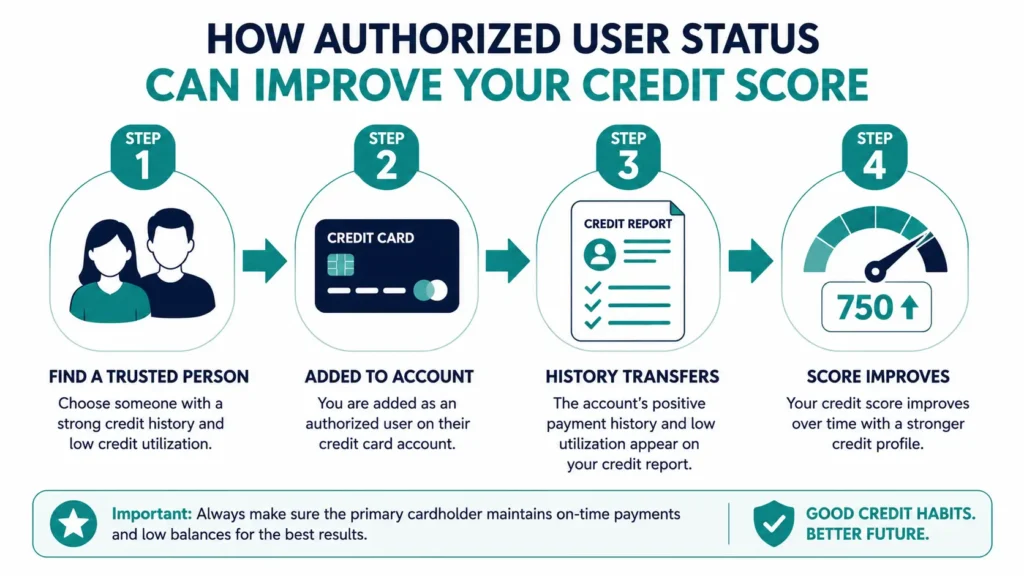
Step 4: Become an Authorized User
If you have a family member or close friend with a long, clean credit history, asking them to add you as an authorized user on one of their credit cards is one of the fastest ways to add positive history to your file.
You do not need to use the card. You do not even need to hold it physically. Simply being listed as an authorized user causes that account’s entire history — including its length and payment record — to appear on your credit report.
This works best when the primary cardholder has:
- An account open for several years
- A low utilization rate (under 20%)
- A perfect or near-perfect payment history
One honest caution: if the primary cardholder misses a payment or maxes out their card, that negative information will also appear on your report. Only do this with someone whose financial habits you completely trust.
Step 5: Never Miss a Payment Again
Payment history is 35% of your FICO score — the single most important factor. And after bankruptcy, it is the one area where you have zero room for error.
One missed payment in the first two years after bankruptcy can set your recovery back six to twelve months. It signals to lenders and scoring models that the patterns that led to bankruptcy may still be present. It is not a permanent setback, but it is a real one.
Set up autopay for every account — secured card, credit-builder loan, any remaining bills. Set the autopay for the minimum payment at minimum, and pay the full balance manually on top of that when possible. The autopay is your safety net. It prevents an accidental oversight from becoming a scoring disaster.
What Credit Score Do You Need to Buy a House in 2026?
Let us answer this clearly, because most articles bury the actual numbers in vague language.
The practical answer for 2026 is: 580 works for many FHA buyers with 3.5% down, 500–579 may work for FHA with 10% down, and conventional loans commonly start around 620. VA loans have no official minimum set by the Department of Veterans Affairs, but most lenders impose their own floor of around 620.
Here is the complete breakdown by loan type:
| FHA Loan | 580 (3.5% down) / 500 (10% down) | 3.5%–10% | First-time buyers, lower scores |
| Conventional Loan | 620+ (though minimums now more flexible) | 3%–20% | Buyers with good-to-excellent credit |
| VA Loan | No official minimum (lenders often set 620) | 0% | Military veterans and active service members |
| USDA Loan | 580+ | 0% | Rural and suburban buyers, income limits apply |
| Jumbo Loan | 700–720+ | 10%–20% | Homes above $832,750 |
One important nuance that most guides skip: these are program minimums, not lender minimums. Individual lenders often set requirements 20 to 40 points above the program floor — called overlays. The score your actual lender requires may be higher than what the program allows.
In plain English: qualifying for an FHA loan “in theory” at 580 and qualifying with the specific lender you call tomorrow are two different things. Aiming for 620 or higher gives you significantly more lender options and better terms.
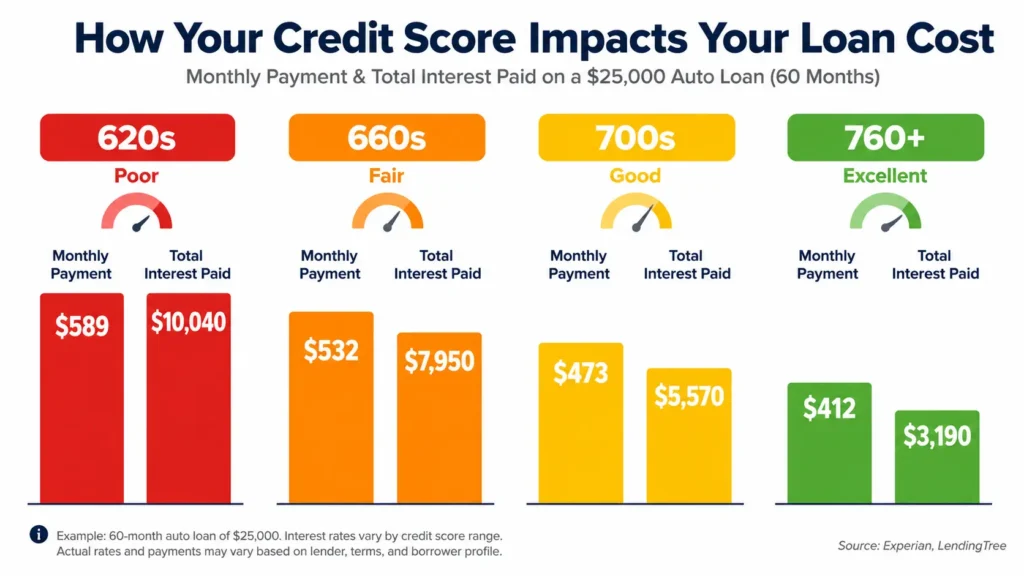
How Your Score Affects Your Mortgage Rate — Real Numbers
This is where improving your credit score to buy a house stops being abstract and becomes very real money.
A buyer with a 760 score usually has more room to shop for a lower rate than a buyer at 620 — the exact difference changes with market rates, lender fees, loan size, and property type.
Here is a practical illustration using a $350,000 home purchase with 10% down ($315,000 loan) in July 2026:
| 760 – 850 | ~6.5% | ~$1,989 | ~$401,900 |
| 700 – 759 | ~6.8% | ~$2,051 | ~$424,300 |
| 660 – 699 | ~7.3% | ~$2,158 | ~$461,900 |
| 620 – 659 | ~7.9% | ~$2,286 | ~$507,900 |
Rates approximate as of July 2026. For illustration only — actual rates vary by lender, loan type, and market conditions.
The difference between a 620 score and a 760 score on this loan is $297 per month and $106,000 over the life of the loan. Same house. Same neighborhood. Same bank. Just a different three-digit number.
This is why the effort to improve your credit score to buy a house — even by 50 or 60 points — is worth months of focused work before you ever talk to a lender.
The 2026 Mortgage Rule Change You Need to Know About
Something significant shifted in late 2025 that most homebuyers do not know about yet.
Fannie Mae eliminated its minimum credit score requirement on November 15, 2025, as noted in an update to its Selling Guide. If you are buying a house valued under $832,750 in 2026 without using a government loan, your lender is likely using a conforming conventional loan under these new rules.
This means your rent payments, utility bills, and phone service history now count toward your creditworthiness under FICO 10T and VantageScore 4.0 models — great news if you have been paying these bills on time but have not built a traditional credit history.
What does this mean practically? If your score is between 580 and 620 and you have a strong record of paying rent and utilities on time, you may now qualify for conventional loans that would have rejected you before November 2025. This is worth discussing with a mortgage broker who has access to multiple lenders, not just one bank.
Fix Your Credit Score with — 5 Steps
If you are not at your target score yet, here is the fastest path to get there. These five steps are ranked by how quickly they move your number — not alphabetically, not randomly.
Step 1: Pull All Three Credit Reports First
Before taking any action, you need to know exactly what is on your report — because the same error might appear on one bureau’s report and not the others.
Pull your free reports from Equifax, Experian, and TransUnion at AnnualCreditReport.com. Under federal law, you are entitled to a free report from each bureau every week. Check all three. Lenders for conventional loans typically use the middle of your three scores — so a single bad entry on one bureau can drag your qualifying score down significantly.
Look for: accounts you do not recognize, late payments you dispute, incorrect balances, collection accounts that should have been removed, and credit limits reported lower than your actual limit.
Step 2: Drop Your Credit Utilization Below 10%
Credit utilization — how much of your available credit you are using — makes up 30% of your FICO score and is the fastest factor to change.
Most advice says stay below 30%. But if you are trying to improve your credit score to buy a house and need maximum points fast, aim for under 10%. People with scores above 800 typically carry utilization in the single digits.
There is also a timing trick most buyers miss. Your lender will see the balance your card reports on your statement closing date — not your payment due date. Pay your balances down before your statement closes, not before the due date, to maximize your reported utilization improvement.
Practical example: If you have a $6,000 limit and a $2,400 balance, your utilization is 40%. Paying it to $500 drops utilization to 8.3% — and can add 30 to 50 points to your score within one billing cycle.
Step 3: Dispute Every Error on Your Credit Report
The FTC reports that 1 in 5 consumers has a credit report error significant enough to affect their score. Before you assume your score is accurate, go through your report carefully.
File disputes online directly at Equifax.com, Experian.com, and TransUnion.com. Each bureau has its own portal. Under the Fair Credit Reporting Act, they must investigate within 30 days and remove anything they cannot verify.
Common errors worth disputing when you are trying to improve your credit score to buy a house:
- A late payment from five years ago that you actually paid on time
- A collection account that belongs to someone with a similar name
- A credit limit reported as lower than your actual limit (this artificially inflates your utilization)
- Negative items older than seven years that should have aged off your report
Consumer Financial Protection Bureau’s free credit dispute guide: “The CFPB provides free tools and guides to help you dispute credit report errors and understand your rights under federal law.”
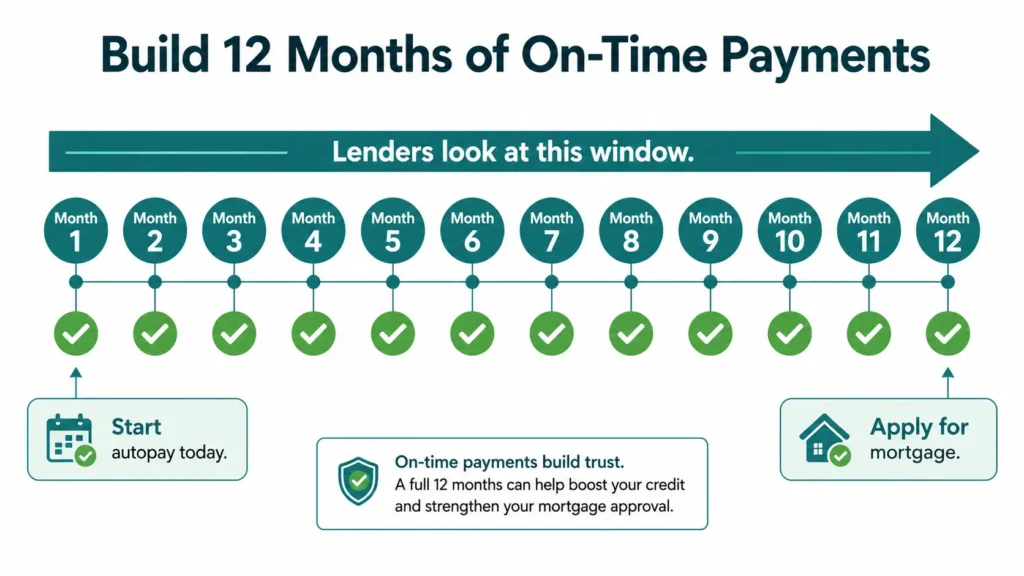
Step 4: Never Miss a Payment in the Months Before Applying
Payment history makes up 35% of your FICO score — it is the single most weighted factor. And it is also the one that can hurt you fastest.
Even with a 580 score, you will need compensating factors like stable employment, a low debt-to-income ratio, or significant cash reserves to strengthen your application. A recent late payment — within the last 12 months — can override those compensating factors and send your application to denial.
Set every account to autopay for at least the minimum payment starting today. One missed payment can drop your score 50 to 100 points and stay on your report for seven years. When you are saving for a house, you cannot afford that setback.
Step 5: Avoid New Credit Applications for 6 Months Before Applying
Every time you apply for a new credit card, personal loan, or car loan, the lender runs a hard inquiry on your credit report. Each hard inquiry temporarily drops your score by five to ten points. Multiple inquiries in a short period signal financial stress to mortgage lenders.
The standard advice is to avoid any new credit applications for at least six months before applying for a mortgage. Do not open a new rewards card because of a sign-up bonus. Do not finance a new car. Do not apply for a store credit card at checkout.
One exception: when you shop for mortgage rates with multiple lenders within a short window (typically 14 to 45 days depending on the scoring model), FICO treats all those mortgage inquiries as a single inquiry. So rate shopping does not hurt you — as long as you do it within that window.
What Slows Down 200-Point Gains
❌ Opening multiple new cards — Each hard inquiry = 5-10 point hit. Three new cards = 15-30 point setback.
❌ Increasing credit card balances — Utilization spikes = immediate 20-40 point drop.
❌ Missing payments — Even one 30-day late = 50-100 point drop. Erases 2+ months of gains.
❌ Closing old accounts — Reduces credit age + increases utilization. Dual penalty.
❌ Paying off collections in a lump sum — They report as recently paid (often a slight score dip). Better strategy: negotiate removal before paying.
The Psychology of Long-Term Credit Building
Here’s what most articles won’t tell you: the first 100 points come from removing damage. The second 100 come from building positive history.
First 100 points (Months 1-3): Fixing errors, reducing utilization, catching up on late payments. These are damage control actions.
Second 100 points (Months 4-6+): Building credit mix, consistent on-time payments, credit history aging. These are reputation-building actions.
The second part requires patience. But that’s what separates people who reach 750+ and stay there vs. people who spike to 720 and drop back to 650.
Tools to Track Progress
Free (updated monthly):
- Credit Karma — Equifax & TransUnion scores
- Experian app — Experian score
- AnnualCreditReport.com — Full reports
Paid (real-time updates):
- MyFICO — Official FICO score + detailed breakdown
- Credit Sesame — Daily monitoring + score alerts
- IdentityWorks — Full credit protection + scores
What to track: Monthly score, utilization by card, number of on-time payments, age of oldest account, recent inquiries.
Real Timelines (No False Promises)
Can you improve your credit score by 200 points in 3 months?
Unlikely unless you’re removing a major error or a paid-off collection.
Can you do it in 6 months?
Yes, with disciplined execution—especially if damage is recent.
Can you do it in 12 months?
Absolutely. This is realistic for most people.
The honest truth: The further you’ve fallen, the faster you can climb initially. If you’re at 550, gaining 100 points in 3 months is feasible (removing errors + utilization). If you’re at 700, gaining 50 points takes 6+ months (slower because you’re closer to the ceiling and positive factors matter more).
Disclaimer: This article is educational and not professional financial or credit advice. Credit score improvements depend on individual factors, credit file contents, creditor policies, and economic conditions. Results vary. If you have complex credit issues (bankruptcy, fraud, legal judgments), consult a licensed credit counselor or financial advisor. Data references current industry standards as of 2026, but credit bureaus and lenders update policies regularly. Always verify information with official sources.
4. FAQ SECTION
Q1: Is 200 points a realistic gain or marketing hype?
Realistic, but with caveats. If you’re starting at 550-620 with recent damage (collections, late payments, high utilization), 200 points in 6-12 months is achievable through systematic action. If you’re at 700+, expect 50-100 points over the same period. Lower starting scores = faster proportional gains.
Q2: What’s the single biggest factor in improving credit by 200 points?
Credit utilization if it’s high (above 30%), or bringing current late payments if you have them. These two factors account for 100+ of possible 200-point gains alone.
Q3: Do I need to pay off all debt to improve my score by 200 points?
No. You need to reduce utilization to 20-30%, not eliminate debt entirely. You can carry $5,000 in balances and score 800+ if your total limits are $25,000+. The ratio matters more than the absolute amount.
Q4: How long before authorized user benefits appear on my credit report?
Typically 1-2 business days, but some issuers take 30+ days to report to bureaus. Call the card issuer first to confirm they report authorized users to all three bureaus (not all do).
Q5: Will paying off a collection account improve or hurt my score short-term?
Hurt short-term (5-10 point dip) because it resets the “payment date” on the account. Long-term benefit: stops the account from aging as delinquent and opens negotiation opportunities. Better play: negotiate removal before paying.
Q6: How many hard inquiries are safe before my score drops significantly?
1-2 inquiries = minimal impact (5 points each). 5+ in 6 months = major red flag (50+ point penalty). Space credit applications 6+ months apart for minimal inquiry impact.
Conclusion
At the end of the day, rebuilding or optimizing your credit score isn’t about pulling off a one-time financial miracle. Whether you are trying to erase the heavy damage of a past bankruptcy, rushing to clear immediate errors for a quick overnight bump, or meticulously grooming your report to secure a low-interest mortgage for your dream house—the underlying engine is exactly the same: consistency and strategy.
A 200-point surge doesn’t happen by luck; it happens when you systematically eliminate report errors, manage your utilization lines, and refuse to let commercial credit bureaus dictate your financial health.
Your credit report is a living document that changes with your habits. Do not let a low score lock you out of wealth-building opportunities or trap you in high-interest cycles this season. Take the quick wins today, stay aggressive with your six-month rebuilding plan, and protect your credit history like the valuable asset it is. Your financial freedom starts with the very next payment cycle.

Ankur Saxena is a Personal Finance Researcher & Content Lead at My Finance Goal. With a focus on data-driven money management, high-yield savings strategies, and budgeting frameworks, he translates complex US economic policies and IRS updates into practical financial steps for readers.