
Introduction
To improve your credit score to buy a house in 2026, your first target is 580 for an FHA loan with 3.5% down, 620 for a conventional loan, and 700+ for the best interest rates available. The good news: a rule change that took effect in November 2025 means Fannie Mae no longer has a strict 620 minimum — lenders now evaluate your full financial picture, which opens doors for more buyers than ever before.
This guide tells you exactly what score you need, what each loan type requires, and the specific steps to take — ranked by speed — to improve your credit score to buy a house on your timeline.
Disclaimer: This article is for informational and educational purposes only. It does not constitute personalized financial, mortgage, or legal advice. Please consult a licensed mortgage professional or financial advisor before making any home-buying decisions.
What Credit Score Do You Need to Buy a House in 2026?
Let us answer this clearly, because most articles bury the actual numbers in vague language.
The practical answer for 2026 is: 580 works for many FHA buyers with 3.5% down, 500–579 may work for FHA with 10% down, and conventional loans commonly start around 620. VA loans have no official minimum set by the Department of Veterans Affairs, but most lenders impose their own floor of around 620.
Here is the complete breakdown by loan type:
| FHA Loan | 580 (3.5% down) / 500 (10% down) | 3.5%–10% | First-time buyers, lower scores |
| Conventional Loan | 620+ (though minimums now more flexible) | 3%–20% | Buyers with good-to-excellent credit |
| VA Loan | No official minimum (lenders often set 620) | 0% | Military veterans and active service members |
| USDA Loan | 580+ | 0% | Rural and suburban buyers, income limits apply |
| Jumbo Loan | 700–720+ | 10%–20% | Homes above $832,750 |
Sources: FHA.gov, VA.gov, FHFA, verified July 2026.
One important nuance that most guides skip: these are program minimums, not lender minimums. Individual lenders often set requirements 20 to 40 points above the program floor — called overlays. The score your actual lender requires may be higher than what the program allows.
In plain English: qualifying for an FHA loan “in theory” at 580 and qualifying with the specific lender you call tomorrow are two different things. Aiming for 620 or higher gives you significantly more lender options and better terms.
“Not sure where your score stands or how to move it quickly? Read our complete guide on how to improve your credit score in 30 days.”
How Your Score Affects Your Mortgage Rate — Real Numbers
This is where improving your credit score to buy a house stops being abstract and becomes very real money.
A buyer with a 760 score usually has more room to shop for a lower rate than a buyer at 620 — the exact difference changes with market rates, lender fees, loan size, and property type.
Here is a practical illustration using a $350,000 home purchase with 10% down ($315,000 loan) in July 2026:
| 760 – 850 | ~6.5% | ~$1,989 | ~$401,900 |
| 700 – 759 | ~6.8% | ~$2,051 | ~$424,300 |
| 660 – 699 | ~7.3% | ~$2,158 | ~$461,900 |
| 620 – 659 | ~7.9% | ~$2,286 | ~$507,900 |
Rates approximate as of July 2026. For illustration only — actual rates vary by lender, loan type, and market conditions.
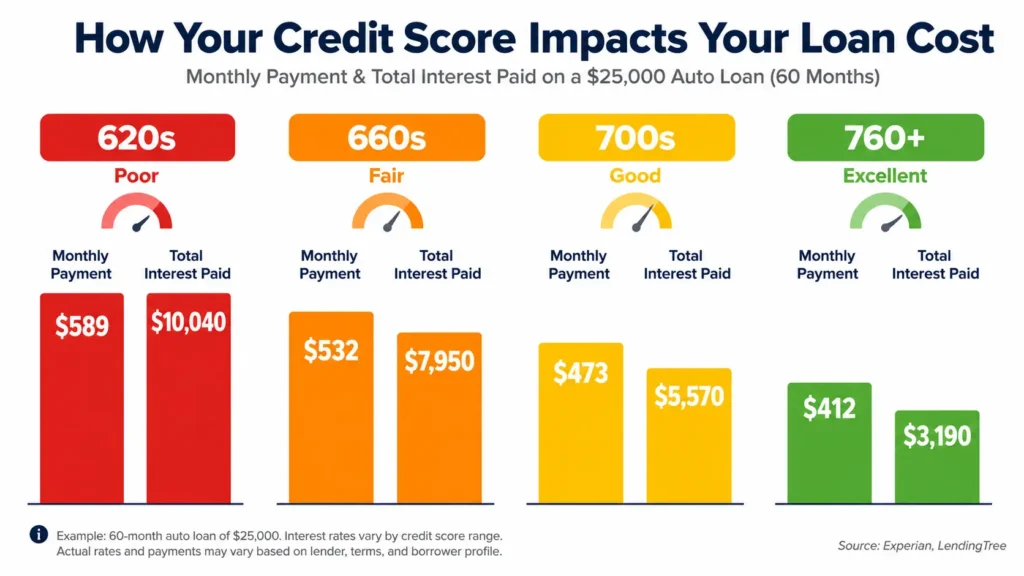
The difference between a 620 score and a 760 score on this loan is $297 per month and $106,000 over the life of the loan. Same house. Same neighborhood. Same bank. Just a different three-digit number.
This is why the effort to improve your credit score to buy a house — even by 50 or 60 points — is worth months of focused work before you ever talk to a lender.
The 2026 Mortgage Rule Change You Need to Know About
Something significant shifted in late 2025 that most homebuyers do not know about yet.
Fannie Mae eliminated its minimum credit score requirement on November 15, 2025, as noted in an update to its Selling Guide. If you are buying a house valued under $832,750 in 2026 without using a government loan, your lender is likely using a conforming conventional loan under these new rules.
This means your rent payments, utility bills, and phone service history now count toward your creditworthiness under FICO 10T and VantageScore 4.0 models — great news if you have been paying these bills on time but have not built a traditional credit history.
What does this mean practically? If your score is between 580 and 620 and you have a strong record of paying rent and utilities on time, you may now qualify for conventional loans that would have rejected you before November 2025. This is worth discussing with a mortgage broker who has access to multiple lenders, not just one bank.
Fix Your Credit Score with — 5 Steps
If you are not at your target score yet, here is the fastest path to get there. These five steps are ranked by how quickly they move your number — not alphabetically, not randomly.
Step 1: Pull All Three Credit Reports First
Before taking any action, you need to know exactly what is on your report — because the same error might appear on one bureau’s report and not the others.
Pull your free reports from Equifax, Experian, and TransUnion at AnnualCreditReport.com. Under federal law, you are entitled to a free report from each bureau every week. Check all three. Lenders for conventional loans typically use the middle of your three scores — so a single bad entry on one bureau can drag your qualifying score down significantly.
Look for: accounts you do not recognize, late payments you dispute, incorrect balances, collection accounts that should have been removed, and credit limits reported lower than your actual limit.
Step 2: Drop Your Credit Utilization Below 10%
Credit utilization — how much of your available credit you are using — makes up 30% of your FICO score and is the fastest factor to change.
Most advice says stay below 30%. But if you are trying to improve your credit score to buy a house and need maximum points fast, aim for under 10%. People with scores above 800 typically carry utilization in the single digits.
There is also a timing trick most buyers miss. Your lender will see the balance your card reports on your statement closing date — not your payment due date. Pay your balances down before your statement closes, not before the due date, to maximize your reported utilization improvement.
Practical example: If you have a $6,000 limit and a $2,400 balance, your utilization is 40%. Paying it to $500 drops utilization to 8.3% — and can add 30 to 50 points to your score within one billing cycle.
Step 3: Dispute Every Error on Your Credit Report
The FTC reports that 1 in 5 consumers has a credit report error significant enough to affect their score. Before you assume your score is accurate, go through your report carefully.
File disputes online directly at Equifax.com, Experian.com, and TransUnion.com. Each bureau has its own portal. Under the Fair Credit Reporting Act, they must investigate within 30 days and remove anything they cannot verify.
Common errors worth disputing when you are trying to improve your credit score to buy a house:
- A late payment from five years ago that you actually paid on time
- A collection account that belongs to someone with a similar name
- A credit limit reported as lower than your actual limit (this artificially inflates your utilization)
- Negative items older than seven years that should have aged off your report
Consumer Financial Protection Bureau’s free credit dispute guide: “The CFPB provides free tools and guides to help you dispute credit report errors and understand your rights under federal law.”
Step 4: Never Miss a Payment in the Months Before Applying
Payment history makes up 35% of your FICO score — it is the single most weighted factor. And it is also the one that can hurt you fastest.
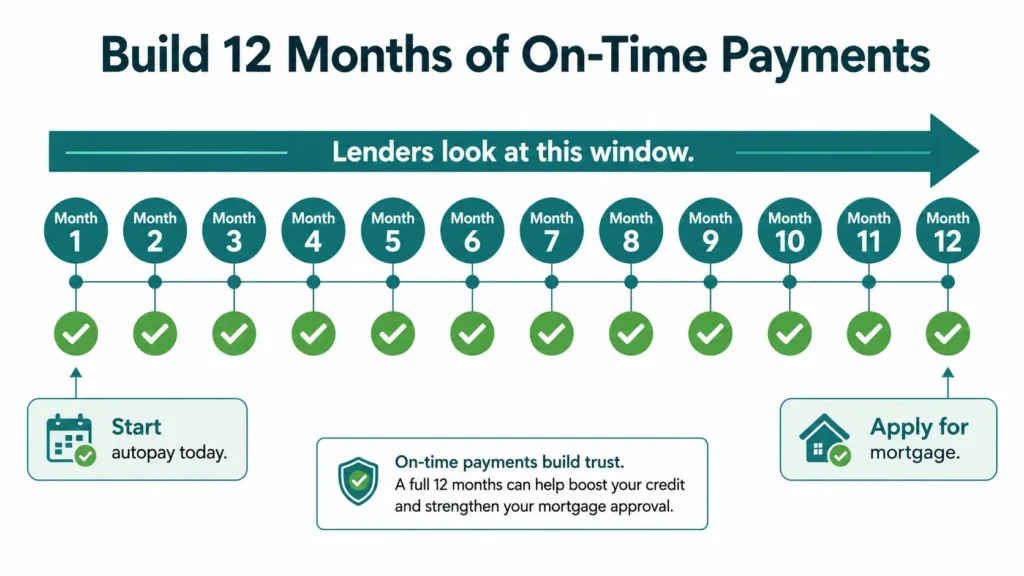
Even with a 580 score, you will need compensating factors like stable employment, a low debt-to-income ratio, or significant cash reserves to strengthen your application. A recent late payment — within the last 12 months — can override those compensating factors and send your application to denial.
Set every account to autopay for at least the minimum payment starting today. One missed payment can drop your score 50 to 100 points and stay on your report for seven years. When you are saving for a house, you cannot afford that setback.
Step 5: Avoid New Credit Applications for 6 Months Before Applying
Every time you apply for a new credit card, personal loan, or car loan, the lender runs a hard inquiry on your credit report. Each hard inquiry temporarily drops your score by five to ten points. Multiple inquiries in a short period signal financial stress to mortgage lenders.
The standard advice is to avoid any new credit applications for at least six months before applying for a mortgage. Do not open a new rewards card because of a sign-up bonus. Do not finance a new car. Do not apply for a store credit card at checkout.
One exception: when you shop for mortgage rates with multiple lenders within a short window (typically 14 to 45 days depending on the scoring model), FICO treats all those mortgage inquiries as a single inquiry. So rate shopping does not hurt you — as long as you do it within that window.
How Long Does It Take to Reach Each Score Milestone?
If you are wondering how long the journey will realistically take, here is an honest timeline based on 2026 data:
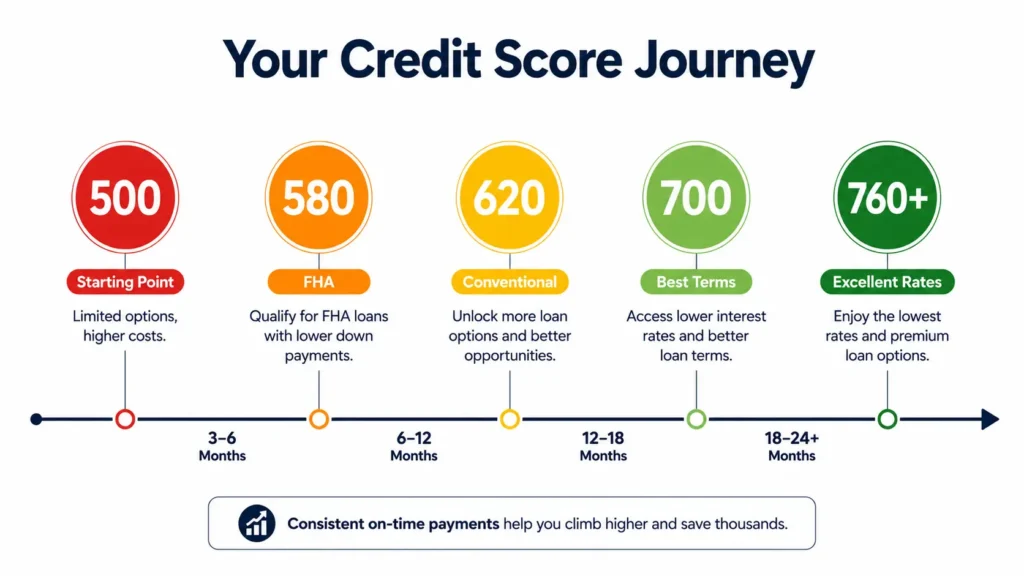
Moving from 500 to 580 — the FHA qualifying threshold with 3.5% down — typically takes 3 to 6 months. Reaching 620 for conventional qualifying from the 550–580 range takes another 3 to 6 months. Climbing from 620 to 700 for the best conventional terms takes 6 to 12 months.
| Below 500 | 580 (FHA eligible) | 6–12 months | Pay all accounts current, reduce utilization |
| 500 – 579 | 620 (Conventional) | 3–6 months | Dispute errors, reduce utilization |
| 580 – 620 | 660 (Better terms) | 3–6 months | Consistent payments, utilization below 10% |
| 620 – 660 | 700+ (Best rates) | 6–12 months | No new credit, perfect payment history |
| 700 – 739 | 760+ (Excellent rates) | 6–12 months | Utilization below 7%, aged accounts |
These are realistic ranges — not guarantees. Your specific timeline depends on what is currently hurting your score, how quickly errors get resolved, and how much you can pay down on existing balances.
FAQ — How to Improve Credit Score to Buy a House
Q1: What is the minimum credit score to buy a house in 2026?
The minimum credit score to buy a house in 2026 is 500 for an FHA loan with 10% down, or 580 for FHA with 3.5% down. Conventional loans now have more flexible standards after Fannie Mae’s November 2025 rule change, but most lenders still prefer 620 or higher. VA loans have no official minimum, though most lenders set their own floor around 620.
Q2: How long does it take to improve your credit score enough to buy a house?
It depends on your starting point. Moving from 580 to 620 typically takes 3 to 6 months of consistent effort — paying bills on time, reducing credit utilization below 10%, and disputing errors. Reaching 700+ from the mid-600s generally takes 6 to 12 months. The biggest jumps come from fixing credit report errors and dropping high utilization.
Q3: Does applying for a mortgage hurt your credit score?
Yes — but only slightly and temporarily. A single mortgage application creates one hard inquiry, which typically lowers your score by 5 to 10 points. However, if you shop rates with multiple lenders within a 14 to 45-day window, FICO treats all those mortgage inquiries as a single inquiry — so you can compare lenders without compounding the damage.
Q4: Can I buy a house with a 580 credit score?
Yes — with an FHA loan and at least 3.5% down. However, most FHA-approved lenders set their own minimum at 620, so not every lender will approve you at 580. Your best path at 580 is to work with a mortgage broker who has access to multiple lenders and can find one whose overlay matches your profile.
Q5: What credit score do I need for a conventional loan in 2026?
Conventionally, 620 has been the floor — but Fannie Mae eliminated its hard minimum in November 2025. Lenders now evaluate your full credit file using newer scoring models, including FICO 10T and VantageScore 4.0. In practice, most conventional lenders still prefer 620 or above, and you will need 700+ for the most competitive interest rates.
Q6: Does paying rent help my credit score for a mortgage?
Under the new 2026 mortgage guidelines using FICO 10T, consistent rent payment history can now count toward your creditworthiness for conventional loans. If you have been paying rent on time but lack a strong traditional credit history, this rule change works in your favor. Ask your lender or mortgage broker whether they are using the updated scoring models.
Conclusion
Improving your credit score to buy a house is one of the highest-return financial moves you can make. The difference between a 620 score and a 760 score on a $315,000 mortgage is not small — it is $297 per month and more than $100,000 over 30 years. The work it takes to close that gap is finite. The savings last decades.
Start with what you can control today: pull your credit reports, identify any errors, pay down your highest utilization card, and set every account to autopay. Those four actions, done this week, start moving your score before the month is out.
Your timeline to homeownership is closer than most people think — it just requires a plan and the willingness to follow it.
Your next step: A better credit score is only one piece of mortgage readiness. Make sure your financial foundation is solid before you start the home-buying process.
📌 Read Next: [How to Improve Your Credit Score in 30 Days — Complete 2026 Guide ]
📌 Also Read: [How to Build an Emergency Fund Fast — 30-Day Plan ]

Financial enthusiast with 5 years of experience in the US market trends and personal wealth management