Introduction
To build an emergency fund fast, start with one goal: save your first $1,000 within 30 days by automating a fixed transfer to a high-yield savings account the same day you get paid. That single habit — before you pay for anything else — is what separates people who have a financial cushion from those who go into debt every time life gets unpredictable.
Most Americans do not have that cushion. <cite index=”13-1″>Bankrate’s 2026 survey found that only 47% of Americans have enough emergency savings to cover a $1,000 expense.</cite> If you are in the other 53%, this guide gives you a real, no-fluff plan to change that — fast.
Disclaimer: This article is for informational and educational purposes only. It does not constitute personalized financial advice. Please consult a licensed financial advisor before making investment decisions.
How to Build an Emergency Fund Fast — Start With $1,000
Here is something most financial guides get wrong. They tell you to save three to six months of expenses before you do anything else. That number — which can easily be $15,000 or more — stops people before they even start.
The emergency fund rule of thumb that actually works for beginners is simpler: start with $1,000.
<cite index=”13-1″>Swift Debt Relief’s 2026 analysis found that focusing exclusively on reaching the initial $1,000 milestone before pursuing the full three-to-six-month target builds momentum and confidence — and leads to higher long-term savings rates.</cite>
Why $1,000 specifically? Because it covers the most common financial emergencies Americans actually face:
- Car repair: average cost $500–$800
- Emergency room co-pay: $150–$500
- Broken appliance: $200–$600
- One month of essential bills if income drops
It is not a complete safety net — but it is enough to stop a bad situation from becoming a financial disaster. Once you have $1,000, you build toward one month of expenses. Then three. Then six. One step at a time.
“Once your emergency fund is in place, your next step is putting your money to work. Here is our complete guide on how to invest $1,000 for beginners.”
Where to Keep Your Emergency Fund Fast in 2026
Before you save a single dollar, you need the right account. This matters more than most people realize.
Your emergency fund needs three things: it must be safe (no risk of loss), accessible (available within one to three business days), and earning real interest (not 0.01% in a regular checking account).
In 2026, high-yield savings accounts (HYSAs) are the best option for emergency funds for beginners. Even as the Fed has adjusted rates, top online banks are still paying meaningful APYs:
| Varo | 5.00% | $0 | ✓ Yes |
| Axos Bank | 4.21% | $0 | ✓ Yes |
| Newtek Bank | 4.20% | $0 | ✓ Yes |
| SoFi | ~4.00% | $0 | ✓ Yes |
| Marcus by Goldman Sachs | ~3.90% | $0 | ✓ Yes |
Rates verified July 2026. Rates change — always confirm current APY on the bank’s official website.
<cite index=”14-1″>A $10,000 emergency fund in a high-yield savings account earning 4–5% APY generates $400–$500 per year — compared to just $39 in an average checking account.</cite> That difference compounds quietly every single month.
The other rule: keep it separate. Not in your everyday checking account. Open a dedicated HYSA specifically for your emergency fund and nickname it something like “Safety Net” — the psychological distance makes it harder to dip into casually.
External Link — Place here: Bankrate’s 2026 Best High-Yield Savings Accounts → bankrate.com/banking/savings/best-high-yield-interests-savings-accounts “Compare current HYSA rates across top banks on Bankrate before opening your account.”
How to Build an Emergency Fund Fast — The 30-Day Starter Plan
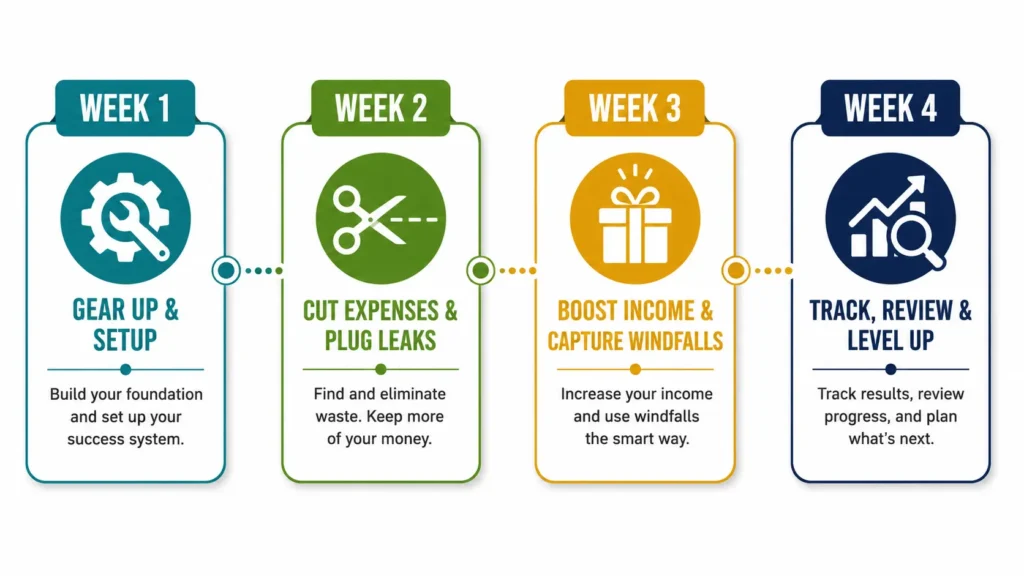
Here is the plan. Not vague advice — an actual week-by-week breakdown for how to build an emergency fund fast starting today.
Week 1 — Set Up Your System
Day 1: Open a high-yield savings account (Varo, SoFi, or Marcus — all free, online, ten minutes). Transfer whatever you have right now — even $20.
Day 2: Calculate your monthly take-home pay. Decide on a fixed amount to auto-transfer every payday. Start with 10% if you can. Even $50 works — it builds the habit.
Day 3: Set up the automatic transfer. Schedule it for the same day your paycheck hits. Pay your emergency fund first, before anything else gets spent.
Week 2 — Find Your First $200
Look at last month’s bank statement. Find one thing to cut — just one. A streaming service you barely use. Takeout twice a week instead of four. <cite index=”13-1″>According to a 2026 MoneyLion analysis, canceling even one unused subscription creates room in your budget without requiring a complete financial overhaul.</cite>
Transfer whatever you save directly to your HYSA. Do not let it sit in checking.
Week 3 — Add a Windfall
Tax refund sitting somewhere? A small gift? Cash back rewards from a credit card? Any unexpected money this week goes straight to the emergency fund — all of it. <cite index=”11-1″>U.S. News financial advisor Mike O’Rourke says tax refunds, bonuses, and cash gifts directed toward an emergency fund can help you reach your first milestone faster without straining your regular budget.</cite>
Week 4 — Track and Adjust
Log into your HYSA. See the number. Feel the progress. Then ask yourself: can I increase the auto-transfer by even $25 next month? Most people say yes after seeing real growth.
6 Ways to Find Extra Money This Month
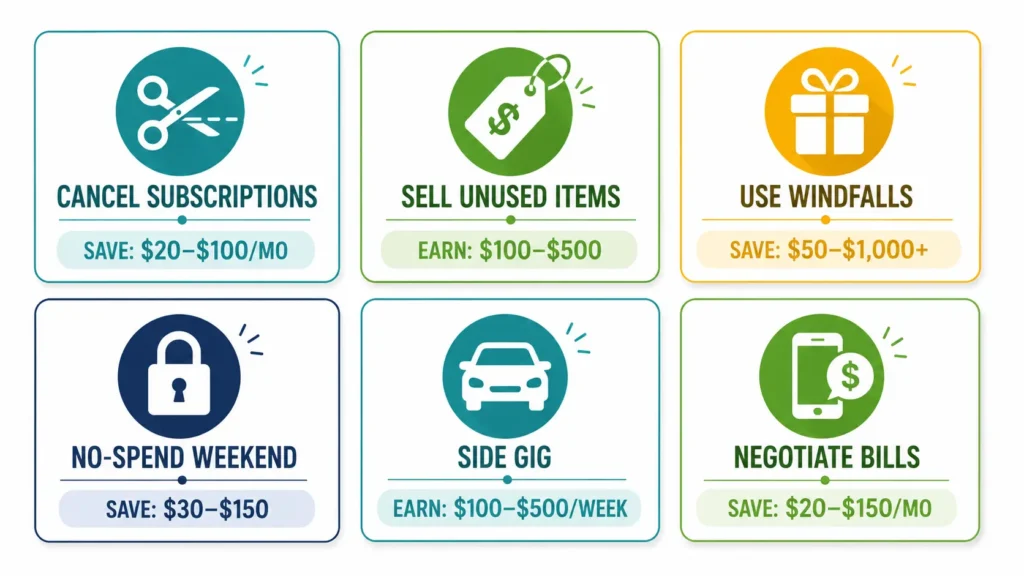
The hardest part of building an emergency fund fast is finding the money in the first place. Here are six approaches that work — ranked from easiest to most impactful.
1. Cancel one subscription today The average American pays for 4.5 streaming services. Pick one you have not used in two weeks. Cancel it. Transfer that $15–$20 per month to savings.
2. Sell something you own A quick pass through your home will surface at least $100–$200 worth of things you no longer use — electronics, clothes, furniture, exercise equipment. List them on Facebook Marketplace or eBay this weekend.
3. Redirect your next windfall <cite index=”15-1″>A single tax refund could cover an entire month of expenses. A few months of side gig work could complete your three-month cushion.</cite> Treat windfalls as opportunities to accelerate savings, not permission to spend.
4. Do a “no-spend” weekend Pick one weekend this month. No restaurants, no online shopping, no impulse buys. Move whatever you would have spent into your HYSA on Monday.
5. Pick up one gig shift <cite index=”13-1″>A 2026 survey found that 21% of Americans are side-gigging specifically to build emergency savings.</cite> DoorDash, Uber Eats, or TaskRabbit — one weekend shift can add $80–$150 to your fund.
6. Negotiate one bill Call your internet or phone provider and ask for a lower rate or a promotional plan. This works more often than people expect — especially if you mention you are considering switching. Save the difference each month.
How Much Should Your Full Emergency Fund Be?
Once you build your first $1,000, the next target is three to six months of essential living expenses. Here is how to calculate your personal number.
Step 1: Add up your non-negotiable monthly expenses only:
- Rent or mortgage
- Utilities
- Groceries
- Transportation
- Insurance
- Minimum debt payments
Step 2: Multiply by 3 (minimum) or 6 (recommended).
Example: If your essential monthly expenses total $2,800, your target is $8,400 to $16,800.
| Single, stable job, no dependents | 3 months | Lower risk, easier to find new income |
| Dual income household | 3–4 months | Two income streams reduce risk |
| Single income, dependents | 5–6 months | Higher stakes if income stops |
| Freelancer or self-employed | 6+ months | Income is variable and unpredictable |
Do not let the six-month target feel paralyzing. Build to $1,000 first. Then $2,500. Then one month. The habit matters more than the final number — especially when you are just starting out.
📌 “Once your emergency fund is secure, consider opening a Roth IRA to start growing tax-free wealth. Here is our complete Roth IRA for beginners 2026 guide.”
External Link — Place here: Consumer Financial Protection Bureau — Emergency Fund Resource → consumerfinance.gov/an-essential-guide-to-building-an-emergency-fund Anchor text: “The CFPB offers a free emergency fund planning worksheet and savings guide worth bookmarking.”
What NOT to Do With Your Emergency Fund
A few things that seem smart but will hurt you.
❌ Do not invest it in stocks or ETFs <cite index=”14-1″>Markets can drop 30–40% exactly when you need the money — which defeats the entire purpose of having the fund.</cite> Emergency funds should never be in volatile assets. Safety first, always.
❌ Do not keep it in a regular checking account The money will gradually disappear into daily spending. Keep it in a dedicated, separate HYSA — out of sight, out of easy reach.
❌ Do not wait until you are debt-free Build your $1,000 starter fund first, even while paying down debt. Without any cushion, the next emergency just adds more debt — creating a cycle that is hard to escape.
❌ Do not touch it for non-emergencies A sale, a vacation, a new gadget — these are not emergencies. Define “emergency” before you need it: job loss, medical expense, essential repair, urgent travel. Everything else can wait.
FAQ — How to Build an Emergency Fund Fast
Q1: How fast can I realistically build an emergency fund?
With consistent effort, most people can save their first $1,000 in 30 to 90 days. The key factors are automating a fixed transfer every payday, cutting one or two expenses, and directing any unexpected income — tax refunds, bonuses, or side hustle earnings — directly into a high-yield savings account.
Q2: What is the emergency fund rule of thumb?
The standard emergency fund rule of thumb is three to six months of essential living expenses. However, for beginners, financial experts in 2026 increasingly recommend starting with a $1,000 target first. That initial milestone builds momentum and covers the most common financial emergencies without feeling overwhelming.
Q3: Where is the best place to keep an emergency fund in 2026?
A high-yield savings account (HYSA) is the best option for most people. Top picks in July 2026 include Varo (5.00% APY), Axos Bank (4.21%), and Newtek Bank (4.20%) — all FDIC-insured with no minimum balance requirements. Your money earns meaningful interest while staying fully accessible within one to three business days.
Q4: Should I build an emergency fund or pay off debt first?
Build a $500–$1,000 starter emergency fund first, then focus aggressively on high-interest debt. Without any cushion, the next unexpected expense goes straight onto your credit card — adding more debt and undoing your progress. A small safety net breaks that cycle.
Q5: How much should I save each month for an emergency fund?
Save whatever you can automate consistently — even $50 per month builds $600 in one year. Most financial experts suggest targeting 10% of your take-home pay if possible. The amount matters less than the consistency. Automate it on payday so the decision is never left to willpower.
Q6: Can I build an emergency fund on a low income?
Yes — and the approach is the same. Start with $25 or $50 per month automated to a HYSA. Add any windfalls immediately. Cancel one subscription. Do one no-spend weekend per month. Small, consistent actions compound. <cite index=”8-1″>Even a few dollars each week makes a real difference when you stay consistent and keep the habit going.</cite>
Conclusion
Building an emergency fund fast is not about finding a magic shortcut — it is about removing friction from the process. Open the right account today. Automate a transfer for payday. Cut one thing. Direct the next windfall to savings. Repeat.
<cite index=”10-1″>An emergency fund is not a financial nice-to-have in 2026 — it is the difference between absorbing a surprise and spiraling because of it.</cite> The people who build one are not necessarily earning more. They just started.
Your $1,000 is closer than you think. Start today, not next month.
Your next step: Now that your safety net is taking shape, it is time to put the rest of your money to work.
📌 Read Next: [How to Invest $1,000 for Beginners — 5 Smart Moves That Actually Work]
📌 Also Read: [What Is the Best ETF for Beginners in 2026?]

Financial enthusiast with 5 years of experience in the US market trends and personal wealth management