Introduction
The best S&P 500 index funds for beginners are FXAIX, VOO, SWPPX, and VTI — all low-cost funds that track the same market index and require zero previous investing experience to use. In 2025, each of these funds delivered returns above 17%, while charging fees as low as 0.015% per year.
If you are just getting started, this guide ranks the best S&P 500 index funds for beginners side by side — with real numbers, honest trade-offs, and a clear recommendation based on where you invest.
Disclaimer: This article is for informational and educational purposes only. It does not constitute personalized financial advice. Please consult a licensed financial advisor before making investment decisions.
Why S&P 500 Index Funds Work for Beginners
Before ranking the best S&P 500 index funds for beginners, it helps to understand why they work so well in the first place.
An S&P 500 index fund gives you instant ownership in 500 of America’s largest companies — Apple, Microsoft, Amazon, Google, and 496 more — all in one single purchase. Instead of picking individual stocks, you own a tiny piece of the entire US economy.
Furthermore, these funds are passively managed. Nobody is paid to guess which stocks will outperform. As a result, fees are extremely low — often under $3 per year for every $10,000 you invest.
Three reasons beginners love S&P 500 index funds:
- Instant diversification — 500 companies in one purchase
- Low cost — expense ratios of 0.015%–0.03%
- Proven track record — the S&P 500 has averaged approximately 10.4% annually over 50 years
“New to investing entirely? Start with our full guide on how to invest $1,000 for beginners.”
Best S&P 500 index Funds — Full Comparison
All four funds below track the same S&P 500 index. Consequently, their long-term performance is nearly identical. The right choice comes down to your brokerage, your preference for ETFs vs. mutual funds, and how much you are starting with.
Fund #1: FXAIX — Best for Fidelity Beginners
Fidelity 500 Index Fund (FXAIX)
FXAIX is the single best starting point for most beginners. It has the lowest expense ratio of any mainstream S&P 500 fund, no minimum investment, and is available at Fidelity with automatic contributions and dividend reinvestment built in.
Key facts:
- Type: Mutual Fund
- Expense ratio: 0.015% — ($1.50 per year per $10,000 invested)
- Minimum investment: $1 at Fidelity
- 2025 total return: 17.86% (including reinvested dividends)
- Best for: Beginners who bank or invest at Fidelity
Unlike ETFs, FXAIX trades once per day at the closing price. This actually helps beginners avoid the temptation to trade during market swings — a habit that hurts long-term returns. Additionally, fractional investing means you can put in any dollar amount, not just whole shares.
Source: Fidelity FXAIX Fund Overview → fundresearch.fidelity.com . “See the latest FXAIX performance data directly on Fidelity’s website.”
Fund #2: VOO — Best ETF for Long-Term Investors
Vanguard S&P 500 ETF (VOO)
VOO is the most widely held S&P 500 ETF in the world. Vanguard invented the concept of low-cost index investing, and VOO carries that legacy — charging just 0.03% per year on over $1.7 trillion in assets as of mid-2026.
Key facts:
- Type: ETF
- Expense ratio: 0.03% — ($3 per year per $10,000 invested)
- Minimum investment: $1 (fractional shares available at most brokerages)
- 2025 total return: 17.82% (including reinvested dividends)
- Best for: Beginners who want the most trusted S&P 500 ETF
Unlike FXAIX, VOO trades throughout the day like a stock. This gives you more flexibility — but also more temptation to check prices constantly. For most beginners, that does not matter much if you plan to hold long term.
VOO is available commission-free at virtually every major brokerage — Fidelity, Schwab, Robinhood, and others. Therefore, it is the most portable choice if you ever switch brokerages.
Fund #3: SWPPX — Best S&P 500 Fund for Schwab Users
Schwab S&P 500 Index Fund (SWPPX)
SWPPX is Schwab’s flagship S&P 500 mutual fund. It tracks the same index as FXAIX and VOO, at a slightly higher but still extremely low 0.02% expense ratio.
Key facts:
- Type: Mutual Fund
- Expense ratio: 0.02% — ($2 per year per $10,000 invested)
- Minimum investment: $1 at Schwab
- 2025 total return: ~17.83% (virtually identical to FXAIX and VOO)
- Best for: Beginners with accounts at Charles Schwab
Specifically, if your employer 401(k) is at Schwab or you already have a Schwab brokerage account, SWPPX is the most cost-effective option. You avoid any transaction fees and can set up automatic monthly contributions easily.
Fund #4: VTI — Best for Total US Market Coverage
Vanguard Total Stock Market ETF (VTI)
VTI goes one step beyond the S&P 500. Instead of 500 large companies, it covers approximately 3,600 US companies — including mid-sized and smaller companies that the S&P 500 excludes.
Key facts:
- Type: ETF
- Expense ratio: 0.03% — ($3 per year per $10,000 invested)
- Minimum investment: $1 (fractional shares available)
- 2025 total return: ~17.6%
- Best for: Beginners who want broader US market diversification
Historically, VTI has delivered returns very close to VOO. However, in periods when smaller companies outperform large ones, VTI tends to pull ahead slightly. Moreover, many long-term investors prefer VTI because it represents the entire US market — not just the top 500.
S&P 500 Index Fund Comparison Table — All Key Metrics
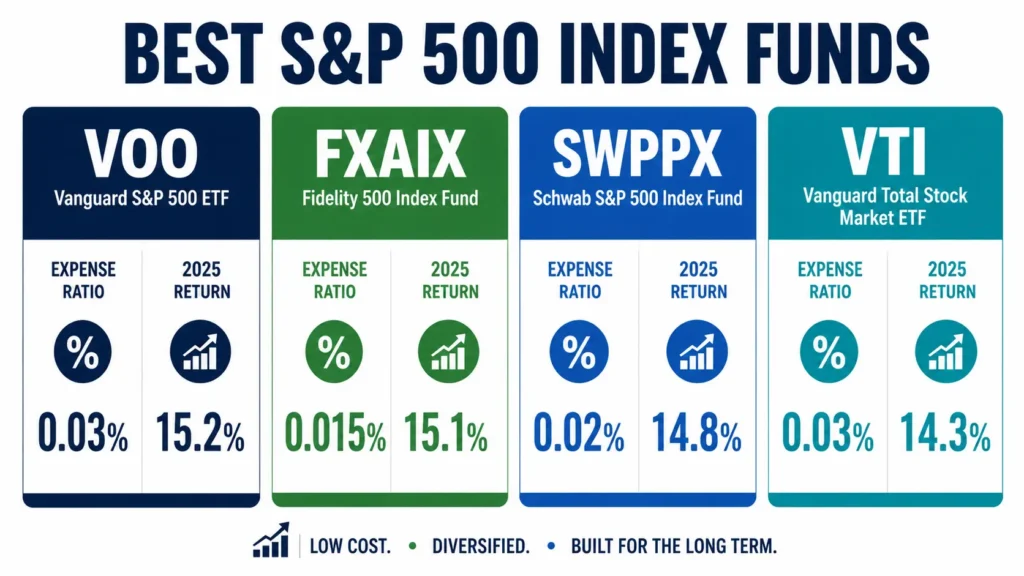
| FXAIX | Mutual Fund | 0.015% | 17.86% | $1 (Fidelity) | Best overall for Fidelity users |
| VOO | ETF | 0.03% | 17.82% | $1 (fractional) | Most portable — works anywhere |
| SWPPX | Mutual Fund | 0.02% | ~17.83% | $1 (Schwab) | Best for Schwab users |
| VTI | ETF | 0.03% | ~17.6% | $1 (fractional) | Broader US market exposure |
Returns shown are 2025 calendar-year total returns including reinvested dividends. Past performance does not guarantee future results. Sources: Fidelity, Vanguard, Schwab fund pages — verified July 2026.
Which Fund Should You Pick? A Simple Decision Guide
This is the question most beginners get stuck on. However, the honest answer is that all four funds are excellent choices. Here is the clearest guide to picking the right one:
→ If you invest at Fidelity: Choose FXAIX — lowest fees, easiest automation, no minimums.
→ If you invest at Schwab: Choose SWPPX — same simplicity as FXAIX but built for Schwab accounts.
→ If you want an ETF that works at any brokerage: Choose VOO — the most trusted and portable S&P 500 ETF available.
→ If you want the entire US stock market, not just the top 500: Choose VTI — slightly broader exposure at the same 0.03% cost as VOO.
The most important rule: Pick one fund and start. Do not wait until you have found the “perfect” option. All four of these funds have delivered nearly identical returns over the last 10, 20, and 30 years. The difference between them is tiny. The difference between starting today and waiting another month is not.
“Holding these funds inside a Roth IRA maximizes their tax-free growth potential — here is our complete Roth IRA for beginners guide.”
How Much Can You Earn? Real Growth Numbers
Here is what the best S&P 500 index funds for beginners can actually grow to — using a 10% average annual return based on historical S&P 500 data:
| $0/month (lump $1,000) | $2,594 | $6,727 | $17,449 |
| $100/month | $22,000 | $77,000 | $217,000 |
| $300/month | $62,000 | $228,000 | $641,000 |
| $500/month | $103,000 | $379,000 | $1,067,000 |
Assumes 10% average annual return, compounded monthly. For illustration only — not a guarantee of future performance.
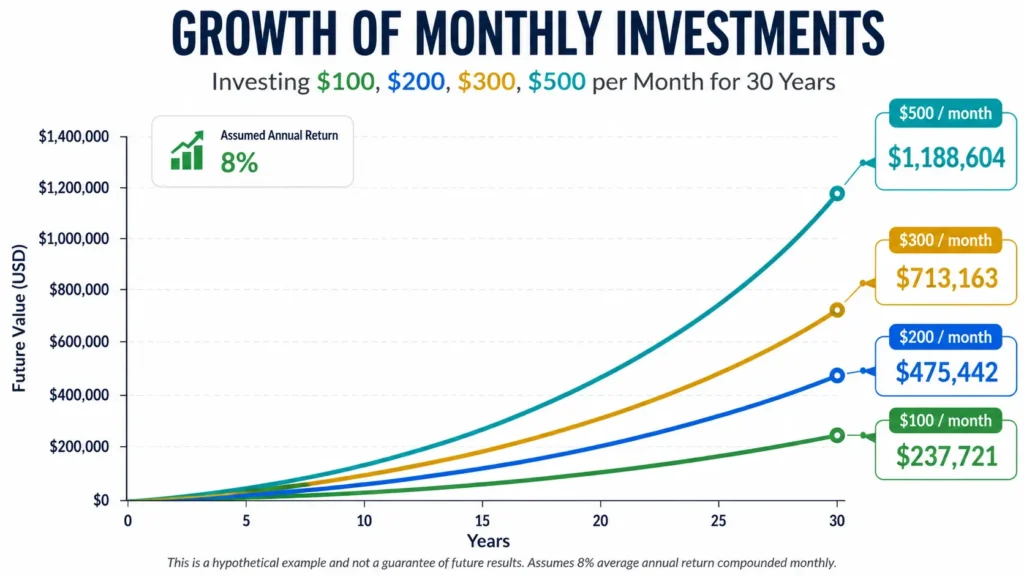
The table above shows one key truth about the best S&P 500 index funds for beginners — your contribution amount matters far more than which fund you pick. All four funds would produce nearly identical results in the table above.
Source: Morningstar Fund Data — morningstar.com . “You can track and compare S&P 500 fund performance in detail on Morningstar.”
FAQ — Best S&P 500 Index Funds for Beginners
Q1: What is the best S&P 500 index fund for beginners in 2026?
FXAIX is the best S&P 500 index fund for beginners at Fidelity — it has the lowest expense ratio (0.015%), no minimum investment, and delivered a 17.86% total return in 2025. For beginners at other brokerages, VOO is the most trusted and portable ETF option, available commission-free almost everywhere.
Q2: Is VOO or FXAIX better for beginners?
Both are excellent. FXAIX has a slightly lower expense ratio (0.015% vs 0.03%) and is a mutual fund that trades once daily — which can reduce the temptation to trade frequently. VOO is an ETF that trades throughout the day and works at any brokerage. For most beginners at Fidelity, FXAIX is the better pick. Everywhere else, VOO wins.
Q3: How do I compare S&P 500 index funds?
When you compare S&P 500 index funds, focus on three things: expense ratio (lower is better), minimum investment (check your brokerage), and whether it is a mutual fund or ETF. Since all S&P 500 index funds track the same index, long-term performance differences between them are extremely small and driven mostly by fees.
Q4: Can I lose money in an S&P 500 index fund?
Yes — in the short term. The S&P 500 drops in some years. For example, it fell approximately 18% in 2022. However, over every 20-year period in history, the S&P 500 has been positive. Beginners who hold through downturns and continue contributing consistently have historically been rewarded with strong long-term returns.
Q5: How much money do I need to start investing in an S&P 500 index fund?
Most of the best S&P 500 index funds for beginners require as little as $1 to start. FXAIX, SWPPX, and fractional shares of VOO and VTI are all available with no meaningful minimum at Fidelity, Schwab, and most major brokerages. You do not need to wait until you have $500 or $1,000 — start with whatever you have today.
Q6: Are S&P 500 index funds S&P 500 index funds ranked differently based on returns?
Over short periods, S&P 500 index funds ranked by annual return may show small differences — usually a few hundredths of a percent. These differences come from expense ratios and tracking error, not strategy. Over 10 or more years, the S&P 500 index fund comparison almost always shows nearly identical results across all major low-cost funds.
Conclusion
The best S&P 500 index funds for beginners — FXAIX, VOO, SWPPX, and VTI — are all outstanding starting points. They are cheap, diversified, and have a long track record of rewarding patient investors. The decision between them is far less important than simply picking one and starting today.
If you invest at Fidelity, go with FXAIX. If you want the most widely used ETF, pick VOO. At Schwab, use SWPPX. For broader market exposure, choose VTI.
Your next step: Now that you know which S&P 500 index fund to buy — where should you hold it? A Roth IRA lets all of that growth compound completely tax-free.
Read Next: [Roth IRA for Beginners 2026 — Everything You Need to Know ]
Also Read: [Invest $1,000 for Beginners — 5 Smart Moves That Actually Work ]

Financial enthusiast with 5 years of experience in the US market trends and personal wealth management