Introduction
Everyone who says “you can’t save money while paying off debt” has terrible financial advice. You don’t have to choose. In fact, the people who successfully eliminate debt while building savings are usually the ones with the strongest financial outcomes long-term. But here’s what makes it work: it’s not about doing both equally. It’s about understanding the priority sequence, the psychology of splitting your cash flow, and the exact percentage split that prevents you from burning out.
This guide shows you how to pay off debt and save money simultaneously without sacrificing either goal or driving yourself into the ground with restrictive budgeting. Most people fail at this balance because they either commit 100% to debt (which leaves them vulnerable to emergencies) or try to split 50/50 (which makes debt payoff feel glacially slow). The winning formula is different—and it’s based on math, not motivation.
Let’s build a system that actually works.
The False Choice: Debt Payoff OR Savings
Before we show you how to do both, let’s destroy the myth that you can only pick one.
Where This “Either/Or” Myth Comes From
The myth started with legitimate advice: “If you have high-interest debt (credit cards, payday loans), the guaranteed return on paying it off (eliminating interest) beats any savings rate you’ll earn.”
The math they use:
- Credit card at 22% APR (negative return if you don’t pay)
- Savings account at 4-5% APY (positive return)
- Difference: 17-18% in debt’s favor
Conclusion: “Pay off debt first, save after.”
This logic is mathematically correct. But it’s financially incomplete.
Why Complete “No Savings” Debt Payoff Fails
You commit 100% to debt payoff: $500/month toward credit cards, $0 toward savings.
Month 1-3: Feels great. Progress is visible.
Month 4: Your car needs a $1,200 repair. You don’t have emergency savings. You put it on—wait for it—a credit card.
Month 5: You’re back to square one. Debt increased. Motivation dead.
The real statistic: According to Federal Reserve data (2024), 40% of Americans say they couldn’t cover a $400 emergency without borrowing or selling something. That’s not just poor people—that’s middle class without emergency savings.
This is why how to pay off debt and save money simultaneously matters: Without savings, one emergency restarts your entire debt payoff clock. You’re not just losing momentum—you’re going backwards.
Why Splitting Your Focus Actually Works Better
This is counterintuitive, but splitting your payoff focus 80/20 or 70/30 often beats 100/0.
The Motivation Paradox
Paying $500/month toward debt for 24 months straight is brutal. By month 12, you’re burned out. Progress feels invisible (you still owe $6,000 on a $15,000 debt).
But if you split: $400 toward debt, $100 toward savings:
- You’re building savings (psychological win)
- Debt is still accelerating ($400/month)
- You feel progress on multiple fronts (motivation boost)
The psychological research: People are more motivated by multiple small wins than one big eventual win. Paying debt + building savings = two progress streams. This keeps motivation alive for the full payoff journey.
The Emergency Fund Protective Effect
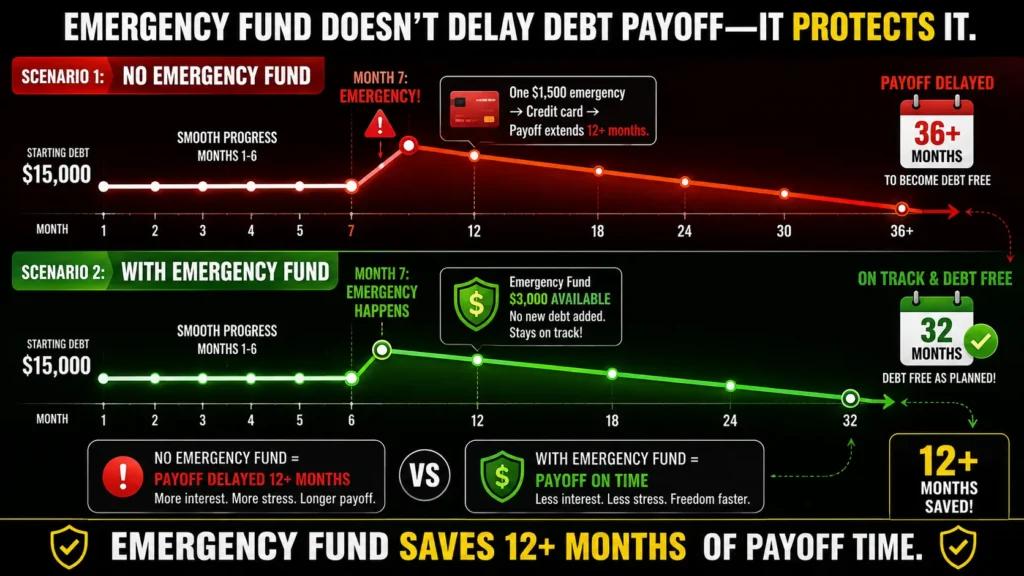
When you have $2,000 saved and an emergency hits, you don’t use a credit card. You use savings.
This prevents the “emergency debt spiral” that resets your payoff timeline.
The math of protection:
- Without savings: Emergency → Credit card → Debt increases → Payoff timeline extends 12+ months
- With savings: Emergency → Use savings → Savings rebuilds → Payoff timeline stays on track
One $1,500 emergency prevented = worth more than any interest rate mathematics.
This is why how to pay off debt and save money together creates financial resilience that 100% debt-focused strategies can’t provide.
The Framework: Calculating Your Optimal Split
Here’s the exact system used by people who actually succeed at both goals.
Step 1: Determine Your Monthly Available Cash Flow
This is money after basic expenses (rent, food, utilities, minimum debt payments).
Example:
- Monthly income: $3,200
- Rent: $1,000
- Utilities: $300
- Food: $400
- Transportation: $200
- Insurance: $150
- Minimum debt payments: $300
- Available for extra debt payoff + savings: $850
This is your total “extra” monthly cash available.
Step 2: Calculate Your Emergency Fund Target
This depends on debt type and life stability:
| Stable job, low debt | 3 months expenses = $3,000-5,000 | Build to this first (6-12 months) |
| Unstable job/income | 6 months expenses = $6,000-10,000 | Build to this before aggressive debt attack |
| High-interest debt (credit cards) | 1 month expenses = $1,500-2,500 | Minimum baseline, then attack debt |
| Medical debt/legal issues | 3 months expenses = $3,000-5,000 | Critical buffer (emergencies likely) |
Reality check: Most people need $2,000-5,000 for true emergency coverage. Not $20,000.
“Not sure what your target should be? Use an emergency fund calculator to determine your specific amount based on your monthly expenses. Most people need $2,000-$5,000 for true emergency coverage
Step 3: Split Your Available Cash Flow
Once you know your emergency fund target, the split becomes clear.
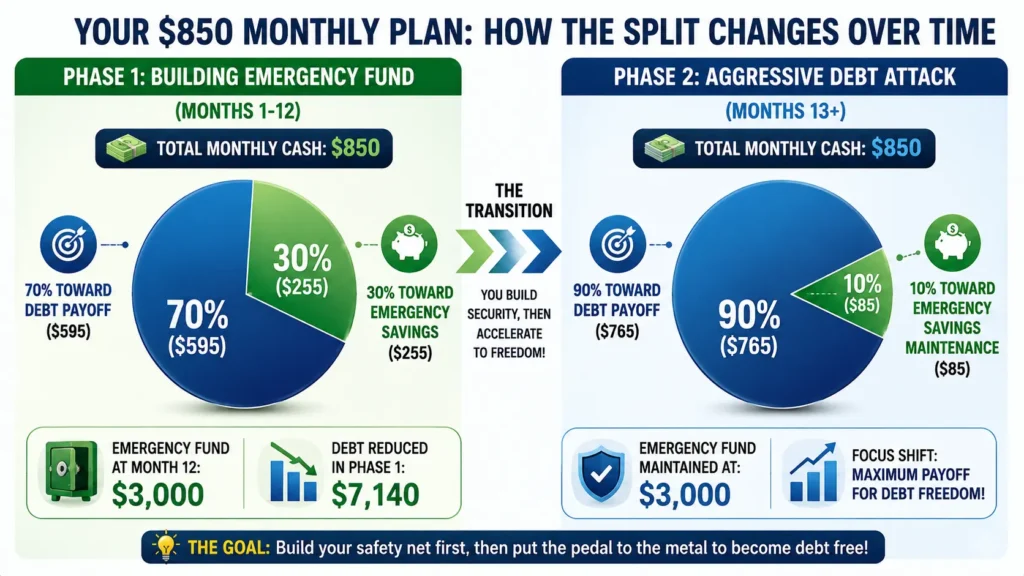
Phase 1: Building Emergency Fund (First 6-12 Months)
If you have $0 emergency savings and $850/month available:
| Target $3,000 emergency fund | $250/month (30%) | $600/month (70%) | 12 months |
| Target $5,000 emergency fund | $400/month (47%) | $450/month (53%) | 12-13 months |
Why this ratio? You need emergency savings fast, but not at the complete expense of debt payoff. 12 months builds meaningful emergency coverage while still attacking high-interest debt.
Example outcome after 12 months:
- Emergency fund built: $3,000 ✓
- High-interest debt reduced: $7,200 payoff ($600 × 12)
- Total progress: Safer + $7,200 closer to freedom
Step 4: After Emergency Fund is Built (Phase 2)
Once you’ve hit your emergency fund target, the split changes dramatically.
Phase 2: Aggressive Debt Attack + Savings Maintenance
Now your $850 available splits differently:
| Maintain $3K emergency fund | $50/month (6%) | $800/month (94%) | Finish debt, keep emergency buffer |
| Maintain $5K emergency fund | $75/month (9%) | $775/month (91%) | Finish debt, strong buffer |
Why this works: You’re not starting from zero on emergency fund. You’re maintaining it ($50-75/month rebuilds anything you use). Meanwhile, 90%+ of your available cash attacks debt aggressively.
Example outcome:
- Months 13-24: $800/month toward debt
- Months 13-24: Maintain $3,000 emergency fund
- At month 24: Emergency fund intact, debt significantly reduced
The Real-World Case Study: How It Looks in Practice
Theory is nice. Here’s how actual people execute this.
Sarah’s Situation
- Income: $3,200/month
- Rent: $1,200
- Utilities: $300
- Food: $400
- Transportation: $250
- Insurance: $150
- Minimum debt payments: $300
- High-interest debt: $15,000 (credit cards)
Available monthly: $600
Sarah’s 24-Month Plan
Months 1-10: Build Emergency Fund
- Save: $200/month ($2,000 emergency fund target reached by month 10)
- Extra debt payoff: $400/month
- Total debt paid: $4,000
Months 11-24: Aggressive Debt Attack + Maintenance
- Save: $50/month (maintain $2,000 emergency fund)
- Extra debt payoff: $550/month
- Total debt paid: $6,600 (months 11-24)
Outcome at Month 24:
- Emergency fund: $2,000 ✓ (intact)
- High-interest debt reduced: $10,600 ($4,000 + $6,600)
- Remaining credit card debt: $4,400
- Months to finish: 8 more months at $550/month
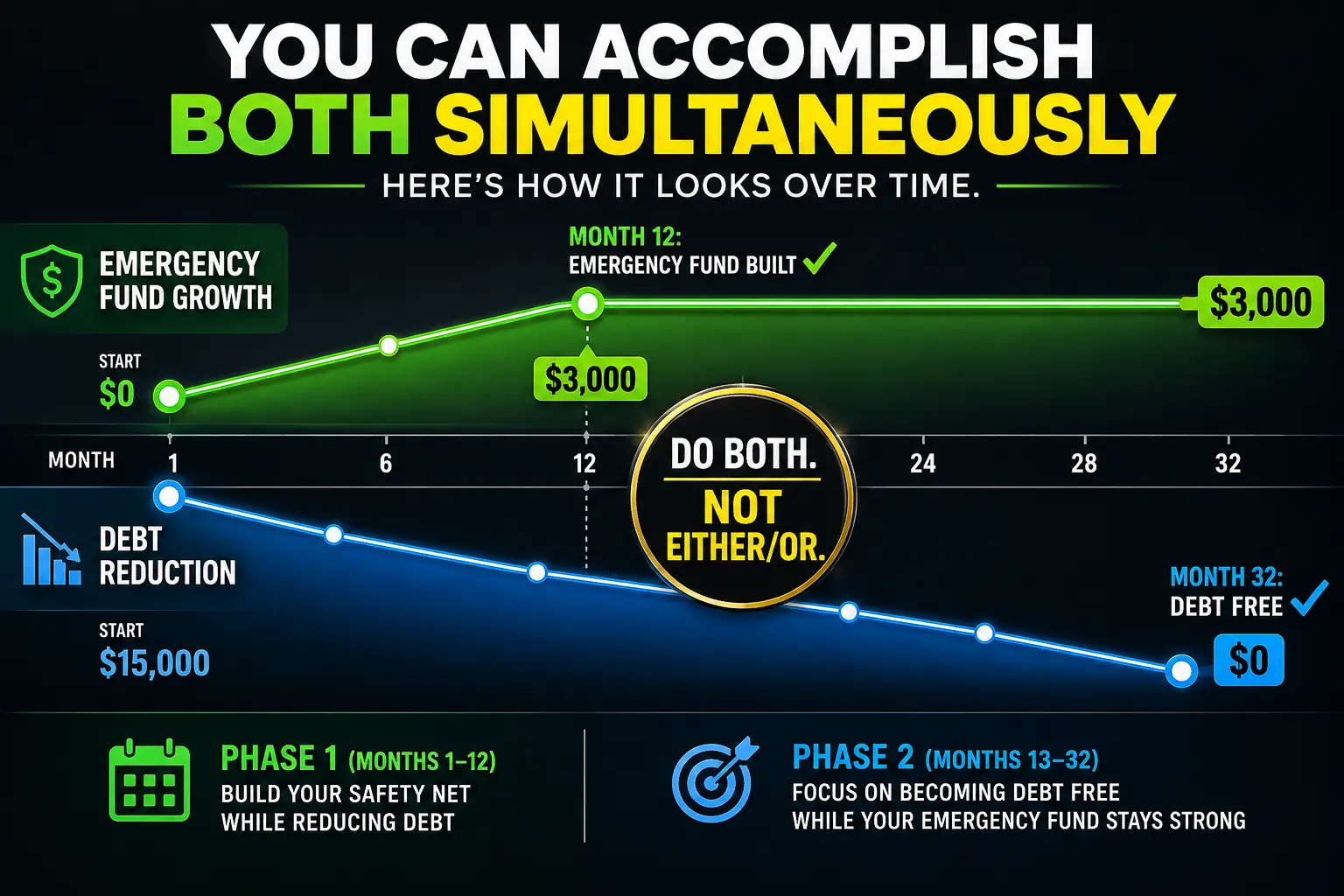
Total payoff timeline: 32 months to eliminate credit card debt AND maintain emergency fund.
Compare to “100% debt payoff” approach:
- $600/month toward debt only = 25 months payoff
- But: One $1,500 emergency in month 8 → puts it back on card → extends timeline 4+ months
- Real timeline: 29+ months with emergency setback
- Emergency fund: $0
Sarah’s approach: 32 months but with emergency safety net the entire time.
How to Pay Off Debt and Save Money: The Complete Budget Breakdown
Here’s exactly how to structure your budget to accomplish both goals.
The Three-Bucket Model
Bucket 1: Essential Expenses (Must Pay)
- Rent/Mortgage
- Utilities
- Food
- Transportation
- Insurance
- Minimum debt payments
Bucket 2: Emergency Savings (Conditional)
- Build until you hit your target ($2,000-5,000)
- Then maintain monthly ($50-100)
Bucket 3: Aggressive Debt Payoff (What’s Left)
Everything remaining after Buckets 1 & 2
This framework comes from standard debt management practices endorsed by financial authorities. For detailed guidance on structuring your budget during debt payoff, the CFPB provides resources on budgeting strategies.
Monthly Budget Example ($3,500 Income)
| BUCKET 1: Essential | — | — |
| Rent | $1,200 | Fixed |
| Utilities | $300 | Fixed |
| Food | $400 | Fixed |
| Transportation | $250 | Fixed |
| Insurance | $150 | Fixed |
| Minimum debt payments | $300 | Fixed |
| Total Essential | $2,600 | — |
| BUCKET 2: Emergency Savings | $250 | While building fund |
| BUCKET 3: Aggressive Debt | $650 | Remaining balance |
| Total Outflow | $3,500 | — |
This structure ensures:
✅ All necessities covered
✅ Emergency fund building simultaneously
✅ Aggressive debt attack happening
✅ No “all or nothing” mentality
Common Mistakes: Where People Fail at Doing Both
Even with the right formula, people sabotage themselves.
Mistake 1: “Savings is Optional” Mentality
You decide the emergency fund can wait until the debt is gone.
Result: Month 6, $400 emergency. You put it on credit card. Debt increases. Motivation dies. Timeline extends 12+ months.
Prevention: Treat emergency savings like a mandatory expense. Non-negotiable.
Mistake 2: Splitting 50/50
You decide “I’ll put half toward savings, half toward debt” to be “balanced.”
Result: $300/month to debt means 50-month payoff on $15,000 debt (4+ years). Motivation dies from glacial progress. You abandon debt focus.
Prevention: Front-load emergency fund building (30% savings, 70% debt) for first 6-12 months, then flip it (6% savings maintenance, 94% debt).
Mistake 3: Touching Emergency Fund for Non-Emergencies
You build $3,000 emergency fund, then use it for:
- Vacation ($800)
- New laptop ($500)
- Dining out ($200)
Result: Emergency fund erodes. One real emergency comes up. Back to credit cards. Debt payoff stalls.
Prevention: Define “emergency” strictly: medical, vehicle repair, job loss only. Everything else is lifestyle, not emergency.
Mistake 4: Counting Savings “Interest” Toward Debt Payoff
“My savings is earning 4% interest, so I don’t need to pay extra toward debt.”
Result: Debt costs 22% (credit card), savings earns 4%. You’re losing 18% per dollar sitting in this strategy.
Prevention: Savings and debt payoff are separate goals. They’re not offsetting each other. Build emergency fund regardless of interest rate difference.
Keeping Motivation Over 24+ Months
How to pay off debt and save money simultaneously requires more than math—it requires understanding motivation.
Track Multiple Win Streams
Don’t track one number (total debt). Track three:
- Emergency fund balance ($2,000 → $3,000 → maintained)
- High-interest debt reduction ($15,000 → $10,000 → $5,000)
- Payment history improvement (months on-time)
Why this works: Three improving numbers keep you motivated when any one number stalls.
The Milestone Moment
The biggest psychological win happens at month 12 when you say: “I have $3,000 saved AND I’ve paid $4,800 toward debt.”
Most “debt-only” approaches at month 12 say: “I’ve paid $7,200 toward debt” (higher number, but no emergency safety net).
The psychology: Having both goals accomplished feels better than maximizing one. You feel solid, not sacrificed.
Specific Scenarios: Customize to Your Situation
Different situations require different splits.
Scenario 1: High-Income, Stable Job, Low Debt
- Income: $5,000/month
- Debt: $10,000 credit cards
- Job security: Very high
Recommended split:
- Months 1-6: $300 savings, $1,200 debt ($10,000 becomes $2,800)
- Months 7-12: $100 savings, $1,400 debt (remaining $2,800 eliminated)
- Result: Debt paid off, emergency fund built, psychological wins throughout
Scenario 2: Lower Income, Unstable Job, High Debt
- Income: $2,800/month
- Debt: $25,000 across multiple cards
- Job security: Moderate (contract work)
Recommended split:
- Months 1-12: $300 savings, $350 debt ($4,200 debt payoff)
- Months 13-24: $150 savings, $500 debt ($6,000 debt payoff)
- Months 25+: $100 savings, $550 debt (accelerate)
- Result: Stronger emergency fund given job instability, sustainable debt timeline
Scenario 3: Student Loans + Credit Cards
- Income: $3,500/month
- Credit card debt: $12,000 (22% APR)
- Student loans: $35,000 (5% APR, income-driven plan)
Recommended split:
- Focus emergency fund + credit card payoff (high interest)
- Student loans: Income-driven plan only ($200/month automatic)
- Months 1-12: $250 savings, $600 credit card payoff
- Months 13-24: $100 savings, $750 credit card payoff
- Result: Credit cards eliminated, emergency fund solid, student loans manageable
Disclaimer: This article is educational content about debt payoff and savings strategies. It is not personalized financial advice. Individual circumstances vary significantly based on income stability, debt type, interest rates, living expenses, and life situations. Before implementing any debt payoff strategy, consult a licensed financial advisor or credit counselor who can evaluate your specific situation. Emergency fund targets and savings rates discussed reflect general recommendations; your appropriate amounts may differ. All income and expense figures are illustrative examples. 2024 Federal Reserve and economic data reflected here may change; verify current information before decisions.
Conclusion
How to pay off debt and save money simultaneously isn’t an either/or choice. It’s a sequence: build emergency fund while attacking debt, then maintain that fund while aggressively finishing debt. This approach eliminates the “emergency debt spiral” that destroys 100%-debt-focused strategies, maintains motivation through multiple win streams, and builds financial resilience that lasts beyond debt payoff.
Most people fail at this balance not because it’s mathematically impossible—it’s not—but because they think they have to choose. They don’t. The key is accepting that phase one (building emergency fund + attacking debt) takes slightly longer than pure debt payoff, but phase two (aggressive finish line with safety net) gets you to actual freedom faster and more sustainably.
Your next step: Calculate your current available cash flow, determine your emergency fund target based on your job stability, and implement the Phase 1/Phase 2 split this month. Start with $150-300 toward emergency savings and the rest toward debt. Once you’ve hit your emergency fund target (6-12 months), flip the ratio and watch your debt payoff accelerate while your safety net stays intact.
Want to see how this debt payoff approach fits into a larger financial strategy? Check out our complete guide on how to pay off debt fast with low income, which shows where emergency savings fit in your priority hierarchy, or explore building your credit score while paying off debt to understand how this dual approach affects your long-term financial recovery.
Freedom isn’t choosing between debt payoff and savings. It’s doing both, wisely.
FAQ SECTION
Q1: Can you really pay off debt and save money at the same time?
Yes, absolutely. But most guides oversimplify by saying “100% debt first, then save.” That’s mathematically optimal but practically disastrous because one emergency derails everything. The sustainable approach: split your available cash flow 70-80% toward debt payoff and 20-30% toward emergency savings for the first 6-12 months while building a $2,000-3,000 emergency fund. Once built, flip the split to 90%+ debt/10% savings maintenance. This prevents the emergency spiral that kills single-focus strategies while maintaining aggressive debt payoff.
Q2: What’s the minimum emergency fund needed to start aggressive debt payoff?
$1,500-2,000 minimum for people with stable employment and no dependents. $3,000-5,000 if you have job instability, dependents, or high medical risk. The target: enough to cover a $1,200 car repair or medical bill without borrowing or credit cards. You don’t need $20,000—that delays debt payoff unnecessarily. The 80/20 rule applies: $2,000-3,000 handles 80% of common emergencies.
Q3: Should I save money or pay off debt first?
Neither exclusively. Build a minimal emergency fund ($1,500-2,000) first if you have zero savings, then split your available cash 70% debt/30% savings until you reach a fuller fund ($3,000-5,000), then flip to 90% debt/10% savings. This sequence prevents emergencies from becoming credit card disasters while still attacking high-interest debt aggressively. Pure “save first” is slow; pure “debt first without savings” is risky.
Q4: How do you stay motivated saving AND paying debt for 24+ months?
Track multiple progress streams instead of just one number. Monitor: (1) Emergency fund growing, (2) Debt shrinking, (3) Payment history improving (on-time payments). Celebrate monthly wins on all three fronts. This psychological split keeps motivation alive where single-focus approaches (debt-only) burn out by month 4-6 because progress feels invisible. Seeing your emergency fund grow while debt shrinks feels like compounding wins.
Q5: What if an emergency depletes my emergency fund mid-payoff?
Pause extra debt payoff temporarily (cut it to minimum) and rebuild emergency fund for 6-8 months at accelerated rate ($300-400/month). Once refilled to $2,000-3,000, resume aggressive debt payoff. This is precisely why emergency fund matters—it prevents emergencies from triggering the “credit card spiral” that extends your entire payoff timeline 12+ months. One emergency with no fund costs you more in extended payoff than the slower build-fund timeline.
Q6: What’s the “best” percentage split between savings and emergency fund?
Phase 1 (building emergency fund): 70% debt/30% savings while building to $3,000 (takes 6-12 months depending on available cash). Phase 2 (maintaining fund): 90% debt/10% savings once emergency fund is built. This ratio balances building crucial emergency cushion while maintaining aggressive debt elimination. Adjust if your job is very unstable (more savings %) or if your debt is high-interest (more debt %).

Financial enthusiast with 5 years of experience in the US market trends and personal wealth management