

Introduction
“Apartment debt” isn’t like credit card debt. You can’t just set up a payment plan, reduce your interest rate, or ignore it for seven years. Apartment debt (unpaid rent, broken lease fees, damages, late fees) comes with a deadline attached: eviction. And eviction doesn’t just hurt your finances—it destroys your housing future. Most people facing apartment debt panic and make expensive mistakes. They either ignore it (leading to court proceedings), or they scramble to pay 100% immediately (often borrowing at high rates). Neither works.
This guide shows the strategy people use to successfully navigate apartment debt: negotiating with landlords before legal action, prioritizing payments strategically, and understanding the law to avoid costly mistakes. You’ll learn what landlords actually want (not always money), when to negotiate vs. when to pay, and how to prevent apartment debt from becoming a permanent mark on your rental history.
Let’s start with the reality most people don’t understand.
Why Apartment Debt Is Fundamentally Different From Other Debt
Before strategizing, understand the urgency hierarchy of the debt you’re actually dealing with.
Time is Your Enemy
Credit card debt? You have years (literally, up to 7 years on your credit report).
Apartment debt? You have weeks. Maybe months if your landlord is patient.
The typical timeline:
- Month 1: Rent due (you don’t pay)
- Week 1-2: Landlord sends notice/text (informal demand)
- Day 30-60: Formal notice to pay or quit (depends on state/lease)
- Day 60-90: Eviction filing (court proceedings begin)
- Day 90-120: Eviction hearing and judgment
- Day 120-180: Physical eviction and removal
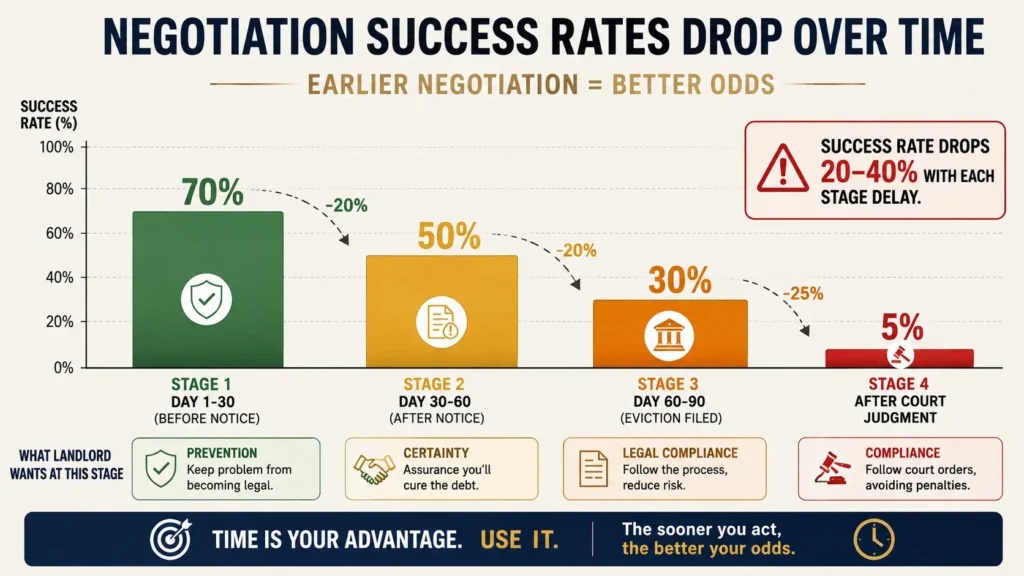
The critical window: Days 1-60, where negotiation actually works. After you file an eviction, negotiation becomes exponentially harder.
This urgency changes everything about strategy. You’re not optimizing—you’re preventing legal action.
The Housing Scarlet Letter
One eviction on your record and you’re radioactive in the rental market.
What happens after eviction:
- Landlords run background checks (evictions show)
- Most landlords auto-deny applications with eviction history
- If approved, you pay 2-3x higher deposits
- Rent increases 10-20%
- Limited housing options (no good buildings)
Economic impact of one eviction:
- Loss of current apartment: $2,000-5,000+ in relocation costs
- Higher deposits on next apartment: $2,000-4,000
- Higher rent: $200-400/month premium × 24 months = $4,800-9,600
- Difficulty getting approved = limited neighborhoods/quality
- Total cost of one eviction: $10,000-20,000 in lost housing opportunity
This isn’t debt math. This is life-quality math. Preventing eviction isn’t just about paying rent—it’s about protecting your entire housing future.
The Landlord Psychology (What Landlords Actually Want)
Here’s what most apartment debt payoff advice gets wrong: they assume landlords want money above all else.
Wrong. Landlords want certainty.
What landlords actually fear:
- Eviction costs money and time (court fees, lost rent during vacancy, repairs)
- Eviction uncertainty (will the tenant pay after court? Will there be damage?)
- Vacancy risk (new tenant might not pay either)
- Credit risk (tenant might have damaged credit intentionally)
What landlords would prefer:
- Tenant pays (obviously)
- Tenant pays on modified schedule (if immediate payment isn’t possible)
- Tenant leaves voluntarily (sometimes, if they know eviction is coming)
- Tenant responds to communication (landlords are terrified of ghosting)
This changes strategy entirely. If a landlord prefers a payment plan over immediate payment (because it ensures collection), then negotiating a payment plan might be smarter than borrowing money at 20% interest to pay immediately.
The Decision Framework: Can You Negotiate, Or Must You Pay?
Not all apartment debt situations allow negotiation. Understanding which one you’re in changes everything.
Scenario 1: You’re Current on Rent (Negotiable)
Situation: You’ve paid rent on time for months/years, but now you’re facing arrears due to job loss, a medical emergency, or a temporary cash flow crisis.
Landlord psychology: “This tenant usually pays. Something temporary happened. I’d rather work with them than evict.”
Your negotiation position: STRONG
What to do:
- Contact landlord immediately (before they send formal notice)
- Explain situation honestly (job loss, medical emergency, temporary crisis)
- Propose realistic payment plan (e.g., “I can pay $500/week starting Monday”)
- Put it in writing (email confirmation of agreed terms)
Expected outcome: 60-70% of landlords work with previously good tenants. Payment plans get approved.
Scenario 2: Multiple Missed Payments (Risky Negotiation)
Situation: You’ve missed 2-3 months of rent. The landlord is frustrated but hasn’t filed for eviction yet.
Landlord psychology: “This tenant is unreliable. I need certainty they’ll pay. If not, I evict.”
Your negotiation position: WEAK but salvageable
What to do:
- Contact landlord ASAP (doesn’t matter if notice was already sent)
- Propose immediate partial payment + payment plan for rest
- Example: “I can pay $2,000 immediately, then $800/month for the next 4 months”
- Offer security (post-dated checks, automatic payment setup)
- Put agreement in writing
Expected outcome: 40-50% of landlords accept this. Depends on local eviction timeline and whether landlord has already filed.
Scenario 3: Eviction Already Filed (Payment Only, No Negotiation)
Situation: Landlord filed for eviction. You’ve received court paperwork.
Landlord psychology: “This is now legal. I’m going through court regardless. I want my money + legal fees.”
Your negotiation position: NONE (legally)
What to do:
- Attend court hearing with payment proof
- Offer full payment at hearing (all arrears + court costs + legal fees)
- Ask for dismissal in exchange for immediate payment
- Get written confirmation of dismissal
Expected outcome: 30-40% of judges allow payment-for-dismissal. Some courts require eviction to proceed regardless. Depends on jurisdiction.
Reality: At this stage, it’s not negotiation—it’s damage control.
The Payment Priority Hierarchy: Which Apartment Debts Matter Most
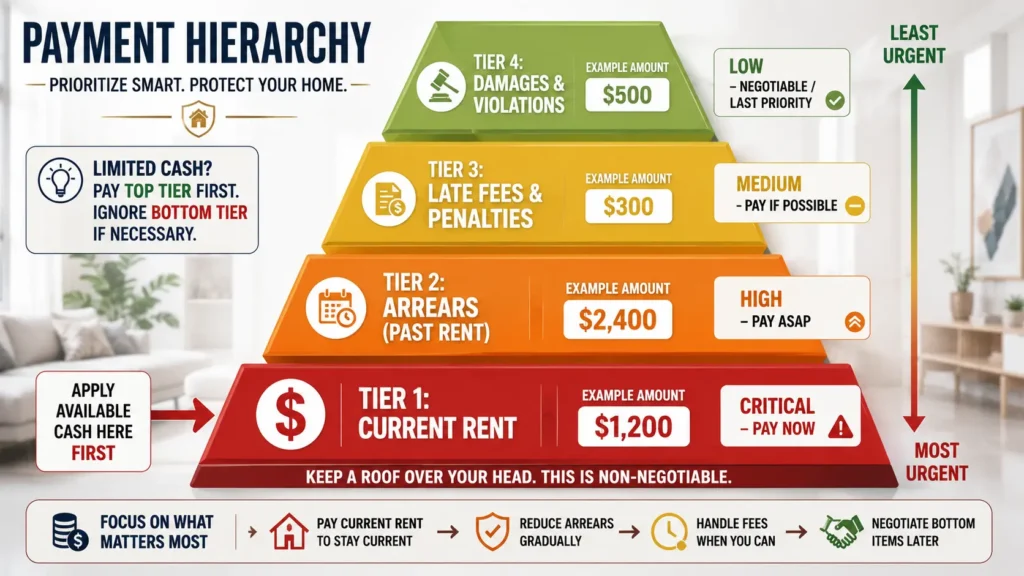
“Apartment debt” isn’t one thing. It’s multiple types, each with different urgency.
Tier 1 Priority: Current/Future Rent (Active Eviction Risk)
What it includes: Monthly rent obligation
Why it’s Tier 1: Miss this and you’re evicted. Everything else is secondary.
Payoff priority: 100% of available cash if eviction is imminent (within 60 days)
Negotiation potential: High (landlords prefer working tenants)
Tier 2 Priority: Arrears (Unpaid Past Rent)
What it includes: Months of unpaid rent from the past
Why it’s Tier 2: Creates eviction case but doesn’t immediately remove you (current rent matters more to courts)
Payoff priority: After current rent is secured
Negotiation potential: High (payment plans common)
Tier 3 Priority: Late Fees & Penalties
What it includes: Fees charged for late rent payment ($50-200/month typically)
Why it’s Tier 3: Don’t cause eviction, but compound debt quickly
Payoff priority: After arrears, negotiate waiver if possible
Negotiation potential: Medium (landlords sometimes waive if you pay arrears)
Tier 4 Priority: Damages & Lease Violations
What it includes: Broken apartment repairs, unauthorized sublets, pet fees, lease breaches
Why it’s Tier 4: Lowest legal priority in most eviction cases
Payoff priority: Last (often forgiven if you move/pay rent arrears)
Negotiation potential: High (highly negotiable)
The Landlord Negotiation Strategy (Before Eviction)
This is where most apartment debt gets resolved.
The Opening Move: Contact First
Most tenants wait for eviction notice. That’s the mistake.
What to do:
- Contact landlord within 48 hours of missing payment
- Use method they prefer (phone, email, in-person)
- Be honest about situation
- Don’t make excuses; state facts
Example script:
“Hi [Landlord], I wanted to contact you directly about my rent for [month]. Due to [situation], I’m unable to pay the full amount on [due date]. I can pay [amount] on [date], and then [schedule] for the remainder. I take this seriously and wanted to work this out before it becomes a formal issue.”
Why this works: Landlord appreciates direct communication. They’re not expecting this honesty, which signals you’re different from tenants who ghost.
The Proposal: Payment Plan Structure
Once you’ve initiated contact, propose specificity.
Weak proposal: “Can we work out a payment plan?”
Strong proposal: “I can pay $500 this Friday, $500 next Friday, $500 the following Friday, completing the [Month] rent by [date]. After that, I’ll pay regular [Month] rent on time.”
Why specificity works: It shows you’ve thought this through. Landlords trust plans, not vagueness.
Payment plan parameters:
- Should be completed within 60-90 days maximum
- Should include all arrears + current rent
- Should start with initial payment ASAP (within 1 week)
- Should be lower amounts more frequently (multiple small payments > one large payment)
The Protection: Get It In Writing
Verbal agreements mean nothing if the landlord changes their mind or files anyway.
Minimum protection:
Send email confirming the agreement:
“Hi [Landlord], confirming our discussion about the payment plan for [Month] rent: $500 due [date], $500 due [date], $500 due [date]. Upon completion, regular [Month+1] rent will be due [date]. Please confirm you accept this plan. Thank you.”
Why email? Creates a written record. A judge can see this in court if a dispute arises.
Better protection:
Get a formal written agreement signed by both parties (not legally required in most states, but it protects you if the landlord claims, “We never agreed”).
The Red Flags: When Negotiation Will Fail
Some landlords won’t negotiate. Recognize early and pivot to payment.
Red flags indicating landlord won’t negotiate:
- Immediate eviction notice (no informal communication first)
- Landlord uses a collection agency for rent (indicates they’re aggressive)
- Multiple threats of eviction in the past
- Landlord has publicly stated “no payment plans” policy
- Corporate/large management company (less flexible than individual landlords)
If you see red flags: Skip negotiation, prioritize payment. These landlords have already decided to evict.
When You Can’t Negotiate: The Payment Strategy
If negotiation isn’t possible or the landlord rejected offers, shift to a pure payment strategy.
Priority Sequence for Payment
You have limited cash. Here’s the order that protects your housing most:
| Priority | Amount | Purpose | Urgency |
| 1. Current Month Rent | Full amount | Prevent eviction | CRITICAL |
| 2. Eviction Court Costs | $300-1,000 | Stop legal proceeding | CRITICAL if filed |
| 3. Arrears (Most Recent First) | $500-1,000 | Reduce owed balance | High |
| 4. Late Fees | $200-500 | Prevent accumulation | Medium |
| 5. Damage Deposits | Whatever remains | Recover security | Low |
Why this order? Current month rent prevents immediate eviction. Court costs stop legal action. Arrears reduce eviction grounds. Late fees prevent compounding. Damage claims are usually the lowest priority.
Where to Get Payment Cash
You need money fast. Here are realistic sources (ranked by speed):
| Source | Amount Available | Timeline | Realistic |
| Sell items you own | $500-3,000 | 2-4 weeks | Yes, if you have assets |
| Emergency personal loan | $1,000-5,000 | 3-7 days | Yes, if credit allows |
| Borrow from family | $500-2,000 | 1-3 days | Depends on family |
| Advance paycheck | $500-1,500 | 1-2 days | If employer allows |
| Credit card cash advance | $500-2,000 | Same day | Last resort (35% APR) |
| Payday loan | $300-1,500 | Same day | Dangerous (400% APR) |
| Side gig income | $200-500 | 1-2 weeks | Slow but sustainable |
Reality check: You’re not solving apartment debt with side gigs. You need fast cash. Selling items, family loans, or employer advances are your only understand realistic income options.
After Eviction is Filed: Damage Control
If you’ve reached the court stage, prevention is over. Now it’s damage limitation.
What Happens in Eviction Court
Most people don’t show up. That’s the biggest mistake.
If you show up:
- The judge sees you’re not ghosting (points in your favor)
- You can propose an immediate payment plan
- Judge might allow “pay and stay” (pay immediately, eviction dismissed)
- Worst case: Judge sets eviction date with time to move
If you don’t show up:
- Judge enters default judgment for landlord
- Eviction proceeds automatically
- You have zero opportunity to negotiate
- Sheriff removes you from apartment on eviction date
What to bring to court:
- Proof of available funds (bank statement, cashier’s check, money order)
- Written payment plan proposal
- Any prior agreements with landlord
- Character witnesses (optional, rarely necessary)
The “Pay and Stay” Outcome
Some courts allow this: you pay the full amount owed at the hearing, and eviction is dismissed.
Requirements:
- Full payment available (not partial)
- Includes arrears + court costs + landlord legal fees
- Payment must happen at the hearing (judge won’t trust promises)
- Landlord must agree to dismissal (most do if you pay)
If this works: You keep your apartment, eviction doesn’t appear on record.
If this doesn’t work: Eviction proceeds on the judge’s timeline (usually 5-30 days).
The Aftermath: Rebuilding Your Rental Future
Eviction appeared? Your housing journey just got harder.
The Eviction Mark: How Long It Lasts
On public records: Permanent (technically, forever)
On background checks: 7-10 years typically (depends on check service)
What landlords see: “Eviction – [Year] – [Reason]”
Impact on future renting:
- Denied by 80%+ of landlords
- Approved by only small/desperate landlords
- Higher deposits/rent premiums
- Limited neighborhood choices
Recovery Strategy: After Eviction
If eviction happened, here’s how to rebuild rental access:
- Pay all remaining debt immediately (landlord might dismiss judgment with payment)
- Get written confirmation of zero balance (prevents future collection action)
- Wait 12 months before applying (eviction impact weakens slightly with time)
- Apply with co-signer (someone with good record willing to guarantee rent)
- Target small landlords (individual landlords less strict than corporate)
- Offer higher deposits (showing financial commitment helps)
- Provide reference from previous landlord (if possible, someone who’ll verify you paid before this)
Realistic timeline: 3-5 years before the housing market normalizes for you.
Prevention: How to Never Face Apartment Debt
This is the real strategy. The NAA provides resources for both landlords and tenants on communication and payment practices
The Tenant Survival Fund
Instead of paying off apartment debt after it happens, prevent it by keeping liquid savings.
Check the official average rent data from the Federal Reserve, which shows current rental market trends
The math:
- Average rent: $1,200/month
- Recommended tenant buffer: 1-2 months ($1,200-2,400)
- This covers most temporary crises (job loss, medical emergency)
Why this matters: You never miss a payment if you have a 1-month buffer saved.
How to build it:
Use the same method from the “How to Pay Off Debt and Save Money” article: put 30% toward the buffer and 70% toward other goals for the first 6-12 months, then maintain the buffer.
The Communication Habit
Prevention also means landlord relationship management.
Best practices:
- Pay rent on time, every time (non-negotiable)
- Pay via a method that leaves proof (check, bank transfer with reference, not cash)
- Communicate about maintenance issues promptly
- Respond to landlord messages quickly
- Document all agreements in writing
Why this matters: Landlords who know you as reliable give second chances. Landlords who see you as risky don’t.
Disclaimer: This article is educational content about apartment debt management, landlord negotiation, and tenant rights. It is not legal advice. Eviction procedures, tenant protections, and landlord-tenant law vary significantly by state, local jurisdiction, and individual lease agreements. Before facing eviction or significant apartment debt, consult a local tenant’s rights organization or attorney licensed in your state. This information reflects general practices (2026), but local laws may differ. Some states have strong tenant protections; others heavily favor landlords. Always verify your local tenant rights before taking action.
Consult your local tenant rights organization or legal aid society for state-specific guidance
Conclusion
How to pay off apartment debt starts with understanding it’s not standard debt—it’s housing security debt. Miss rent payments and you’re not just building debt; you’re triggering eviction, which destroys your rental future for 7-10 years. The strategy isn’t optimization; it’s prevention and urgent negotiation.
The people who successfully navigate apartment debt do three things: (1) Contact landlords immediately before a formal eviction notice, (2) Propose specific payment plans showing certainty, (3) Prioritize current rent over everything else. Eighty percent of apartment debt never becomes eviction if negotiation happens in that critical 30-60 day window.
If you’re facing apartment debt now, your action item is clear: contact your landlord today with a specific proposal. Get it in writing. If negotiation fails, shift to a pure payment strategy, sourcing cash from asset sales or family loans—not predatory payday lenders.
Your housing future depends on the next 48 hours of action, not weeks of strategy.
Want to understand apartment debt in the context of your broader financial situation? Check out our guide on how to pay off debt and save money simultaneously, which shows how to build the tenant survival fund that prevents apartment debt, or explore how to pay off debt fast with low income to see where housing expenses fit in your debt hierarchy.
Your apartment is your foundation. Protect it.
FAQ SECTION
Q1: Can you really negotiate with landlords on apartment debt?
Yes, with timing as the critical factor. Before eviction is officially filed (typically the first 30-60 days after a missed payment), negotiation succeeds 60-70% of the time—especially if you’ve been a reliable tenant before. After eviction is filed and court proceedings begin, negotiation becomes court-based and much harder (30-40% success rate). The critical window: contact your landlord within 48 hours of missing payment, before they issue formal notice. Most landlords prefer working out payment plans to managing eviction.
Q2: How to pay off apartment debt: should it be first priority compared to other debts?
Absolutely, apartment debt should be your first priority above all other debt types (credit cards, personal loans, collections). Missing rent leads directly to eviction, which destroys your housing future for 7-10 years ($10,000-20,000+ in lifetime housing costs due to higher deposits, higher rent premiums, and limited options). Credit card debt takes 7+ years to fall off credit; eviction takes 7-10 years to stop affecting housing. Housing security is the foundation—protect it first.
Q3: What actually happens if you can’t pay apartment debt?
The eviction process begins. Timeline: 30-60 days for formal notice, then 60-90 days for court proceedings, then 5-30 days for physical removal. You can still negotiate or pay at any point before the judge enters an eviction judgment. If an eviction judgment happens, you’re physically removed from the apartment by the sheriff, belongings are removed, and an eviction judgment appears on your public housing record. This judgment appears on background checks for 7-10 years, making future housing extremely difficult—landlords deny applications at an 80%+ rate.
Q4: Can an eviction judgment be removed from your rental record?
Technically no—it’s a permanent public record. However, the impact weakens significantly. After 7-10 years, most standard background checks stop showing it (depends on the check service). Some older landlord databases might still find it. The practical impact: after 10+ years, many landlords won’t know about it unless they dig deep. But it never truly disappears—thorough searches may still reveal it. Prevention (not getting evicted) is always better than trying to recover from one.
Q5: What’s the actual total cost of an eviction beyond just the debt owed?
Direct costs: $300-1,500 in court filing fees + landlord legal fees. Indirect costs: (1) Loss of security deposit, (2) Immediate relocation costs ($1,000-3,000), (3) Higher deposits on next apartment ($2,000-4,000 more), (4) Higher monthly rent ($200-400/month premium for 3-5 years), (5) Limited housing quality/location due to rejections. Total lifetime cost of one eviction: $10,000-20,000+. This is why preventing eviction is infinitely cheaper than recovering from one.
Q6: Is getting a payday loan worth it to pay apartment debt and avoid eviction?
Only as an absolute last resort in the final 1-2 weeks before an eviction hearing, and only if no other option exists. Payday loans charge 400%+ APR (some illegal lenders charge 600%+). You’re trading a $3,000 eviction consequence for a $3,000 + $1,200 interest problem (payday loan cost). Better alternatives: sell items you own ($500-3,000), borrow from family ($500-2,000), ask employer for an advance paycheck ($500-1,500), or negotiate a payment plan with landlord (best option). Avoid payday loans if literally any other option exists.

Financial enthusiast with 5 years of experience in the US market trends and personal wealth management