
Introduction
Most people asking “how to pay off student debt fast” are asking the wrong question. The real question is: “Is paying off my student debt fast actually the best financial move?” Here’s the uncomfortable truth: sometimes it’s not. For some borrowers, strategically not paying off their student loans as fast as possible saves more money through forgiveness programs than aggressive payoff ever could. For others, paying fast is the right move. This guide shows you how to identify which camp you’re in and execute the exact strategy that makes sense for your specific situation.
The landscape of student debt has changed. Interest rates are higher, forgiveness program rules have shifted (with Public Service Loan Forgiveness still recovering from the payment pause), and income-driven repayment plans have become sophisticated enough that the math requires actual calculation, not just guesswork. You need clarity on when speed matters and when patience pays better dividends.
Let’s build that clarity.
The Decision Framework (Before You Attack Your Student Debt)
Before learning how to pay off student debt fast, you need to understand whether “fast” is even your goal.
Forgiveness vs. Payoff: The $50,000 Question
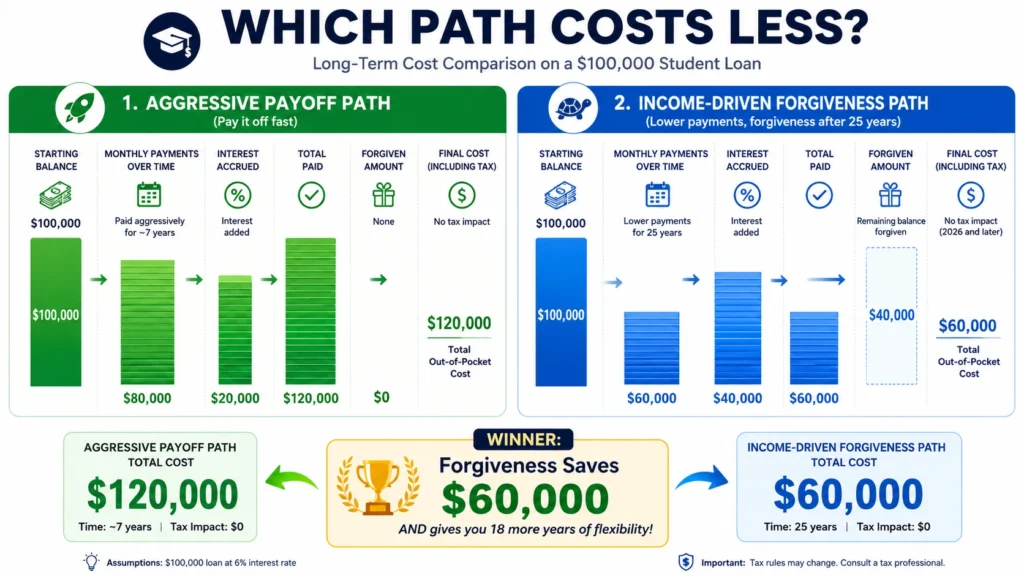
Federal student loans offer forgiveness programs that private loans don’t. If you borrowed $50,000 federally and your goal is payoff speed, you might aggressively eliminate it in 8-10 years. But if you’re on an income-driven repayment plan (IDR), that same $50,000 could be forgiven in 20-25 years with potentially lower total payments.
The math matters: On a $50,000 federal loan at 5% interest:
- Aggressive payoff ($600/month): Paid off in 9 years, $14,000 total interest
- Income-driven plan ($200/month for 25 years): Forgiven after 25 years, $10,000 total payments (forgiven balance = $0 tax impact)
In this scenario, income-driven forgiveness costs you LESS total money, even though it takes longer. But there’s a tax bomb risk: forgiven amounts may be taxable income. That changes the calculation entirely.
The critical insight: How to pay off student debt fast sometimes means not paying it off fast, but strategically positioning yourself for forgiveness while minimizing tax exposure.
Loan Type Analysis: Federal vs. Private vs. Parent PLUS
Not all student loans are the same, and how to pay off student debt fast depends entirely on what type you have.
Federal Loans (Direct Loans, Stafford, PLUS borrowed by you):
- Income-driven repayment plans available
- Forgiveness programs available (20-25 years or PSLF at 10 years)
- Interest rates fixed (5-8%)
- Pause/deferment options available
Private Loans (Sallie Mae, Discover, private lenders):
- No income-driven plans
- No forgiveness programs
- Interest rates variable (6-13%+)
- Deferment limited
- Fewer protections
Parent PLUS Loans (federal, borrowed by parent):
- Income-driven repayment for “Parent PLUS” only if consolidated to Direct Consolidation Loan
- Forgiveness available after consolidation (PAYE plan only)
- Higher interest rates (7-8%)
- Can be discharged in hardship
The implication: Aggressive payoff makes sense for private loans (no other option). Federal loans? You might strategically use forgiveness. Parent PLUS? Consolidation unlocks forgiveness options that change the payoff math entirely.
Income-Driven Repayment Plans: Your Hidden Payoff Lever
This is where most people learning how to pay off student debt fast make expensive mistakes. They ignore income-driven plans because they sound like they’ll take forever. Sometimes that’s true. Sometimes it’s not.
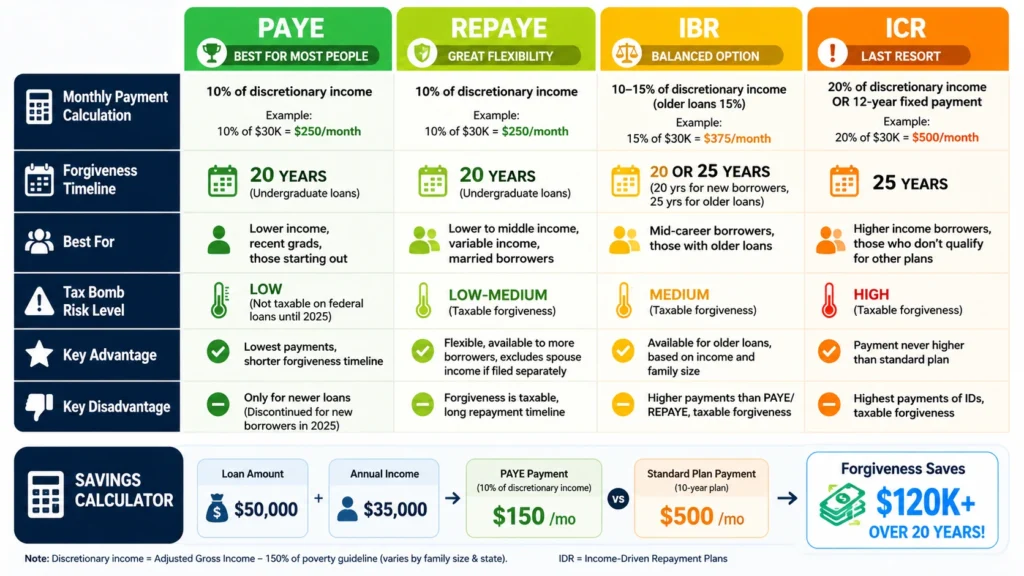
The Four Income-Driven Plans
All four income-driven options are available through Federal Student Aid with detailed calculators and enrollment
| PAYE (Pay As You Earn) | 10% of discretionary income | 20 years | Moderate | Lower-income borrowers, younger loans |
| REPAYE | 10% of discretionary income | 20-25 years depending on loan type | High | Recent graduates, income-driven focus |
| IBR (Income-Based Repayment) | 10-15% of discretionary income | 20-25 years | Moderate | Mid-career, moderate income |
| ICR (Income-Contingent) | 20% of discretionary income | 25 years | Highest | Parent PLUS consolidation, last resort |
The critical comparison: PAYE calculates forgiveness at 20 years. REPAYE extends to 25 years for undergraduate loans but offers lower payments. If you’re low-income and asking how to pay off student debt fast, PAYE’s 20-year forgiveness might actually be faster than aggressive payoff on a 10-year timeline because your payments stay affordable.
The Discretionary Income Loophole
Income-driven repayment plans for low earners calculate payments based on “discretionary income”—typically gross income minus 150% of the poverty line. This creates a legal loophole few people exploit.
Example: You earn $45,000/year. The poverty line is ~$14,580. Discretionary income = $45,000 – ($14,580 × 1.5) = $23,130.
On PAYE, you pay 10% of $23,130 = $2,313/year = $193/month.
But if you marry someone with lower income (or file separately strategically), discretionary income drops, payment drops, and forgiveness accelerates (because unpaid interest capitalizes less).
The reality: Some people learning how to pay off student debt fast actually use income-driven plans to minimize payments, marry strategically, and position for forgiveness. It’s perfectly legal and significantly cheaper than aggressive payoff for some borrowers.
The Aggressive Payoff Path: When Speed Truly Wins
Not everyone should rely on forgiveness. Some situations demand how to pay off student debt fast as the core strategy.
When to Prioritize Speed Over Forgiveness
Private loans: Mandatory. No forgiveness. Only speed matters.
High-income trajectory: If you’re earning $50K now but expect $100K+ in 5 years, aggressive payoff before income rises saves more interest than waiting for forgiveness.
Tax concerns: If forgiveness would create $30,000+ taxable income and you’re concerned about tax liability, paying off avoids the tax bomb entirely.
Psychological factors: Some people sleep better knowing loans are gone. If that’s you, the financial optimization matters less than mental peace.
Short timeline: Loans under $15,000 with high interest rates (private at 10%+) often payoff faster than refinancing or waiting.
The Aggressive Payoff Timeline: How Fast Can You Actually Go?
Using federal loan payoff calculators with realistic income, here are actual timelines:
| $30,000 | 5.5% | $300 | 11 years | $9,900 |
| $30,000 | 5.5% | $500 | 6.5 years | $5,250 |
| $60,000 | 6.2% | $500 | 14 years | $23,800 |
| $60,000 | 6.2% | $800 | 8 years | $12,000 |
The insight: How to pay off student debt fast comes down to payment amount. Doubling payment from $300 to $600 cuts the timeline nearly in half. But this assumes you have the cash flow. Most people don’t, which is why income-driven plans exist.
Refinancing: The Game-Changer for Private Loans
Refinancing is the fastest lever for how to pay off student debt fast—but it’s also where people make expensive mistakes.
Federal Loan Refinancing: When It Makes Sense, When It Doesn’t
The temptation: Refinance federal loans to private lenders at lower rates (5-7% vs. 6-8% federal). You save interest and pay off faster.
The hidden cost: You lose forgiveness programs, income-driven plans, and protections (deferment, hardship discharge). For someone on track for PSLF (Public Service Loan Forgiveness), refinancing is financial suicide.
When federal refinancing makes sense:
- You’re high-income and will never qualify for income-driven forgiveness
- You want to aggressively pay off in 5-7 years
- You’re not pursuing PSLF or other forgiveness
- You’ve ruled out federal deferment (not worried about job loss, disability, etc.)
When it doesn’t:
- You work in public service (military, government, nonprofit) → PSLF saves tens of thousands
- You’re uncertain about income stability → Federal protections matter
- You’re low-income → Income-driven plans are cheaper
- You plan to pursue forgiveness at any point → Irreversible decision
Private Loan Refinancing: Your Only Real Option
Private loans have no forgiveness, so refinancing is purely about interest rate optimization. If you can refinance from 10% to 6%, do it immediately (assuming same timeline or faster).
Realistic rates as of 2026:
- Credit score 750+: 5.5-7.0%
- Credit score 700-749: 6.5-8.0%
- Credit score 650-699: 8.0-10%+
Strategy: Refinance private loans aggressively if your credit score is 700+. If it’s lower, build score first (takes 6-12 months), then refinance.
Strategic Targeting When You Have Multiple Loans
Most people asking how to pay off student debt fast have multiple loans—federal, private, varying rates. Strategy beats brute force.
The Priority Ranking System
Attack in this order:
- Private loans above 8% APR (refinance first, then pay aggressively)
- Parent PLUS loans (consider consolidation to unlock forgiveness, or pay aggressively if not eligible)
- Federal loans you’re NOT pursuing forgiveness for (refinance if rate drops 1%+, then accelerate)
- Federal loans you ARE pursuing forgiveness for (stay in income-driven plan, don’t refinance, minimum payments only)
- Low-rate federal loans (minimum payments, let forgiveness handle the rest)
Example scenario:
You have $80,000 student debt:
- $30,000 private at 9% → Attack first (refinance, then $600/month)
- $20,000 federal PLUS → Consolidate and pay $300/month (forgiveness-eligible after consolidation)
- $30,000 federal Stafford at 5% → Income-driven plan ($150/month, let forgive)
This mixed strategy lets you aggressively attack high-interest private debt while using federal programs strategically for lower-rate federal debt.
Public Service Loan Forgiveness (PSLF)
If you work in public service, PSLF changes how to pay off student debt fast entirely—because sometimes “fast” means “never actually pay it off.”
How PSLF Actually Works
You make 120 qualifying payments (10 years) while working full-time for a qualifying employer (government, military, nonprofit, public school, public hospital, etc.). After 120 payments, remaining balance is forgiven tax-free.
2026 status: After COVID payment pause (Sept 2020-Sept 2023), Public Service Loan Forgiveness has been heavily criticized but remains active. Over 500,000 borrowers have received forgiveness since 2023 revival.
The math:
- Loan balance: $100,000
- Income-driven payment: $250/month
- 10 years total payments: $30,000
- Forgiven balance: $70,000
- Tax impact: $0
Compare to aggressive payoff:
- Same $100,000 loan
- Aggressive payment: $1,000/month
- 10 years total payments: $120,000
- Interest paid: ~$20,000 extra
- Tax impact: $0
The insight: If you qualify for PSLF, asking how to pay off student debt fast is almost wrong—you should be asking how to position for forgiveness, which costs thousands less. But that’s just the financial math. The real game- changer? Your credit score improvement happening simultaneously. While you’re making those $250/month payments, your payment history strengthens, your utilization improves, and your score climbs. By the time forgiveness hits in year 10, you’ll have excellent credit ready for major life purchases.
Want to know the month-by-month credit recovery timeline during PSLF? Our article on how credit improves through PSLF shows exactly when you’ll be mortgage-ready, when refinancing makes sense, and how the 10-year strategy compounds beyond just loan forgiveness into complete financial transformation.
The PSLF Eligibility Trap
Not every public service job qualifies. Examples:
Qualifying employers: USDA, HHS, VA, Department of Education, military, police, fire, public school teachers, nonprofit hospitals, nonprofit advocacy organizations.
NOT qualifying: Private contractors working for government, private school teachers, political organizations, unions (often), some nonprofits (must be 501(c)(3)).
The mistake: People assume they qualify, make 60 payments, and then discover they don’t. Verify PSLF eligibility through Federal Student Aid’s official PSLF resources and employment certification tool.
Why Most People Fail at How to Pay Off Student Debt Fast
The biggest barrier to aggressive payoff isn’t math—it’s psychology.
The Payment Fatigue Factor
Paying $600-800/month toward student debt for 8-10 years is brutal. After year 3, motivation evaporates. People start skipping payments, postponing extra payments, or abandoning the goal entirely.
The solution: Set up automatic payments at whatever aggressive level you choose, then forget it exists. Automate it out of your paycheck. You can’t lose motivation toward a goal you’re not consciously tracking daily.
The Inflation Trap
You commit to $600/month payoff at age 25. Great. At age 35, after job changes, life expenses, and lifestyle inflation, that $600/month feels impossible. You didn’t fail—your plan didn’t account for real life.
Better approach: Commit to paying 20% of annual income increase toward student debt. Income goes up $5,000? Put $1,000 toward loans. This scales automatically with your life without creating rigid constraints.
The Opportunity Cost Question
$600/month toward student debt = $600 not going toward retirement, home down payment, or emergency fund. How to pay off student debt fast sometimes means slower wealth building overall.
Critical consideration: If you could earn 8% return in retirement accounts and your student loan is 5%, mathematically you should prioritize retirement. But psychology often demands the debt gone first (which is valid—mental peace has value).
Disclaimer: This article is educational content about student loan repayment strategies, forgiveness programs, and refinancing options. It is not legal or financial advice. Student loan repayment decisions depend on individual circumstances, loan types, employment situation, tax status, and income. Before making major decisions about student debt (refinancing, PSLF pursuit, income-driven plan selection), consult a licensed financial advisor, tax professional, or official student loan counselor (free through Federal Student Aid). PSLF eligibility requirements and forgiveness timelines are accurate as of 2026 but may change. Always verify current information through StudentAid.gov and your loan servicer.
Conclusion
How to pay off student debt fast is less about speed and more about strategy. For private loans, speed wins—refinance and attack aggressively. For federal loans, evaluate forgiveness programs first. Sometimes paying fast costs thousands more than strategic patience. Sometimes it costs thousands less.
The people who win with student debt aren’t the ones who pay fastest. They’re the ones who understood their specific situation (loan type, income trajectory, employment path) and chose the strategy designed for that situation, not the generic strategy everyone else uses.
Your next step: Log into StudentAid.gov and identify your exact loans (federal vs. private, loan type, interest rate). Then use this framework to determine whether forgiveness programs or aggressive payoff makes financial sense for your specific debt. That answer changes everything.
Want to understand how student debt fits into your larger financial strategy? Check out our guide on how to pay off debt fast with low income to see how student loans compare to other debt types in your priority hierarchy, or explore income-driven repayment plans for low-income borrowers if you need detailed guidance on plan selection for your specific situation.
Your student debt doesn’t have to control your future. The right strategy does.
FAQ SECTION
Q1: What’s the fastest way to actually pay off student debt?
The fastest approach depends on loan type. For private loans, aggressive payoff ($800-1,000/month) combined with refinancing to lower rates typically clears $60,000 in 7-9 years. For federal loans, how to pay off student debt fast sometimes means using income-driven repayment to minimize payments while pursuing forgiveness—which costs less total money despite longer timelines. High-income borrowers benefit from speed; low-income borrowers often benefit from forgiveness despite slower apparent progress.
Q2: Should I pay off student debt or invest in retirement?
Mathematically, if your student loans are 5-6% and retirement investments average 8% returns, retirement wins. Contribute enough to get the employer match, then tackle student debt. Psychologically, debt-free feels better to some people, and that emotional benefit has value. A hybrid approach works best: minimum student loan payments while maxing retirement contributions. Don’t sacrifice retirement security to aggressively eliminate low-rate student debt.
Q3: Does refinancing affect how to pay off student debt fast?
Refinancing private loans is always beneficial if it lowers your rate—this accelerates payoff. However, refinancing federal loans creates permanent loss of forgiveness programs, income-driven repayment, and protections like deferment. This is catastrophic if you’d eventually qualify for PSLF (10-year forgiveness for public service). Only refinance federal loans if you’re certain you won’t pursue forgiveness and will aggressively pay regardless.
Q4: Is it worth consolidating Parent PLUS loans to unlock forgiveness?
Yes, if your income supports income-driven repayment. Parent PLUS consolidation to Direct Consolidation Loans unlocks access to 20-25 year forgiveness under PAYE (Pay As You Earn). For lower-income parents, this saves tens of thousands compared to aggressive payoff. However, consolidation resets the clock (starts 10-year PSLF count over), so timing matters.
Q5: What’s the actual tax impact of student loan forgiveness?
As of 2026, forgiven federal student loan debt is NOT taxable (this applies through 2025; potential extension under review). But always verify with a tax professional since this changes frequently. Private loan forgiveness (rare) is typically taxable. For large forgiveness amounts ($50K+), consider consulting a tax advisor about potential future tax liability, even if current rules exclude forgiveness.
Q6: How do I verify I qualify for Public Service Loan Forgiveness?
Use the PSLF Help Tool on FedLoan Servicing’s website (search “PSLF Help Tool”) and upload your employment certification. You need full-time public service employment at a qualifying 501(c)(3) nonprofit, government agency, military, or public institution. Verify with your loan servicer and federal student aid office. Don’t assume eligibility—thousands have discovered mid-repayment that they didn’t qualify.

Financial enthusiast with 5 years of experience in the US market trends and personal wealth management