
Introduction
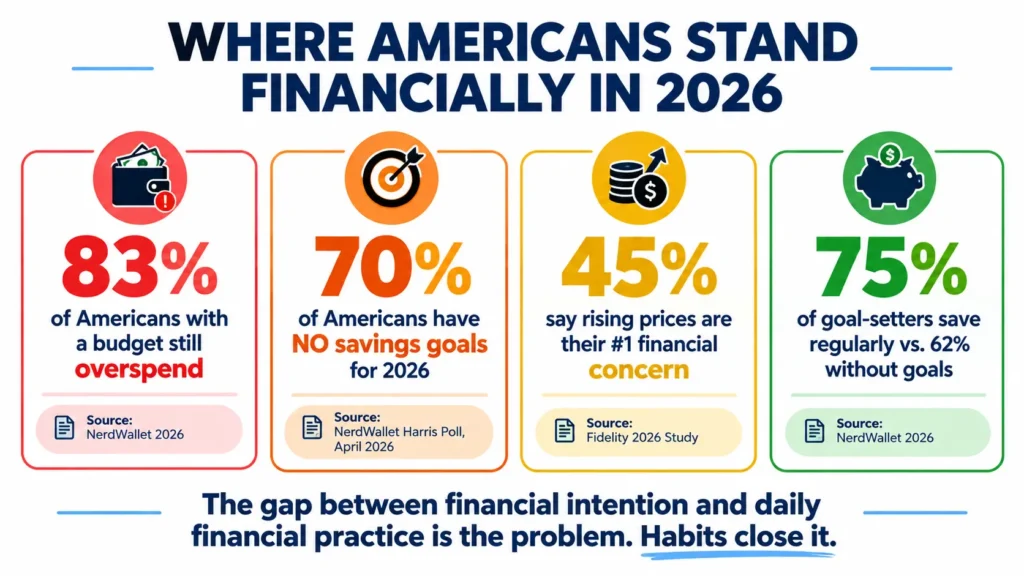
A daily money manager isn’t someone with a finance degree or a six-figure salary. It’s anyone who makes small, consistent financial decisions every day that compound into meaningful results over time. Here’s what the 2026 data actually shows: according to a NerdWallet study, 83% of Americans who have a budget admit they still overspend.
The problem isn’t budgets — it’s the approach. Willpower-based money management fails because it requires perfect decisions every day. Habit-based money management succeeds because it builds systems that make good decisions automatic.
This article covers 10 daily money manager habits that are both realistic and grounded in verified 2026 behavioral finance research.
The 2026 Money Reality
Before building habits, it helps to understand where Americans stand financially in 2026.
According to Fidelity’s 2026 New Year’s Financial Resolutions Study, 64% of Americans say they’re considering a financial resolution this year, up from the 56% who made one in 2025. The 2026 theme is planning with purpose.
Despite this optimism, 31% of Americans describe their relationship with money as “stressful” — and 45% report that rising everyday prices are their top financial concern.
Separately, a NerdWallet study found that 70% of Americans don’t have savings goals for 2026, and 22% of employed Americans don’t know how much of their income they’re regularly saving.
These numbers reveal the gap between financial intention and daily financial practice. Good intentions don’t build wealth — daily habits do. Becoming a consistent daily money manager closes that gap.
Habit 1 — Track Every Dollar
More than four in five Americans — 83% — say rising prices and the cost of living have caused them to track spending more closely in 2026, according to NerdWallet. Two-thirds (66%) say having a specific goal has helped them track spending more closely.
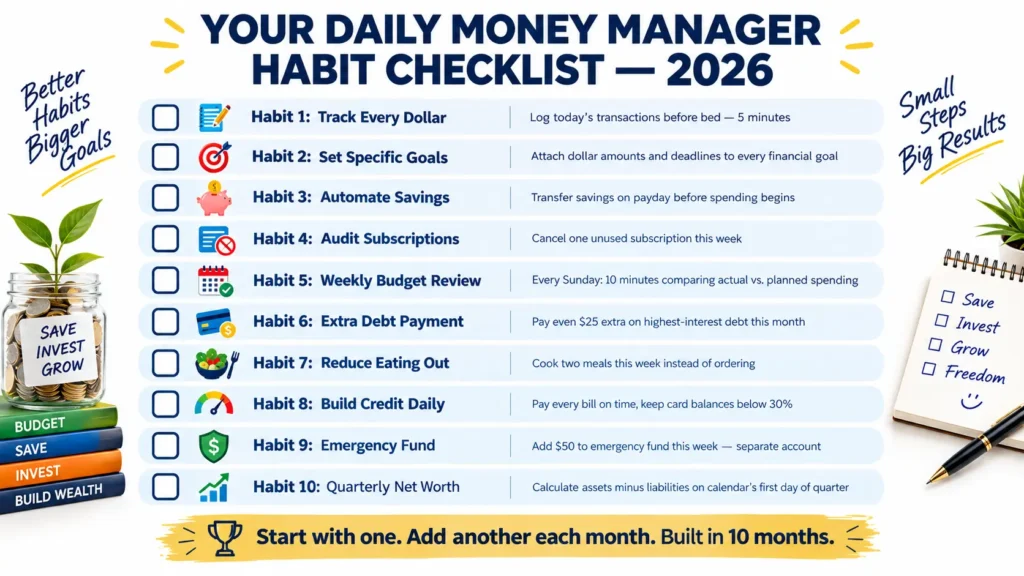
Tracking isn’t about restriction — it’s about awareness. A daily money manager who knows where every dollar went last week makes fundamentally different decisions than one who guesses. Spend five minutes each evening logging the day’s transactions, either in a budgeting app or a simple notebook.
This single habit, maintained consistently, produces more financial clarity than any budgeting framework done inconsistently.
Habit 2 — Set Specific Goals (Not Vague Ones)
According to Fidelity’s 2025 Financial Resolutions Study, people who successfully kept their resolutions cited having clear, specific goals as the top reason for their success. “Save more money” isn’t a goal — “save $200 per month by packing lunch three days a week” is a goal.
NerdWallet’s research confirms this directly: employed Americans with a savings goal are more likely to regularly save a portion of their income than those without — 75% compared with 62%.
A daily money manager ties every daily decision to a specific dollar target and deadline. Without specificity, financial goals remain wishes rather than plans.
Habit 3 — Automate Before You Spend
Automation is the most effective daily money manager habit that requires the least daily effort. Setting up automatic transfers from your checking account to savings, retirement accounts, or debt payments removes the temptation entirely.
This addresses a core problem: willpower-based budgeting assumes you’ll resist temptation indefinitely. Automation removes the decision from the equation.
Set up automatic transfers on payday—before your checking account sees the money as available for spending. When your savings leave automatically, your spending adjusts to what remains. This is how consistent daily money managers build savings during the same months they pay high rent and deal with inflation.
Habit 4 — Audit Subscriptions Monthly
According to a NerdWallet survey on subscriptions, more than half of U.S. adults — 55% — plan to significantly cut their subscriptions to save money in 2026. One NerdWallet writer found $1,470 per year in savings after conducting her own subscription audit.
The full methodology behind this finding is available in NerdWallet’s 2026 savings research, which covers subscription spending patterns across all age groups.
Monthly subscription audits are one of the fastest wins available to any daily money manager. Set a calendar reminder for the first day of each month to review every recurring charge on your bank and credit card statements. Cancel anything unused, downgrade where possible, and redirect the savings directly to your emergency fund or debt payoff.
Habit 5 — Review Your Budget Weekly
Most budgeting frameworks operate on a monthly cycle — but problems compound over four weeks before you notice them. A daily money manager who checks in weekly catches overspending during week two and can course-correct before it becomes a monthly deficit.
Wells Fargo’s 2026 financial survey found that when Americans pair smart spending with easy-to-adopt habits, saving feels manageable rather than daunting. The most effective saving habits start small and feel sustainable, which is why they tend to last.
A 10-minute Sunday evening budget review — comparing the week’s actual spending to the weekly portion of your monthly budget — builds the financial awareness that monthly reviews miss.
Habit 6 — Pay Debt Strategically
NerdWallet’s Consumer Outlook Report found that 30% of Americans plan to pay off one or more of their debts in full in 2026. Speed up debt repayment by making extra payments or paying more than the minimum when possible—this can significantly reduce total interest paid.
A daily money manager approaches debt as a priority, not an afterthought. After automating savings, apply any remaining discretionary cash to high-interest debt before spending on wants. Even an extra $25 payment per month on a credit card balance can meaningfully reduce total interest costs over 12 months.
For a complete debt elimination framework, our guide on how to pay off debt fast with low income covers the Tier system for prioritizing which debts to attack first.
Habit 7 — Reduce Eating Out Intentionally
A meal costing fifteen dollars at a restaurant — plus tax and tip — may cost a couple of dollars to prepare at home. Learning a few cheap, nutritious recipes is well worth the investment in both time and money.
Food spending is one of the most controllable categories in any budget and one of the most commonly underestimated. A daily money manager who tracks food spending often discovers that dining out accounts for 15-25% of their monthly discretionary budget — far more than they estimated.
Reducing restaurant visits by two per week— and cooking instead—typically saves $200-400/month for the average American household without sacrificing nutrition or enjoyment.
Habit 8 — Build Credit Consistently
Credit score improvement is a daily money manager habit with compounding returns — a better credit score reduces the cost of every future loan, mortgage, and financing arrangement.
According to FICO data, consumers who move from fair to good credit typically see meaningful improvement within 12 to 18 months of consistent positive behavior. Every on-time payment is a practice. Every month of keeping credit utilization low builds the habit.
The daily actions here are simple: pay every bill on time, keep card balances below 30% of available credit, and avoid applying for new credit unnecessarily. None of these require willpower — they require automation and awareness.
Habit 9 — Save for the Unexpected (Not Just Goals)
According to Fidelity’s 2026 study, unexpected expenses ranked as the top financial concern for 38% of Americans — ahead of inflation’s day-to-day impact.
A daily money manager maintains a dedicated emergency fund separate from goal-based savings. The purpose of an emergency fund isn’t to fund goals — it’s to prevent emergencies from becoming debt. When car repairs, medical bills, or job disruptions arrive, they draw from savings rather than from credit cards.
The national personal savings rate in January 2026 was just 4.5%, according to the U.S. Bureau of Economic Analysis — far below what most financial experts recommend for genuine emergency preparedness. A daily money manager targets 3-6 months of essential expenses in a separate high-yield savings account before focusing on discretionary goals.
Our guide on money management skills covers emergency fund building in detail, including specific monthly contribution strategies for different income levels.
Habit 10 — Review Net Worth Quarterly
Daily spending habits produce cumulative results that are best measured at a larger scale. A daily money manager who reviews net worth quarterly — total assets minus total liabilities — sees the compound effect of consistent daily decisions over three months.
Net worth tracking converts hundreds of small daily habits into one visible number that either grows or shrinks. Most people who track net worth quarterly report that seeing real progress keeps motivation up during months when individual paychecks feel tight.
Calculate net worth on the first day of each new quarter: list every asset you own (checking, savings, investments, property value) and every liability you owe (all debt balances). The difference is your net worth. Watch it grow as debt falls and savings rise.
Putting It Together — The Daily Money Manager Routine
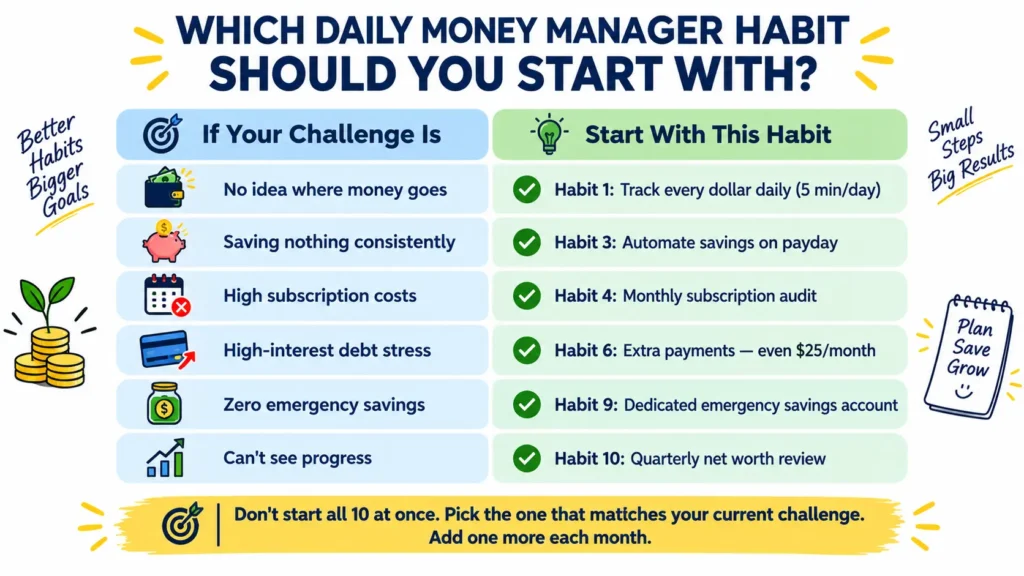
These 10 habits don’t need to happen simultaneously. Start with the ones that address your biggest current weakness:
| If Your Challenge Is… | Start With This Habit |
| No idea where money goes | Habit 1: Track every dollar daily |
| Saving nothing consistently | Habit 3: Automate savings on payday |
| High subscription costs | Habit 4: Monthly subscription audit |
| Carrying high-interest debt | Habit 6: Extra debt payments |
| No emergency fund | Habit 9: Dedicated emergency savings |
| Can’t see financial progress | Habit 10: Quarterly net worth review |
The most effective saving habits start small and feel manageable, which is why they tend to last. Change comes from simple actions you can repeat — ones that build confidence and show steady progress.
A daily money manager isn’t built in a week. It’s built through one repeated choice at a time until that choice stops requiring effort.
Disclaimer
This article presents educational information about personal finance habits sourced from NerdWallet (Harris Poll surveys, April 2026; June 2026; July 2026), Fidelity’s 2026 New Year’s Financial Resolutions Study, Wells Fargo’s 2026 financial survey, FICO data, the U.S. Bureau of Economic Analysis, and Harvard FCU. This is not personalized financial advice. Individual situations vary. Consult a licensed financial advisor before making major financial decisions.
Conclusion
Becoming a consistent daily money manager in 2026 doesn’t require perfect willpower or a dramatically higher income. It requires replacing willpower with systems — automation, weekly reviews, subscription audits, and specific goals — that make good financial decisions the path of least resistance rather than the path of most discipline.
The data makes the case clearly. Americans who pair financial attention with concrete action see real results—and those with specific goals are significantly more likely to save regularly than those without them. Each of the 10 habits in this guide is a concrete action that removes one more financial decision from your daily willpower budget.
Start with one habit this week. Add another next month. By this time next year, your daily money manager practice will look nothing like where it started — and your financial results will reflect that.
Ready to build the complete financial foundation these habits support? Our guide on money management worksheets provides 10 free, print-ready templates, including a daily expense tracker, weekly spending planner, and monthly budget planner that pair directly with the habits covered here.
FAQ Section
Q1: What does being a daily money manager actually mean?
A daily money manager is someone who makes consistent small financial decisions every day — tracking spending, automating savings, reviewing bills, avoiding impulse purchases — that compound into meaningful results over months and years. According to NerdWallet’s 2026 research, 66% of Americans who track spending closely do so because a specific financial goal drives their daily attention.
Q2: How long does it take to build daily money manager habits?
According to behavioral research cited by Fidelity, successful financial habit formation typically takes 12-18 months of consistent behavior to become automatic — particularly for credit-building and savings habits. However, early wins like subscription audits and automated transfers show results within the first month, which builds motivation to sustain the longer-term habits.
Q3: What is the most important daily money manager habit for beginners?
Tracking every dollar is the foundational habit that makes all others more effective. You cannot reduce food spending without knowing how much you spend on food. You cannot increase savings without knowing how much is left after expenses. Even five minutes of daily expense logging provides more financial clarity than any budgeting app used passively.
Q4: How much should a daily money manager save each month?
The national personal savings rate in January 2026 was 4.5%, according to the U.S. Bureau of Economic Analysis. Most financial experts recommend 20% of after-tax income — split between emergency fund, retirement contributions, and specific savings goals. Start wherever you are and increase by 1% each month until you reach your target rate.
Q5: Can daily money manager habits work on a low income?
Yes. The most effective daily money manager habits — tracking spending, automating transfers, auditing subscriptions, meal planning, paying extra on high-interest debt — require no minimum income. They require consistency. A 2026 Wells Fargo survey found that the most effective saving habits start small and feel manageable, which is precisely why they work across all income levels.
Q6: How often should a daily money manager review their finances?
Daily: log transactions (5 minutes). Weekly: compare spending to weekly budget portion (10 minutes). Monthly: audit subscriptions and review bill calendar (30 minutes). Quarterly: calculate net worth and review savings goal progress (45 minutes). Annual: full financial review including tax planning and benefit reviews. This layered review schedule catches problems at every timescale.

Financial enthusiast with 5 years of experience in the US market trends and personal wealth management