
Everyone searching “how to make extra money to pay off debt” has been sold a fantasy. The fantasy says: “Start a side hustle, earn $1,000/month in your spare time, and crush your debt in two years!” The reality? Most side hustles pay $12-15/hour after expenses, which means you’re not earning extra money—you’re trading time at a lower rate than your day job.
Here’s what nobody tells you: the best way to make extra money to pay off debt isn’t finding a new income source. It’s knowing which income sources are actually worth your time, understanding the brutal math behind each option, and then—this is critical—accepting that most side gigs won’t save you. This guide shows you the real numbers, the time investment required, and which income strategies actually compound into real debt-payoff momentum.
By the end, you’ll know exactly which “extra money” opportunities are worth pursuing and which ones are just distracting you from what actually works.
Why Most Side Hustles Fail at Debt Payoff
Before you start anything, understand why most people fail at using extra income to pay off debt. Federal Reserve data shows the average American household carries $38,000 in non-housing debt, making extra income strategies increasingly necessary
The Hourly Rate Trap
You want to make an extra $500/month. Sounds reasonable, right? Let’s check the math.
Scenario 1: DoorDash/Food Delivery
- Realistic earnings: $15-18/hour after gas, vehicle wear-and-tear, taxes
- Hours needed: 30-35 hours/month for $500
- That’s 7-8 hours per week
- Plus: Car maintenance, insurance increase, depreciation (not counted in “$15/hour”)
- Actual cost: You’re working for $10-12/hour after all expenses
Scenario 2: Freelance Writing
- Entry-level rate: $25-50 per article
- Time per 1,000-word article: 4-6 hours
- Actual hourly rate: $4-12/hour
- Plus: Client acquisition, revisions, late payments
Scenario 3: Selling Stuff Online
- Profit per item: $20-50 average
- Time per sale: 1 hour (sourcing, listing, shipping, customer service)
- Actual hourly rate: $20-50/hour (sounds great!)
- Reality: You can only source 5-10 items per week = $100-500/month real income
The insight: How to make extra money to pay off debt starts with understanding that most gigs are trading time at rates lower than your primary job. If you earn $20/hour at your day job, a $12/hour gig isn’t “extra money”—it’s a time waste.
The Time Bankruptcy Problem
You have 168 hours per week. Here’s how they’re actually allocated:
| Sleep (8 hours/night) | 56 | 112 |
| Day job (8 hours) + commute | 40 | 72 |
| Family, eating, hygiene basics | 30 | 42 |
| Exercise, mental health, social | 14 | 28 |
| Available for side hustle | 28 | — |
The problem: 28 hours is theoretical. Real life? Traffic delays, unexpected overtime, family emergencies, illness, burnout. Most people have 10-15 real hours available per week for a side gig.
At $15/hour (realistic rate), 15 hours = $225/month gross = $180/month after taxes and expenses.
Is $180/month worth sacrificing 15 hours of your life every week for 24+ months? Most people say yes initially. By month 3, they burn out.
This is why how to make extra money to pay off debt isn’t about finding gigs—it’s about choosing ones where the hourly rate justifies the time sacrifice.
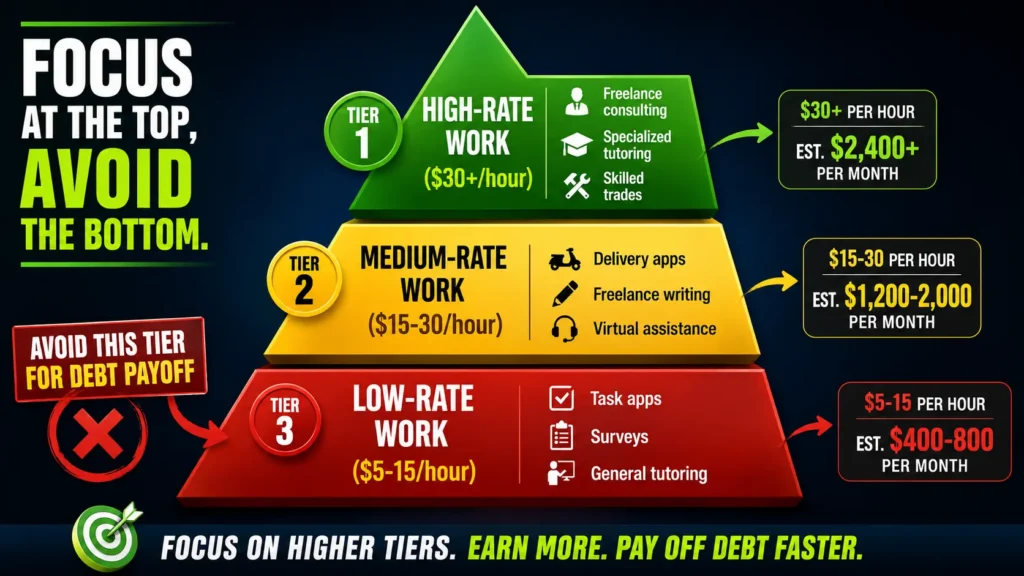
Which Gigs Actually Move the Needle
Not all income opportunities are equal. Some scale. Some compound. Some actually pay.
Tier 1 — High-Hour-Rate ($30+/hour) Income
These are the only gigs worth serious time investment.
Freelance Consulting in Your Field
- Rate: $50-150/hour
- Reality: Requires existing expertise, professional network, or reputation
- Time investment: High upfront (building portfolio, finding clients), then scalable
- Best for: People with specialized skills (programming, design, accounting, legal)
Example: A software engineer earning $60/hour in a day job takes freelance projects at $90-120/hour. 10 hours/month extra = $900-1,200 extra income.
Specialized Tutoring
- Rate: $40-100/hour
- Reality: Test prep (SAT, GRE), college essay coaching, subject expertise
- Time investment: Moderate (students book specific sessions)
- Best for: Teachers, academics, subject matter experts
Example: High school teacher tutoring SAT prep at $60/hour. 8 hours/month = $480/month.
Skilled Trades (If Applicable)
- Rate: $50-200/hour
- Reality: Plumbing, electrical, carpentry side work
- Time investment: High, but paid well
- Best for: People with trade certifications
Example: Electrician doing side jobs on weekends at $100/hour. 20 hours/month = $2,000/month extra income.
The pattern: Tier 1 gigs leverage existing skills or credentials. If you don’t have expertise, you’re stuck in Tier 2.
Tier 2 — Medium-Hour-Rate ($15-30/hour) Income
These are “worth doing” only if your have time and can sustain the monotony.
Delivery/Gig Apps (DoorDash, Instacart, etc.)
- Real earnings: $15-22/hour after expenses
- Time: Flexible (work whenever)
- Sustainability: Medium (burnout by month 4-6)
- Best for: People with paid-off vehicles, zero other options
Freelance Writing/Content
- Rate: $25-50 per piece (entry level)
- Time: 4-8 hours per 1,000-word article
- Actual rate: $6-12/hour initially, scaling to $25-40/hour with experience
- Best for: People building a portfolio for future Tier 1 work
Virtual Assistance
- Rate: $15-25/hour
- Time: 15-25 hours/week typical
- Sustainability: Medium (repetitive tasks)
- Best for: Detail-oriented people comfortable with routine
Selling Used Items Online
- Profit: $20-100 per item depending on sourcing
- Time: 1-2 hours per sale (sourcing, listing, shipping)
- Actual rate: $20-100/hour (but irregular, inconsistent)
- Best for: People with inventory (decluttering = sourcing)
Tier 2 reality: You can make $200-400/month here if you’re disciplined. But most people underestimate time, overestimate earnings, and quit.
Tier 3 — Low-Hour-Rate ($5-15/hour) Income
These are “not worth your time for debt payoff” despite their popularity.
Task Apps (TaskRabbit, Handy)
- Rate: $15-25/task, but after platform fee = $10-15/hour
- Time: Includes travel, waiting, actual task completion
- Sustainability: Low (physically exhausting)
Survey/Micro-Task Sites (MTurk, UserTesting)
- Rate: $5-15/hour for most tasks
- Time: Highly variable, often unpredictable
- Sustainability: Very low (mind-numbing)
Tutoring (General)
- Rate: $15-30/hour for math/language tutoring (non-specialized)
- Time: Includes prep, travel, sessions
- Sustainability: Medium (depends on consistency)
Cashback/Rewards Hustling
- Earnings: $20-50/month for dedicated effort
- Time: 5-10 hours/month
- Actual rate: $2-10/hour
- Best for: People already spending anyway (not extra income)
Tier 3 verdict: If you’re in Tier 3, you’re not solving the debt problem—you’re just tired.
The Income Strategy That Actually Works
Here’s how people who successfully use extra income to pay off debt actually do it.
Month 1-3: Inventory Assessment
Before you make extra money to pay off debt, audit what you already have.
What to assess:
- Unused items in your home (electronics, furniture, clothes, tools)
- Existing skills or certifications
- Professional networks (could these become clients?)
- Time availability (realistic, not idealistic)
- Vehicle condition (can it support gig work? Or is depreciation too high?)
Why this matters: Your first $500-1,000 in extra income comes from liquidating what you own, not creating new income.
Realistic outcome: Most people make $200-800/month from selling stuff. It’s one-time income, not recurring, but it’s the fastest win.
Month 3-6: Skill Leveraging
After you’ve cleared inventory, move to what you’re good at.
The question: “What’s the highest-hourly-rate work I can realistically do?”
If you’re a:
- Teacher: Tutoring test prep ($50-80/hour)
- Software engineer: Freelance projects ($80-120/hour)
- Accountant: Tax prep side work ($75-150/hour)
- Electrician/Plumber: Side jobs ($80-150/hour)
- Designer: Freelance design ($40-100/hour)
- Writer with experience: Freelance content ($50-150/hour)
The pattern: Skill-based income > gig-based income, always.
Realistic outcome: $300-1,200/month if you have a valuable skill. $0-100/month if you don’t (yet).
Month 6+: Compound Strategy
This is where most people fail, but this is also where it works.
The compound formula:
- Use Tier 1 income (skill-based) for consistent monthly debt payoff ($500-1,200)
- Use Tier 2 income (gigs) for bonus months (when you have energy/time)
- Use Tier 3 income (only if) you find one that doesn’t exhaust you (rare)
Example execution:
- Base income: $80/month from skill work (8 hours/month at $60/hour) = sustainable
- Bonus income: $200-400/month from gigs when opportunity arises
- Result: $280-480/month extra going to debt, sustainable pace
Why this works: You’re not betting on one gig or burning out. You’re stacking multiple small streams that add up to real income.
The Income Methods That Actually Scale (For Debt Payoff)
Most “side hustle” advice is garbage because it shows micro-examples (“I made $500 last week!”) not macro-realities (“I made $500 one time, then nothing for 3 weeks”).
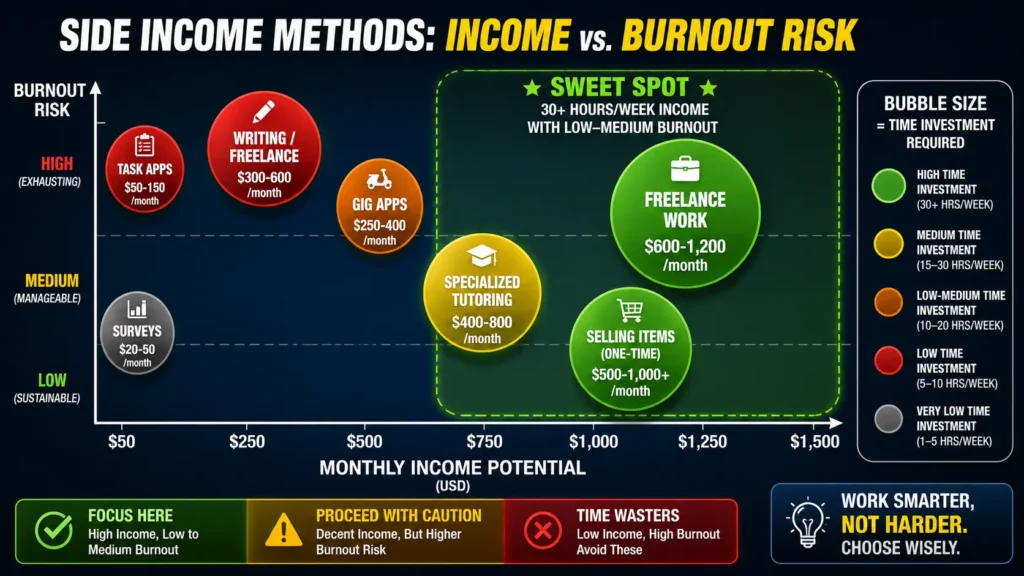
Here’s what actually compounds into debt payoff.
Method 1: Freelance Work (If You Have Skills)
Setup: Create a profile on Upwork, Fiverr, or specialized platforms
Realistic timeline: 2-3 months to first client, 6+ months to consistent work
Earnings curve:
- Months 1-3: $0-50/month (building portfolio)
- Months 4-6: $100-300/month (early clients)
- Months 7-12: $300-800/month (reputation builds)
- Year 2+: $500-2,000+/month (established rates)
Why it works: Income scales with reputation, not hours. By month 12, you might be earning $1,000/month from 10 hours of work per week.
Why it fails: Takes 6+ months to see real money. Most people quit at month 3 after making $50 and feeling ripped off.
Method 2: Selling Stuff (One-Time Income)
Setup: Inventory audit, photography, listings on Facebook Marketplace/eBay
Realistic timeline: 2-4 weeks if you’re aggressive
Earnings potential: $500-3,000 depending on what you own
Effort: 30-50 hours total
Why it works: One-time effort, real money fast. If you sell 20 items at $75 profit each, that’s $1,500 toward debt in 4 weeks.
Why it fails: It’s one-time income, not recurring. Once you’ve sold your stuff, you’re done unless you keep sourcing (which becomes a real job).
Best use: Combine with something recurring. Liquidate assets month 1-2, then shift to skill-based income month 3+.
Method 3: Gig Apps (Supplemental Only)
Setup: Download app, pass background check, start accepting tasks
Realistic timeline: Immediate (work within days)
Earnings potential: $10-20/hour after all expenses
Schedule: Flexible but inconsistent
Why it works: No barrier to entry. If you have a car, you can start making money this week.
Why it fails: Income is below your primary job rate (probably), work is exhausting, and you’re depreciating assets. By month 3-4, most people are burned out.
Best use: Emergency income when you need cash fast (rent due, medical bill). Not for consistent debt payoff.
Method 4: Passive Income (The Slow Play)
High-Yield Savings + Extra Income Combined
- You can earn 4-5% APY on savings (2026 rates)
- If you save an extra $100/month from gigs, that’s $1,200/year
- The interest compounds: $100/month at 4.5% APY = $27.50 in year-one interest
Why this matters: You’re not just earning income; you’re earning income on income. By year 3, you’ve saved $3,600 and earned $200 in interest. That interest accelerates.
Why it fails: Passive income only works if you also generate active income. You need to put away $100/month first.
Best use: After stabilizing active income, move excess to high-yield savings and let it compound toward debt payoff.
What You’re Actually Willing to Do
This is the hardest section because it requires honesty.
The Sustainability Question
How to make extra money to pay off debt requires answering: “Will I actually do this for 12+ months?”
Brutal honesty questions:
- Will you really tutor SAT prep for 6-8 hours/week for 12 months? (Probably not)
- Will you really do DoorDash after your day job? (Maybe for 2 months)
- Will you really build a freelance portfolio? (Only if you have discipline)
- Will you really sell your stuff? (Yes, for 4 weeks, then nothing)
The pattern: People overestimate short-term motivation and underestimate long-term sustainability.
The solution: Choose income methods you can actually sustain for 6-12 months, not what pays most in theory.
The Opportunity Cost
Every hour on a $15/hour gig is an hour not spent on:
- Your primary career advancement (which could raise income faster)
- Your health/mental well-being
- Family time
- Building actual skills that compound
The brutal math: If you’re making $15/hour on DoorDash instead of pursuing a $2,000 raise at your day job (which requires 20 hours of professional development), you’re choosing $12,000/year in lost opportunity for $7,800/year in DoorDash income.
How to make extra money to pay off debt sometimes means not making extra money, but instead investing in career growth that raises your base income permanently.
The Income-to-Debt-Payoff Converter
Here’s the actual math showing how extra income translates to debt payoff.
| Freelance (skilled) | $600-1,200 | 20% | $480-960 | 12-25 months | Low |
| Tutoring (specialized) | $400-800 | 20% | $320-640 | 18-37 months | Medium |
| DoorDash/Gigs | $400-600 | 40% | $240-360 | 33-50 months | High |
| Selling used items | $500-1,000 (one-time) | 10% | $450-900 | 13-26 months (bulk) | N/A (temporary) |
| Freelance writing | $300-600 | 20% | $240-480 | 25-50 months | Very High |
| Part-time shift job | $800-1,200 | 25% | $600-900 | 13-20 months | Very High |
The insight: The only income methods that work for debt payoff pay $30+/hour or $600+/month. Everything else is just lifestyle sacrifice without reward.
Disclaimer: This article is educational content about income opportunities and debt payoff strategies. It is not financial or tax advice. Actual earnings from gig work, freelancing, and side income vary significantly by location, individual skills, market conditions, and effort level. Self-employment income may have tax implications (estimated taxes, self-employment tax) not detailed here. Before pursuing major income strategies, consult a tax professional or financial advisor about implications specific to your situation. 2026 income data reflects current market rates but may change. Always verify actual earnings with the platforms or employers involved.
Conclusion
How to make extra money to pay off debt isn’t about finding the perfect gig. It’s about understanding which income sources actually move the needle (Tier 1: $30+/hour), having the discipline to sustain them for 6-12 months, and combining them strategically (asset liquidation + skill-based work + bonuses).
Most people asking this question expect instant $1,000/month income. Reality: $200-400/month sustainable is the win. That $300/month, consistently, over 24 months = $7,200 toward debt. Combined with expense cuts and debt strategy, that’s life-changing.
Your next step: Audit what you own (sellable assets), identify your highest-value skill, and choose one Tier 1 income method you can sustain for 6+ months. Don’t chase multiple gigs simultaneously—pick one and execute it thoroughly. Most people fail because they jump between gigs, never building the consistency that generates real income.
Want to see how extra income fits into your larger debt strategy? Check out our guide on how to pay off debt fast with low income, which shows exactly where income sits in your priority hierarchy, or explore the complete debt payoff strategy for context on combining income growth with strategic debt targeting.
Your extra income is only as good as your execution. Choose wisely.
FAQ SECTION
Q1: Can you really make $500/month extra to pay off debt?
Yes, but most people overestimate speed and underestimate effort. Realistic pathways: $400-800/month from skilled freelance work (tutoring, consulting, writing if experienced), $500-1,500/month from selling inventory you already own (one-time but significant), $200-400/month from gigs after all expenses. The critical mistake: expecting $1,000+/month immediate income from zero. Income builds gradually—start small, compound intentionally, scale over 6-12 months.
Q2: How to make extra money to pay off debt without burning out?
Choose income methods paying $30+/hour (higher quality, lower burnout) over $15/hour gigs (high-burnout, low-reward). Mix one-time income (selling inventory, quick cash) with recurring income (freelance work, skill-based). Most importantly: be brutally honest about sustainability. Will you really tutoring for 8 hours/week for a full year? If yes, do it. If no, choose something you’ll actually maintain. Burnout happens by month 4 when initial motivation fades—pick methods requiring discipline, not motivation.
Q3: Is it better to cut expenses or make extra money for debt payoff?
Cut expenses first (effort: moderate, results: immediate, sustainability: high). Make extra money second (effort: high, results: slower, sustainability: low). Most people who “make extra income” actually replace expense cuts rather than add new income. Optimal strategy: $200/month in cuts + $300/month in extra income compounds better long-term than $500/month in extra income alone. Cuts are your foundation—extra income is acceleration.
Q4: What’s the fastest income method for debt payoff?
Fastest one-time: Selling stuff you own (3-4 weeks, $500-3,000). Fastest recurring: Specialized freelance work at $50+/hour (6+ months to momentum, then $500-1,200/month). Fastest entry: Gig apps (start working this week) but slowest payoff ($200-300/month realistic). Best real strategy: Quick asset liquidation weeks 1-4, then transition to skill-based freelance work by month 3+ for sustainable income.
Q5: Can you make $1,000/month extra on the side realistically?
Yes, but timeline matters. Realistic: 6-12 months to reach $500/month consistent, 12-24 months to reach $1,000/month. This assumes you have existing marketable skills or are building them intentionally. Gig work alone won’t get you there—skill-based work (consulting, freelancing, specialized tutoring) is required. One-time income (liquidation) won’t sustain it. You need recurring, scalable income sources.
Q6: Should I quit my job to make money for debt payoff faster?
Almost never. Your day job’s salary + benefits + career growth >> any side gig you’d replace it with. Instead: advance at your day job, negotiate raises, pursue promotions, then redirect increases toward debt. Income growth in your primary career compounds faster and more reliably than entrepreneurial side hustles most people attempt. Use side income to accelerate payoff, not replace primary income.

Financial enthusiast with 5 years of experience in the US market trends and personal wealth management