Introduction
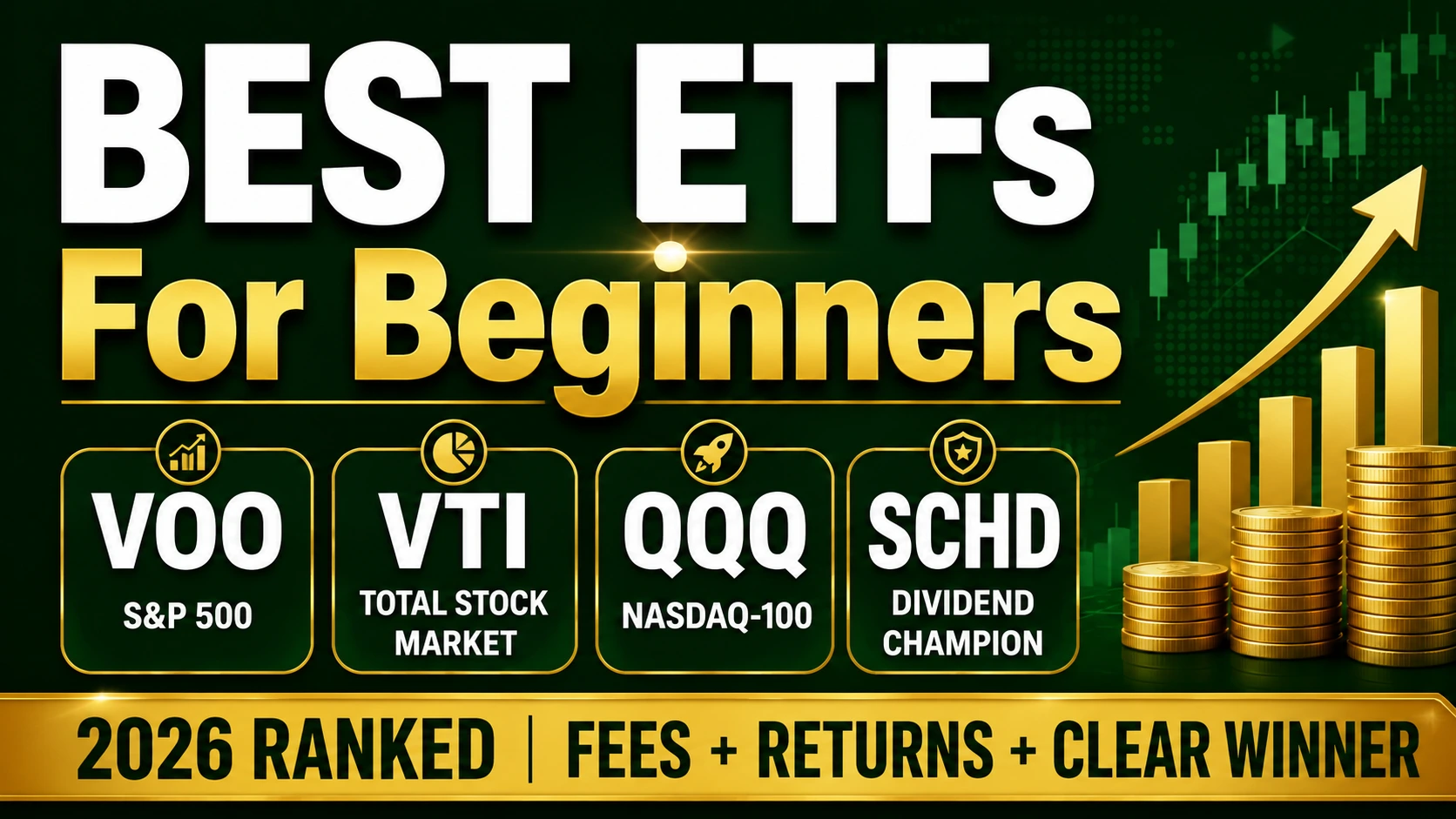
The best ETF for most beginners in 2026 is VOO — the Vanguard S&P 500 ETF — because it charges just 0.03% per year, tracks 500 of America’s largest companies, and recently became the world’s first ETF to surpass $1 trillion in assets under management. It is simple, cheap, and battle-tested over decades.
That said, the right answer to what the best ETF is depends on your goals. Some investors want broader market coverage. Others want dividend income or growth exposure. This guide ranks the top 10 most popular ETFs in plain English — so you can make a confident choice today.
Disclaimer: This article is for informational and educational purposes only. It does not constitute personalized financial advice. Please consult a licensed financial advisor before making investment decisions.
What Is an ETF and Why Does It Matter?
An ETF — Exchange-Traded Fund — is a basket of investments that trades on the stock market like a single share. When you buy one ETF, you instantly own a tiny piece of every company inside it.
Think of it like buying a slice of pizza instead of making the whole pie from scratch. One ETF can give you ownership in 500, 1,000, or even 4,000 companies at once — for the cost of a single trade and a fraction of a percent in annual fees.
This is why figuring out what is the best ETF matters so much. The right ETF can be the only investment you ever need. The wrong one — loaded with fees or concentrated in one risky sector — can quietly drain your returns over decades.
“If you are just starting out with $1,000, read our complete guide on how to invest $1,000 for beginners before choosing your first ETF.”
What Is the Best ETF for Beginners? — Our Top Pick
Before diving into the full rankings, here is the short answer for anyone who just wants to know what is the best ETF and get started today.
VOO — Vanguard S&P 500 ETF
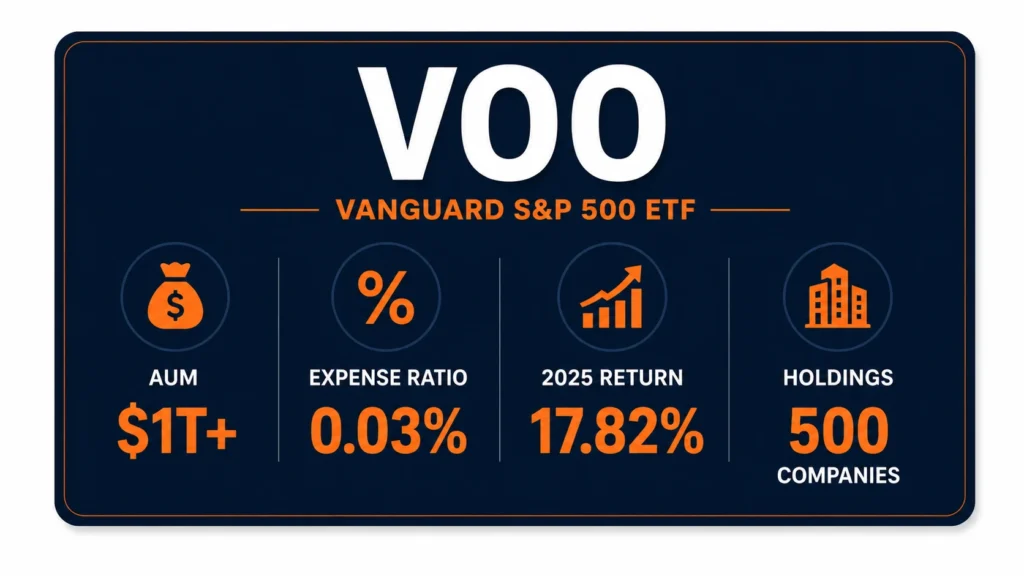
<cite index=”21-1″>VOO just became the world’s first $1 trillion ETF — a milestone reached on June 3, 2026 — reflecting the trust millions of investors have placed in it.</cite> It tracks the S&P 500, charges 0.03% annually, and has delivered an average annual return of approximately 10.4% over the past 50 years.
For a beginner asking what is the best ETF to start with, VOO checks every box: low cost, maximum diversification, strong track record, and available commission-free at Fidelity, Schwab, and most major brokerages.
Top 10 Most Popular ETFs in 2026 — Full Rankings
These are the top 10 most popular ETFs ranked by assets under management (AUM) as of July 2026, with verified expense ratios and 2025 total returns.
| Rank | ETF | What It Tracks | Expense Ratio | 2025 Return | AUM (Approx.) | Best For |
|---|---|---|---|---|---|---|
| 🥇 1 | VOO | S&P 500 | 0.03% | 17.82% | $1T+ | Best overall — beginners & long-term |
| 🥈 2 | VTI | Total US Market | 0.03% | ~17.6% | $500B+ | Broadest US diversification |
| 🥉 3 | QQQ | Nasdaq-100 | 0.20% | ~25.1% | $330B+ | Tech-heavy growth exposure |
| 4 | SPY | S&P 500 | 0.0945% | 17.80% | $620B+ | Active traders — highest liquidity |
| 5 | IVV | S&P 500 | 0.03% | 17.83% | $560B+ | Fidelity users — same as VOO |
| 6 | SCHD | US Dividend stocks | 0.06% | ~14.5% | $65B+ | Dividend income investors |
| 7 | VGT | US Tech sector | 0.10% | ~28.3% | $75B+ | Technology sector focus |
| 8 | BND | US Bond market | 0.03% | ~4.2% | $95B+ | Stability and bond income |
| 9 | VT | Global total market | 0.07% | ~16.1% | $45B+ | International diversification |
| 10 | ARKK | Disruptive innovation | 0.75% | Volatile | $6B+ | High risk — speculative only |
Sources: Vanguard, Fidelity, iShares, Schwab — verified July 2026. Past performance does not predict future results.
: “You can compare real-time ETF data including AUM, expense ratios, and historical returns at ETF.com.“
Best Performing ETFs by Category
Not every investor has the same goal. Here is how the top performing ETFs in the USA break down by category in 2026.
Best ETF for Long-Term Beginners — VOO or VTI
For anyone new to investing, the answer to what is the best ETF is almost always VOO or VTI. Both charge just 0.03%, require no market timing, and have been rewarding patient investors for decades. <cite index=”23-1″>Both VOO and VTI track the U.S. market at the same ultra-low price — VOO covers the 500 largest companies while VTI goes broader by including mid-cap and small-cap stocks alongside large caps.</cite>
Best ETF for Growth — QQQ
<cite index=”17-1″>Invesco QQQ Trust tracks the Nasdaq-100 index, which includes 100 of the Nasdaq’s largest non-financial companies.</cite> It delivered approximately 25.1% in 2025 — well above VOO’s 17.82%. However, it carries more volatility and charges 0.20%, nearly seven times VOO’s fee. Best for investors comfortable with tech-sector swings.
Best ETF for Dividend Income — SCHD
<cite index=”21-1″>SCHD holds 100 U.S. companies selected for high dividend yield, consistent dividend history, strong financial health, and reasonable valuation, with an expense ratio of 0.06%.</cite> For investors who want regular income alongside growth, SCHD is the most popular dividend ETF for a reason.
Best ETF for Bonds — BND
<cite index=”21-1″>With the 30-year Treasury yield at 19-year highs in 2026, BND’s yield of approximately 3.9% is the best it has been in years for new investors starting a position.</cite> BND reduces portfolio volatility and is the simplest way to add bond exposure to a beginner portfolio.
“Looking specifically at S&P 500 options? Read our detailed breakdown of the best S&P 500 index funds for beginners — VOO vs FXAIX vs VTI compared.”
How to Choose the Best ETF for Your Goals
So you know what is the best ETF in theory. Now how do you actually pick the right one for your situation? Use this simple four-question framework.
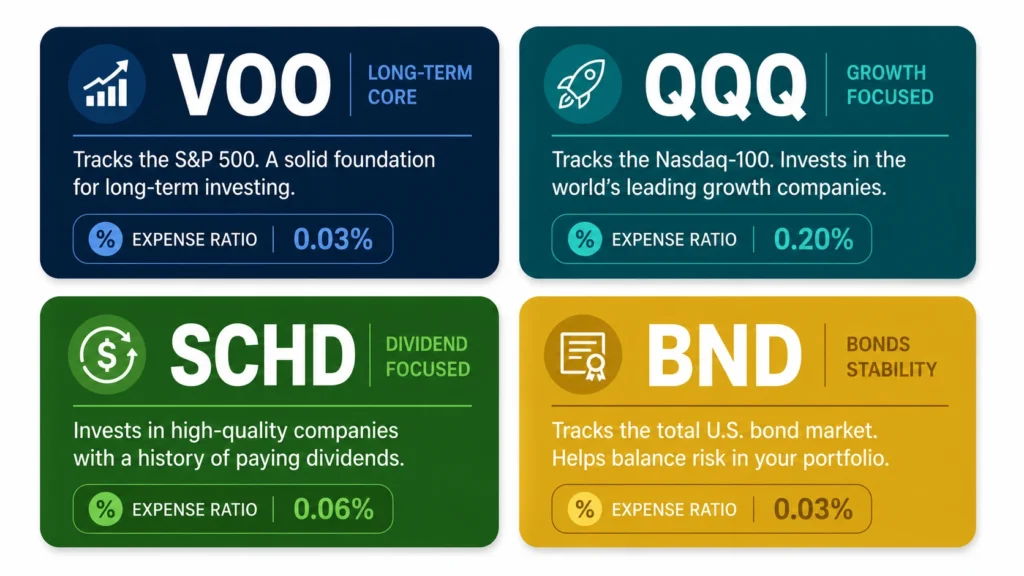
Question 1 — What is your goal? Building long-term wealth → VOO or VTI. Regular dividend income → SCHD. Tech and growth exposure → QQQ. Portfolio stability → BND.
Question 2 — What is the expense ratio? <cite index=”22-1″>Start with the expense ratio — over decades, even small fee differences compound into significant amounts. For core holdings, look for expense ratios below 0.10%.</cite> VOO, VTI, IVV, and BND all meet this standard comfortably.
Question 3 — Where will you hold it? Holding ETFs inside a Roth IRA makes all growth tax-free. Inside a taxable brokerage, you will owe capital gains taxes when you sell. The same ETF in a Roth IRA is always worth more after taxes than in a taxable account.
Question 4 — Can you hold it for 10+ years? The best ETF is only effective if you hold it through market downturns without selling. Choose a fund broad enough that you will not panic when one sector drops. VOO and VTI are specifically designed for this long-term, stay-the-course approach.
“Holding your ETF in a Roth IRA gives you the most tax-free growth. Here is our complete Roth IRA for beginners 2026 guide.”
“Research any ETF’s full historical performance, risk profile, and analyst ratings at Morningstar before you invest.”
What to Avoid When Picking an ETF
Understanding what is the best ETF is only half the answer. Knowing which ETFs to avoid is equally important.
❌ High expense ratios above 0.50% Actively managed ETFs like ARKK charge 0.75% or more annually. On a $50,000 portfolio, that is $375 per year in fees — compared to $15 for VOO. Over 30 years, that difference compounds dramatically against you.
❌ Leveraged and inverse ETFs These products are designed for short-term traders, not long-term investors. <cite index=”18-1″>Leveraged and inverse ETFs use derivatives and may experience significant losses over time — they are not suitable for beginners or long-term investors.</cite>
❌ Thematic or niche ETFs with limited history Single-theme ETFs — cannabis, metaverse, AI-specific — often have short track records, high fees, and concentrated risk. They make headlines but rarely make long-term investors wealthy.
❌ Low-volume ETFs with wide bid-ask spreads <cite index=”22-1″>Bid-ask spread and average daily volume indicate liquidity and trading costs. Larger AUM generally correlates with better liquidity and lower trading costs.</cite> Stick to ETFs with AUM above $1 billion.
Conclusion
The answer to what is the best ETF is not complicated: for most beginners in 2026, VOO delivers the best combination of low cost, proven performance, and simplicity. For broader market exposure, VTI is equally strong. For dividend income, SCHD. For bonds, BND.
The most important decision is not which ETF you pick — it is that you pick one and start. Every month you wait is a month of compounding you cannot get back.
Your next step: Now that you know which ETF to buy — discover exactly how to invest consistently over time without stress.
📌 Read Next: [What Is Dollar Cost Averaging and How Does It Work?
📌 Also Read: [Invest $1,000 for Beginners — 5 Smart Moves That Actually Work]
FAQ — What Is the Best ETF?
Q1: What is the best ETF to buy right now in 2026?
For most investors, VOO — the Vanguard S&P 500 ETF — is the best ETF in 2026. It became the world’s first $1 trillion ETF in June 2026, charges just 0.03% annually, and delivered approximately 17.82% in 2025. For broader US market exposure, VTI is an equally strong choice at the same 0.03% cost.
Q2: What are the top 10 most popular ETFs in 2026?
The top 10 most popular ETFs by assets under management in 2026 are VOO, SPY, IVV, VTI, QQQ, SCHD, VGT, BND, VT, and ARKK. VOO leads with over $1 trillion in assets. For beginners, VOO, VTI, and SCHD are the most practical starting points based on fees, diversification, and track record.
Q3: What is the difference between VOO and VTI?
Both VOO and VTI charge 0.03% and come from Vanguard. VOO tracks the S&P 500 — 500 of America’s largest companies. VTI tracks the total US stock market — approximately 4,000 companies including small and mid-cap stocks. Long-term returns are nearly identical, but VTI provides broader diversification.
Q4: What are the best performing ETFs in the USA right now?
In 2025, the top performing ETFs in the USA included VGT (US Tech, ~28.3%), QQQ (Nasdaq-100, ~25.1%), and VOO (S&P 500, ~17.82%). However, past performance does not predict future results. Many top performing ETFs in one year underperform significantly the next. Consistent low-cost broad market ETFs like VOO tend to outperform most alternatives over 20-year periods.
Q5: Should a beginner buy VOO or QQQ?
For beginners, VOO is the safer and more consistent choice. QQQ delivered higher returns in 2025 (~25.1%) but is concentrated in technology stocks — making it more volatile. VOO spreads risk across 500 companies in all sectors. Most financial experts recommend starting with a broad market ETF like VOO before adding sector-specific funds like QQQ.
Q6: How much money do I need to buy an ETF?
You can buy fractional shares of virtually any ETF — including VOO, VTI, and QQQ — with as little as $1 at Fidelity or Schwab. There is no minimum investment requirement. You simply transfer money to your brokerage account, search for the ETF ticker symbol, and place a buy order for whatever dollar amount fits your budget.

Financial enthusiast with 5 years of experience in the US market trends and personal wealth management