Introduction
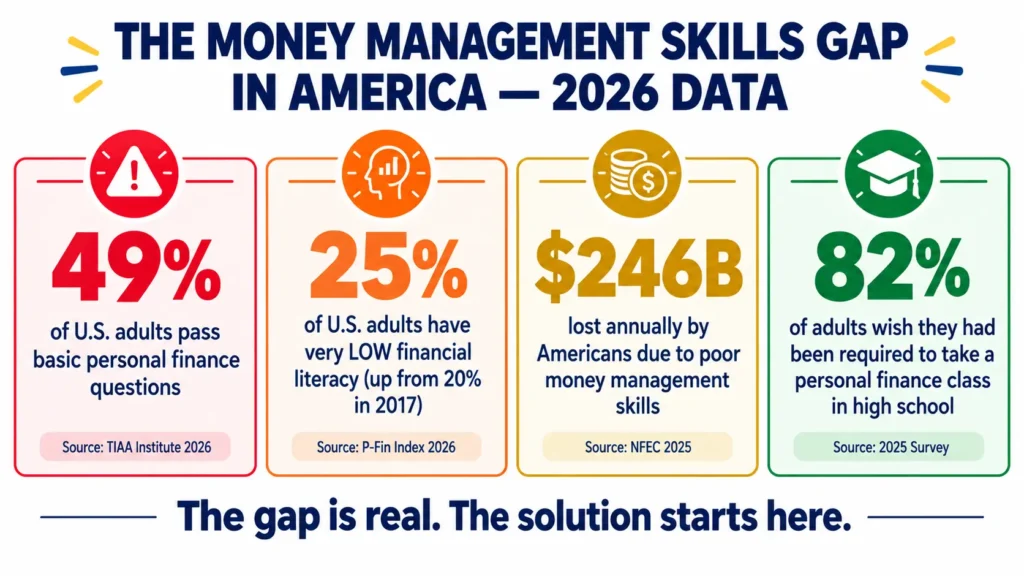
Money management skills are the set of habits, knowledge, and decisions. They determine whether your income builds wealth or disappears each month. Here’s the uncomfortable reality. The 2026 TIAA Institute–GFLEC Personal Finance Index shows U.S. adults answer only 49% of basic questions correctly. That score has remained frozen at that level for nearly a decade. A lack of money management skills costs Americans more than $246 billion annually, averaging about $948 per person. This guide covers every foundational skill — budgeting, saving, debt management, investing, and planning — with verified data and actionable frameworks that work regardless of age, income, or starting point.
Why Money Management Skills Matter More in 2026
The financial landscape has become more demanding, not less. The share of adults with very low financial literacy has grown steadily from 20% in 2017 to 25% in 2026, with the most pronounced gaps among Gen Z, who correctly answered only 38% of questions on average.
This isn’t just an academic problem. People with very low financial literacy are seven times more likely to spend 20 hours or more per week dealing with personal finance-related issues. That’s seven hours of extra stress every week — for people who never learned the basics.
Adults with very low financial literacy are twice as likely to be debt-constrained, three times more likely to be financially fragile, and five times more likely not to have a month’s worth of emergency savings. Each of these outcomes is preventable with the right money management skills.
Critically, 82% of adults who attended high school wish they had been required to take a personal finance class — which means most people reading this guide wish they had learned these skills earlier. Starting now is the second-best option.
Skill 1 — Budgeting
Budgeting is the single most foundational of all money management skills. A budget is simply a plan for where each dollar goes before you spend it. Without one, spending decisions happen reactively — based on what’s available rather than what’s intended.
The 50/30/20 Rule
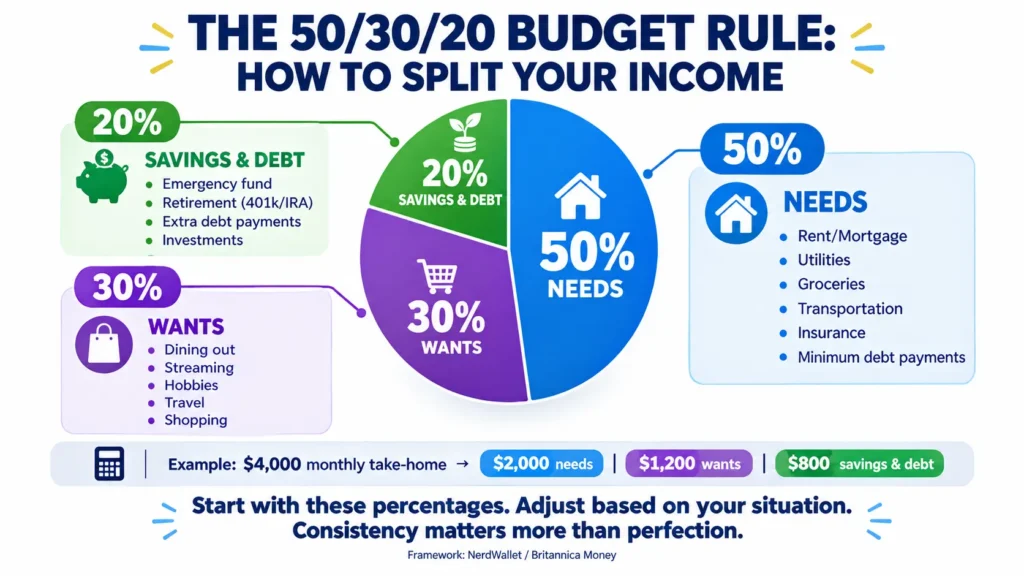
The most widely recommended starting framework is the 50/30/20 rule. One option is the 50/30/20 budget plan, which allocates 50% of your income for needs, 30% for wants, and 20% for savings and debt repayment.
Breaking it down practically:
50% — Needs: Rent or mortgage, utilities, groceries, transportation, insurance, minimum debt payments. These are non-negotiable monthly obligations.
30% — Wants: Dining out, streaming subscriptions, hobbies, travel, clothing beyond basics. These improve quality of life but can be adjusted.
20% — Savings and Debt: Emergency fund contributions, retirement account deposits, extra debt payments, investments. This is the category that builds your future.
The 50/30/20 rule isn’t meant to be a precise budgeting law, but a general guideline to help you think about how to allocate your paychecks. Adjustments are normal — someone with high rent in an expensive city might need 60% for needs and 10% for wants. The framework provides direction, not a rigid formula.
For an interactive 50/30/20 calculator and personalized budgeting tools, NerdWallet’s complete money management guide walks through each category with real income examples.
Budgeting Apps in 2026
By tracking expenses, you can see exactly where your money is going. It may inspire you to cut back in a certain category or adjust your spending habits to better align with your goals.
Top budgeting apps recommended in 2026 include YNAB (You Need a Budget) for zero-based budgeting discipline and Monarch Money for households tracking family finances across multiple accounts.
Automating Your Budget
Setting up automatic payments for credit cards, debt, and savings and investments can take some of the stress out of money management. Automating payments adds consistency to your money routine and can help you stay on track.
Automation is one of the most underrated money management skills. When savings transfer automatically on payday, the money isn’t available for impulse spending. The decision is made once — not every month.
Skill 2 — Building an Emergency Fund
An emergency fund is the financial buffer that separates a setback from a catastrophe. Without one, a $1,200 car repair or $800 medical bill can force you into debt.
Many experts recommend building up several months of bare-bones living expenses. NerdWallet suggests starting an emergency fund of at least $500, which could be enough to cover small emergencies and repairs. If that starting amount isn’t possible, put at least a little bit toward the fund every paycheck.
The traditional recommendation is 3 to 6 months of living expenses. However, many financial experts in 2026 now recommend aiming closer to 6 months because of inflation and uncertain job markets.
According to a recent NerdWallet survey, 46% of Americans planned on saving money for emergencies in 2026. That means 54% did not — putting them one unexpected expense away from debt.
One way to make money management easier is to keep money designated for bills and budgeted expenses separate from your emergency fund. A dedicated high-yield savings account works well for this separation — it earns interest while remaining accessible.
Some people accelerate emergency fund building by combining budget cuts with passive income apps that generate $50-150/month with minimal ongoing effort
Skill 3 — Debt Management
Carrying the wrong kind of debt is one of the fastest ways to undermine every other money management skill you develop. A different NerdWallet study found that nearly half of Americans (46%) say they regularly stress about their debt balance(s).
Good Debt vs. Bad Debt
Not all debt is the same. Mortgages at 6-7% and federal student loans at 4-8% finance appreciating assets or earning potential. Credit card debt at 20-29% APR actively destroys wealth — every unpaid dollar compounds against you.
The priority order for debt management within solid money management skills practice:
| Priority | Action | Reason |
| First | Get employer 401(k) match | Free money with guaranteed 50-100% return |
| Second | Pay off high-interest debt (20%+ APR) | Eliminating 20% interest beats most investments |
| Third | Build emergency fund to $500-$1,000 | Prevents new debt from emergencies |
| Fourth | Continue investing while paying remaining debt | Compounding returns over time |
The Avalanche vs. Snowball Method
Two proven debt payoff strategies exist. The avalanche method targets the highest-interest-rate debt first—mathematically optimal and saving the most money in total interest paid. The snowball method pays the smallest balance first — psychologically powerful, generating early wins that maintain motivation.
Both work. The best method is whichever one you’ll actually maintain consistently.
Skill 4 — Goal-Based Saving
Saving without a specific goal is one of the weakest money management skills in practice — it’s too easy to spend “extra” money that isn’t earmarked for something specific. Goal-based saving assigns each saved dollar a purpose.
Studies show savings increase after a goal-setting session. This is why naming your savings accounts matters — “Emergency Fund,” “House Down Payment,” “Vacation 2027” — each one triggers different saving behavior than a single unnamed account.
Common savings goals with realistic timelines:
| Goal | Recommended Amount | Timeline |
| Starter emergency fund | $500-$1,000 | 1-3 months |
| Full emergency fund | 3-6 months of expenses | 6-18 months |
| House down payment | 3-20% of purchase price | 2-7 years |
| Car replacement fund | $3,000-$8,000 | 2-4 years |
| Retirement | 10-15% of annual income ongoing | 20-40 years |
Don’t wait until you can save large amounts. Small decisions repeated over time create real results. The sooner you build smart financial habits, the easier your future becomes.
Skill 5 — Credit Score Management
Your credit score functions as a financial reputation score that affects your ability to rent apartments, get loans, finance cars, and sometimes even get hired. It is one of the money management skills with the widest-reaching consequences.
The five factors that determine a FICO credit score:
- Payment history — 35% of your score
- Amounts owed (credit utilization) — 30%
- Length of credit history — 15%
- Credit mix — 10%
- New credit inquiries — 10%
The two highest-impact actions for improving your credit score are paying every bill on time (even minimums) and keeping credit card utilization below 30% of available limits.
your can get a free credit report once a year from each of the three bureaus at AnnualCreditReport.com. Errors on credit reports are common and can artificially suppress your score — reviewing the report annually is a fundamental money management skill.
Skill 6 — Investing Basics
Investing is where money management skills transition from maintaining financial stability to building long-term wealth. The distinction matters: saving preserves what you have, while investing grows it.
Only 36% of risk-related questions were answered correctly in 2026, and this is the one functional area where performance is consistently low across all generations, showing little improvement with age. Understanding investment risk is one of the weakest money management skills among American adults.
The fundamental principles of beginner investing:
Start with tax-advantaged accounts first. A 401(k) with an employer match offers an immediate 50-100% return on contributions before any market gains. A Roth IRA provides decades of tax-free growth.
Index funds over individual stocks. For beginners, low-cost S&P 500 index funds reduce single-company risk and have historically delivered about 10% average annual returns over long periods.
Time in market beats timing the market. Waiting for the “right moment” to invest costs more in missed compounding than short-term market volatility.
The power of compound interest: $200 per month invested at 7% average annual return over 30 years grows to approximately $243,000. The same $200 kept in a savings account at 4% APY over 30 years reaches roughly $139,000. The difference — $104,000 — is the return on developing investing as a money management skill.
Skill 7 — Insurance and Risk Protection
Financial planning without insurance leaves a major gap in your wealth-building strategy. A single uninsured health event, car accident, or disability can erase years of careful saving in one incident.
The core insurance categories every adult should evaluate:
Health insurance: Medical debt is the leading cause of personal bankruptcy in the United States. Even a high-deductible plan with an HSA is far better than being uninsured.
Renter’s or homeowner’s insurance: Protects personal property against theft, fire, and certain natural disasters. Renter’s insurance typically costs $15-30/month — one of the highest-value financial protections per dollar spent.
Auto insurance: Most states require it by law. Liability minimums protect others; comprehensive coverage protects your own vehicle.
Disability insurance: Often overlooked, disability insurance replaces income if you can’t work. The Social Security Administration reports that one in four 20-year-olds will experience a disability before retirement age.
Life insurance: Necessary if others depend on your income. Term life insurance is the most cost-effective option for most families.
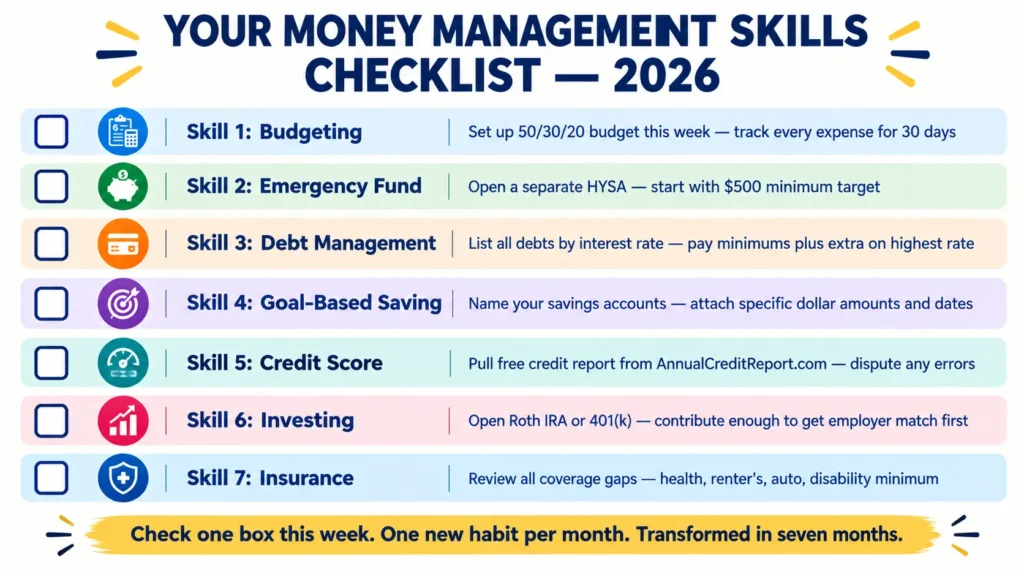
Money Management Skills by Life Stage
For Students
Money management skills for students center on three priorities: avoiding unnecessary debt, building credit carefully, and establishing saving habits before major financial obligations arrive.
Students should avoid carrying credit card balances at all — the 20-29% APR on typical student credit cards is the most expensive money any student will ever borrow. Using a credit card for purchases and paying it in full monthly builds credit history without interest costs.
Half of the students think their school is not doing enough to make them financially literate. Self-directed learning fills this gap.
For Young Adults (22-35)
The early career years are when money management skills compound most powerfully. Getting a 401(k) match from the first job, building credit with disciplined card use, and avoiding lifestyle inflation as income rises are the three habits that most strongly differentiate financially secure young adults from those who struggle.
Between 57% and 62% of the general population are confident in their money management skills, compared to 43% to 50% of Gen Z. This confidence gap matters — lower confidence often leads to financial avoidance, which has real costs.
For Kids
Only 23% of children frequently talk about money with their parents. Yet research consistently shows that financial habits formed in childhood persist into adulthood. Teaching kids the difference between needs and wants, how to save a portion of what they receive, and how to delay gratification for a larger goal builds money management skills that compound over a lifetime.
The Weekly Money Review
Creating a ‘Friday finance hour’ — a weekly check-in with yourself to keep on top of finances — helps your budget change appropriately according to your lifestyle and commitments.
A weekly 10-minute financial review accomplishes more than most people achieve in a month of passive spending. It keeps you aware, catches overspending before it compounds, and reinforces the behavioral habits that make money management skills stick long-term.
Disclaimer
This article presents educational information about personal finance and money management principles. All statistics are sourced from the 2026 TIAA Institute–GFLEC P-Fin Index, NerdWallet, FINRA, National Financial Educators Council, WalletHub, and other verified sources cited throughout. This is not personalized financial advice. Individual circumstances vary significantly. Consult a licensed financial advisor before making major financial decisions. Past investment performance does not guarantee future results.
Conclusion
Money management skills are not innate — they are learned, practiced, and refined over time. The data makes the stakes clear: poor financial literacy costs the average American nearly $1,000 per year, while those with very low literacy are five times less likely to have even one month of emergency savings.
The framework presented here covers all seven core skills: budgeting with the 50/30/20 rule, emergency fund building, debt management, goal-based saving, credit score maintenance, investing basics, and insurance protection. None of these require a finance degree or a high income. They require consistent habits, honest tracking, and patience.
Start with whichever skill reveals the biggest gap in your current practice. For most people, that’s budgeting — because you can’t manage what you aren’t tracking.
Ready to build on these foundations? Our complete guide on how to invest in stock market for beginners shows exactly how to put that 20% savings allocation to work once your emergency fund and debt situation are stable. To understand where your investment money goes, our guide on how to read stock market charts provides the visual literacy tools every beginning investor needs.
Financial freedom doesn’t arrive in one decision. It arrives through hundreds of small, consistent ones — all built on the money management skills covered here.
FAQ Section
Q1: What are the most important money management skills to learn first?
Start with budgeting and building an emergency fund. These two skills form the foundation for everything else. According to NerdWallet, even $500 in an emergency fund meaningfully reduces financial vulnerability. Once those are in place, add debt management and basic investing. The 50/30/20 budgeting rule provides a clear starting framework for beginners.
Q2: How do money management skills differ for students vs. young adults?
Students should prioritize avoiding high-interest debt and building credit without carrying balances. Young adults entering the workforce should focus on maximizing employer 401(k) matches, avoiding lifestyle inflation as income rises, and investing early to benefit from decades of compounding. The core skills are the same — the application priorities shift by life stage.
Q3: Why do Americans struggle so much with money management skills?
According to the 2026 P-Fin Index, U.S. adults answer only 49% of basic personal finance questions correctly — unchanged for nearly a decade. Only 45% of high schoolers took a personal finance class in 2025. Financial education gaps, combined with increasingly complex financial products, mean most adults navigate major financial decisions without adequate preparation.
Q4: What is the 50/30/20 rule and does it actually work?
The 50/30/20 rule allocates 50% of after-tax income to needs, 30% to wants, and 20% to savings and debt repayment. It works as a starting framework precisely because it is simple enough to implement immediately. Adjustments are normal based on local cost of living and personal circumstances. Many personal finance experts and NerdWallet recommend it as the easiest entry point into budgeting.
Q5: How much should I have in an emergency fund?
Most financial experts in 2026 now recommend 6 months of essential living expenses, updated from the traditional 3-6 month recommendation due to higher inflation and uncertain job markets. If that feels too large to start, NerdWallet recommends beginning with $500 as an initial target — enough to cover the most common minor emergencies without turning to high-interest credit cards.
Q6: What money management skills are most important for kids?
The three foundational skills for children are: (1) distinguishing needs from wants, (2) saving a consistent portion of any money received, and (3) understanding delayed gratification — waiting for something larger instead of spending immediately. Only 23% of children frequently discuss money with their parents, according to 2026 data, making intentional financial conversations at home crucial for developing these skills early.

Financial enthusiast with 5 years of experience in the US market trends and personal wealth management