
Introduction
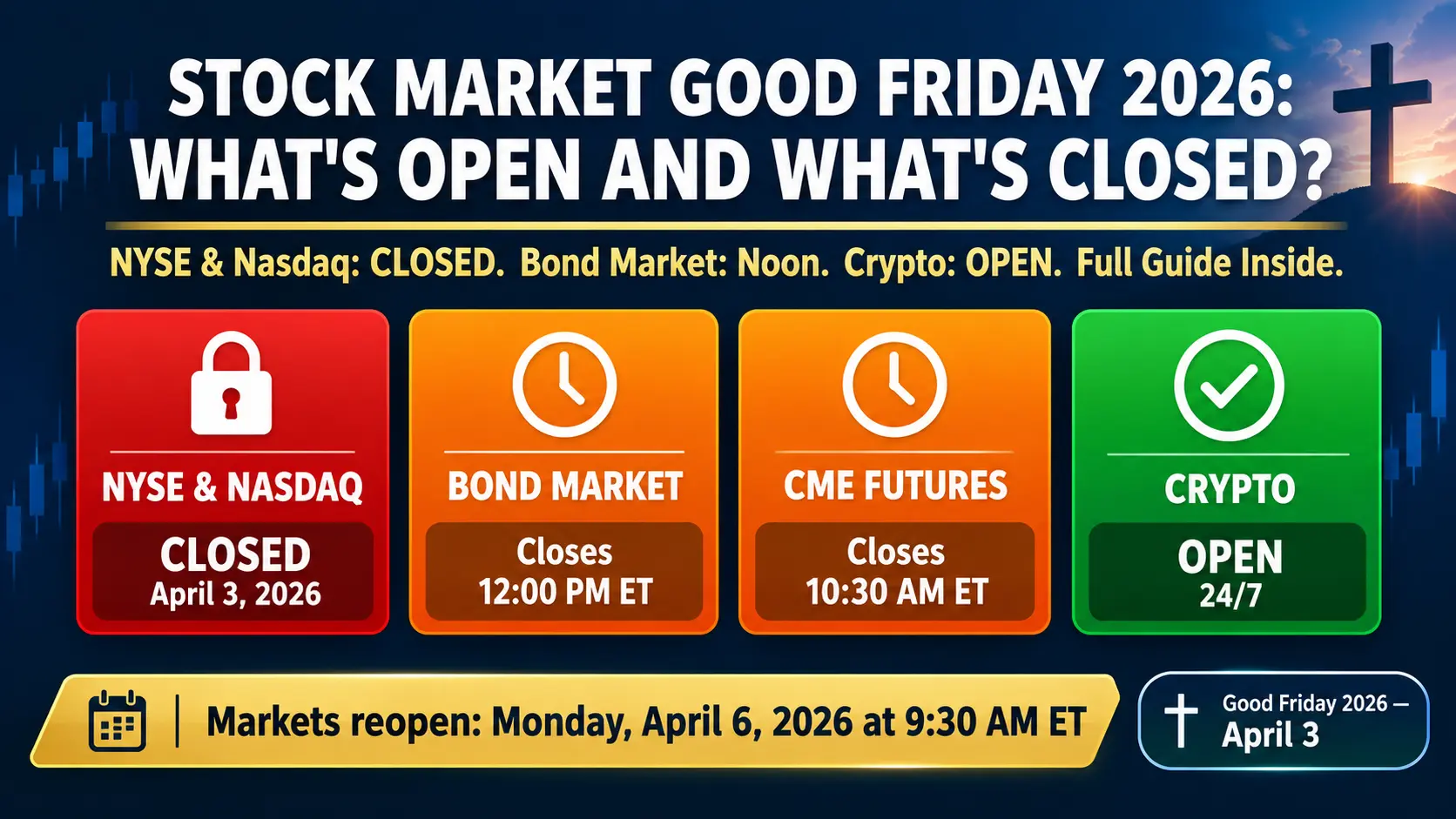
In 2026, the NYSE and Nasdaq will close on the Good Friday, April 3. That’s the short answer. But the longer answer matters more to active traders — because while equity markets go completely dark, not everything stops. Bond markets operate on a different schedule, crypt runs 24/7, and futures trading has its own window. If you’re planning trades around the Easter weekend, here’s exactly what stays open, what closes, and why this particular Friday has been a market holiday since 1864.
The 2026 Schedule
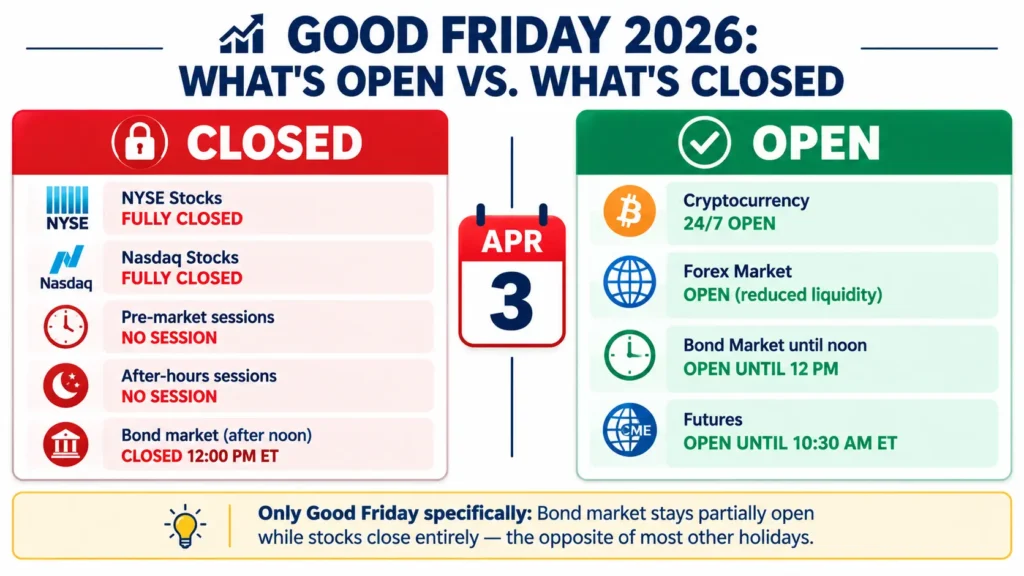
Good Friday 2026 falls on April 3. Here is every market’s exact status for that day, verified from official exchange sources.
Stock Markets (NYSE and Nasdaq)
Both major US stock exchanges are closed on Good Friday. Like most federal holidays, the NYSE and Nasdaq are closed on Good Friday. Regular trading — which normally runs from 9:30 a.m. to 4:00 p.m. Eastern Time — does not take place at all on April 3, 2026.
This closure applies to all securities listed on these exchanges: individual stocks, Effs, and mutual funds that trade on the exchange floor. There are no abbreviated hours, no partial sessions. It is a full-day closure.
Bond Markets
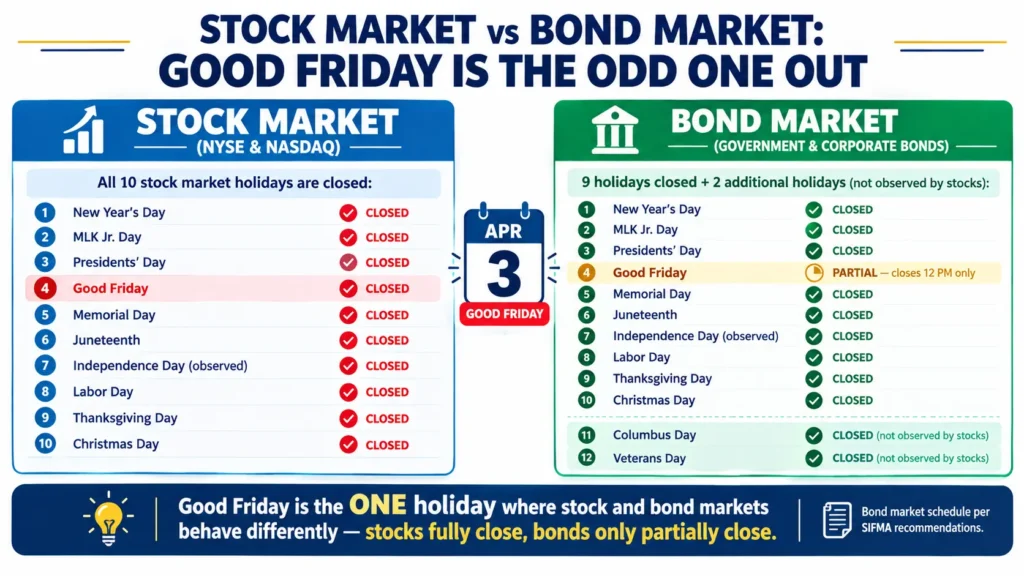
Bond markets operate under a separate calendar managed by SIFMA — the Securities Industry and Financial Markets Association. U.S. bond markets close on nine of the stock market holidays (all but Good Friday) — meaning that on this specific holiday, the bond market stays partially open. Bond trading will be open until 12 p.m. Eastern time.
There’s also an important pre-holiday note: the bond markets close early at 2 p.m. on the Thursday before Good Friday — Thursday, April 2, 2026. Fixed-income traders also need to account for this early close the day before.
Futures Markets
Electronic trading on the Chicago Mercantile Exchange will be open briefly on Good Friday, giving investors a window until 10:30 a.m. Eastern time to trade futures for the S&P 500 stock index and other financial instruments.
Cryptocurrency
Good Friday closures do not affect crypto markets at all. Bitcoin, Ethereum, and other digital assets trade around the clock every day of the year, including holidays. That said, reduced liquidity in traditional markets can dampen overall crypto activity — but exchanges themselves remain fully operational.
Foreign Exchange (Fores)
The forex market also stays open on Good Friday with reduced participation. However, major European currency pairs see thinner liquidity because foreign stock markets such as the London Stock Exchange, Hong Kong Stock Exchange, and Frankfurt Stock Exchange are all closed on Good Friday.
Complete 2026 Market Status Table (Good Friday)
| Market | Status on April 3, 2026 | Hours |
| NYSE (Stocks) | CLOSED | No trading |
| Nasdaq (Stocks) | CLOSED | No trading |
| Bond Market | PARTIAL | Open until 12:00 p.m. ET |
| CME Futures | PARTIAL | Open until 10:30 a.m. ET |
| Cryptocurrency | OPEN | 24/7 as normal |
| Forex | OPEN | Reduced liquidity |
| Pre-market trading | CLOSED | No session |
| After-hours trading | CLOSED | No session |
The Full 2026 Stock Market Holiday List
In 2026, NYSE and Nasdaq observe Good Friday among their ten market holidays. Here is the complete schedule for 2026:
| Holiday | Date |
| New Year’s Day | Thursday, January 1 |
| Martin Luther King Jr. Day | Monday, January 19 |
| Presidents’ Day | Monday, February 16 |
| Good Friday | Friday, April 3 |
| Memorial Day | Monday, May 25 |
| Juneteenth | Friday, June 19 |
| Independence Day (observed) | Friday, July 3 |
| Labor Day | Monday, September 7 |
| Thanksgiving Day | Thursday, November 26 |
| Christmas Day | Friday, December 25 |
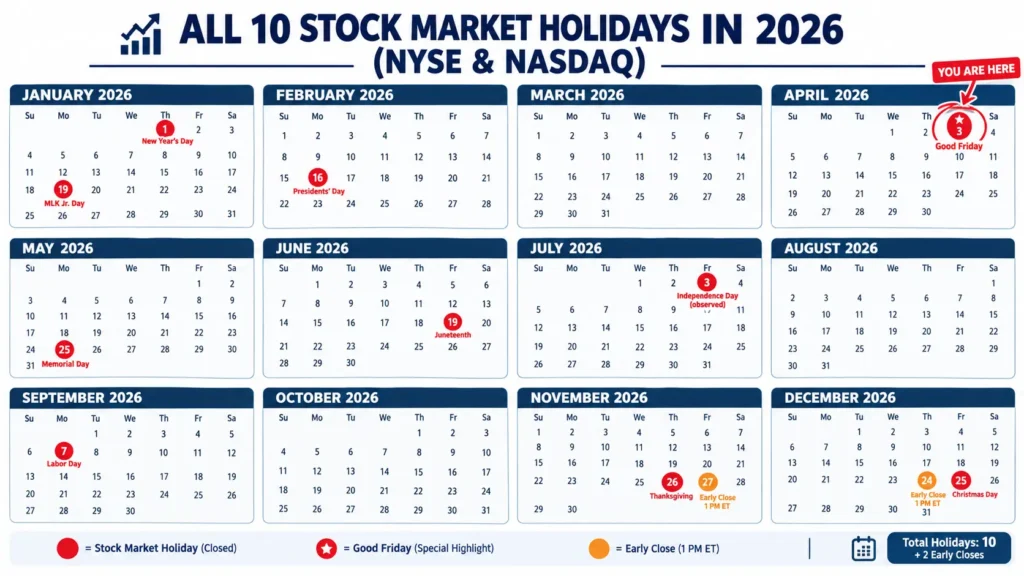
Additionally, the exchanges close early at 1 p.m. ET on the day after Thanksgiving (Friday, November 27) and Christmas Eve (Thursday, December 24).
For the most current official listing of all NYSE and Nasdaq closures, visit Fidelity’s stock market holidays page — updated annually with early-close days included.
Why does the stock market close on Good Friday?
This is the question most people don’t think to ask — but it has a surprisingly complicated answer.
It Is Not a Federal Holiday
Good Friday is not a federal holiday in the United States, nor is it a traditional bank holiday. However, both the NYSE and Nasdaq have consistently closed on Good Friday for decades. This makes it unique among the ten annual market holidays — every other closure corresponds to a federal holiday. Good Friday stands alone as the only market closure based purely on tradition, not government mandate.
The History Goes Back to 1864
The New York Stock Exchange, which opened for business in 1817, first shut down trading for Good Friday in 1864. Since then, the exchange has closed on Good Friday every year but three: 1898, 1906, and 1907, according to the NYSE.
Three Theories Behind the Tradition
Nobody knows the exact origin with certainty. The exact reason for U.S. stock markets closing on Good Friday is unclear. One longstanding theory suggests that an early lease agreement for the NYSE may have included a provision requiring closure on this day.
A second theory relates to banking alignment. The Federal Reserve Banks and most U.S. banks close on Good Friday. Since clearinghouses and settlement systems depend on bank infrastructure, maintaining an active trading floor would create logistical bottlenecks.
A third explanation is international coordination. Major European exchanges, including Euro next, Deutsche Börse, and the London Stock Exchange, close on Good Friday. With reduced liquidity abroad, domestic trading volumes would naturally decline anyway.
Whatever the original reason, Wall Street’s adherence to this tradition has persisted for over 160 years.
What Happens to Your Orders?
If you place a trade order on Good Friday when equity markets are closed, your order does not execute that day. Active traders need to understand what happens next.
Limit orders placed on Good Friday are typically held and execute when markets open on the following Monday morning — Easter Monday, April 6 in 2026. However, the exact treatment depends on your broker’s policies and whether you set your order as day-only or good-till-canceled.
Market orders placed on a closed market day will execute at the opening price on the next trading day. Because markets frequently gap up or gap down on Monday mornings after long weekends—especially when major news breaks over the weekend—a market order placed on Good Friday carries meaningful execution risk.
Per-market and after-hours sessions do not occur on Good Friday. The stock market opens at 9:30 a.m. Monday through Friday, but extended trading hours make it possible to trade even when the market is closed. However, on exchange holidays like Good Friday, extended hours are suspended.
What About Easter Monday?
The market is open on Easter Monday. The stock market closes on Good Friday and resumes normal operations the following Monday.
In 2026, normal trading resumes on Monday, April 6. Both NYSE and Nasdaq return to regular hours of 9:30 a.m. to 4:00 p.m. Eastern Time. There are no abbreviated sessions on Easter Monday — it is a full standard trading day.
Good Friday 2027 and Beyond
Planning further ahead? The NYSE has announced it will be closed for Good Friday on March 26, 2027, and on April 14, 2028. Good Friday’s date shifts each year because it is tied to the lunar calendar and falls on the Friday before Easter Sunday, which itself falls on the first Sunday after the first full moon following the spring equinox.
Practical Checklist for Traders
If you have active positions or pending orders heading into Good Friday, here is what to review before markets close Thursday:
The bond market closes early at 2:00 p.m. ET on Thursday, April 2 — the day before Good Friday — so any fixed income trades need to be settled before that window closes.
Futures traders have a brief window on Good Friday morning until 10:30 a.m. ET on the CME, but equity-index futures will not be a meaningful liquidity environment.
Any stop-loss orders or limit orders set as “good till canceled” will carry over to Monday, April 6 at whatever price levels you have set. Review whether those levels still make sense, since markets may open differently after a long weekend.
Crypto positions require no special planning for Good Friday—exchanges remain open, and you can manage positions at any time over the holiday weekend.
Disclaimer
This article presents factual scheduling information sourced from Fidelity, Kiplinger, AARP, Motley Fool, Fox Business, and TradingHours.com, all verified for 2026. Market holiday schedules are set annually by NYSE and SIFMA and may change. Always verify current holiday schedules directly with your brokerage or on the NYSE’s official website before placing trades. This is not financial or investment advice.
Conclusion
The stock market on Good Friday follows a clear, predictable pattern that has held for over 160 years: NYSE and Nasdaq close entirely, bond markets close at noon, futures trading ends at 10:30 a.m. ET, and crypto continues without interruption. In 2026, Good Friday falls on April 3, with markets resuming full operations on Monday, April 6.
The practical takeaway for any active trader is straightforward — settle your Thursday bond positions before 2:00 p.m. ET on April 2, review pending equity orders before Thursday’s close, and the market will price in Easter weekend news Monday morning.
Want to understand how market holidays fit into broader trading patterns? Our guide on current stock market trends covers the macro factors driving US equity markets right now, and our complete guide on how to read stock market charts explains how to analyze the price action that often follows long holiday weekends when markets reopen.
FAQ Section
Q1: Is the stock market open or closed on Good Friday 2026?
The stock market is closed on Good Friday 2026. NYSE and Nasdaq close on April 3, 2026. No equity trading takes place, and there are no pre-market or after-hours sessions. Bond markets close at 12:00 p.m. ET. Futures trading on the CME ends at 10:30 a.m. ET. Crypto markets remain open as normal.
Q2: Why is the stock market closed on Good Friday but not other Christian holidays?
Good Friday has been observed as a market closure since 1864 — a tradition that predates most current exchange rules. It is the only market holiday that is not also a federal holiday. The closure aligns with early bank closures, European exchange shutdowns, and a long-standing Wall Street tradition. Financial historians debate the exact original reason.
Q3: Are bond markets open on Good Friday?
Partially. Bond markets, which follow a SIFMA-recommended schedule rather than NYSE’s calendar, stay open until 12:00 p.m. ET on Good Friday. They also close early at 2:00 p.m. ET on the Thursday before Good Friday. Bond markets are one of the few segments of US financial markets that treat Good Friday differently from equity markets.
Q4: Can I still trade crypto or forex on Good Friday?
Yes. Cryptocurrency exchanges operate 24 hours a day, 7 days a week, including all holidays. Forex markets also remain open on Good Friday, though trading volume in major pairs like EUR/USD is reduced because European exchanges, including the London Stock Exchange, are also closed. Expect wider spreads and lower liquidity in forex on Good Friday.
Q5: When does the stock market reopen after Good Friday 2026?
The stock market reopens on Monday, April 6, 2026 — Easter Monday — with full regular trading hours of 9:30 a.m. to 4:00 p.m. Eastern Time. Easter Monday is not a market holiday in the United States, so trading resumes normally after the long weekend.

Financial enthusiast with 5 years of experience in the US market trends and personal wealth management