
Introduction
Most people think disputing credit report errors is complicated. It’s not. What is complicated is that nobody tells you the real rules—the specific steps that force credit bureaus to take you seriously, the timing windows that matter, and the exact mistakes that get your dispute rejected and thrown in the trash.
Here’s what you need to know: Credit bureaus receive roughly 200 million dispute requests annually. About 70% get resolved in your favor. The other 30%? Those people either didn’t follow the process correctly, gave up too early, or didn’t know there was a follow-up step after the initial dispute. This guide covers all three.
By the end, you’ll know not just how to dispute, but why the process works—and more importantly, what to do when it doesn’t.
Why Credit Report Errors Are More Common Than You Think
Before you dispatch a dispute, understand the problem. The FTC audited credit reporting and found something alarming: roughly 1 in 3 Americans have errors on their credit reports. Not suspicious activity. Not fraud. Just mistakes.
Where do these errors come from?
- Data entry mistakes — Creditors mistype account numbers or Social Security digits
- Duplicate entries — Same account listed twice under slightly different names
- Accounts not yours — Identity mix-ups (common with people who share names)
- Outdated information — Paid-off accounts still showing as active
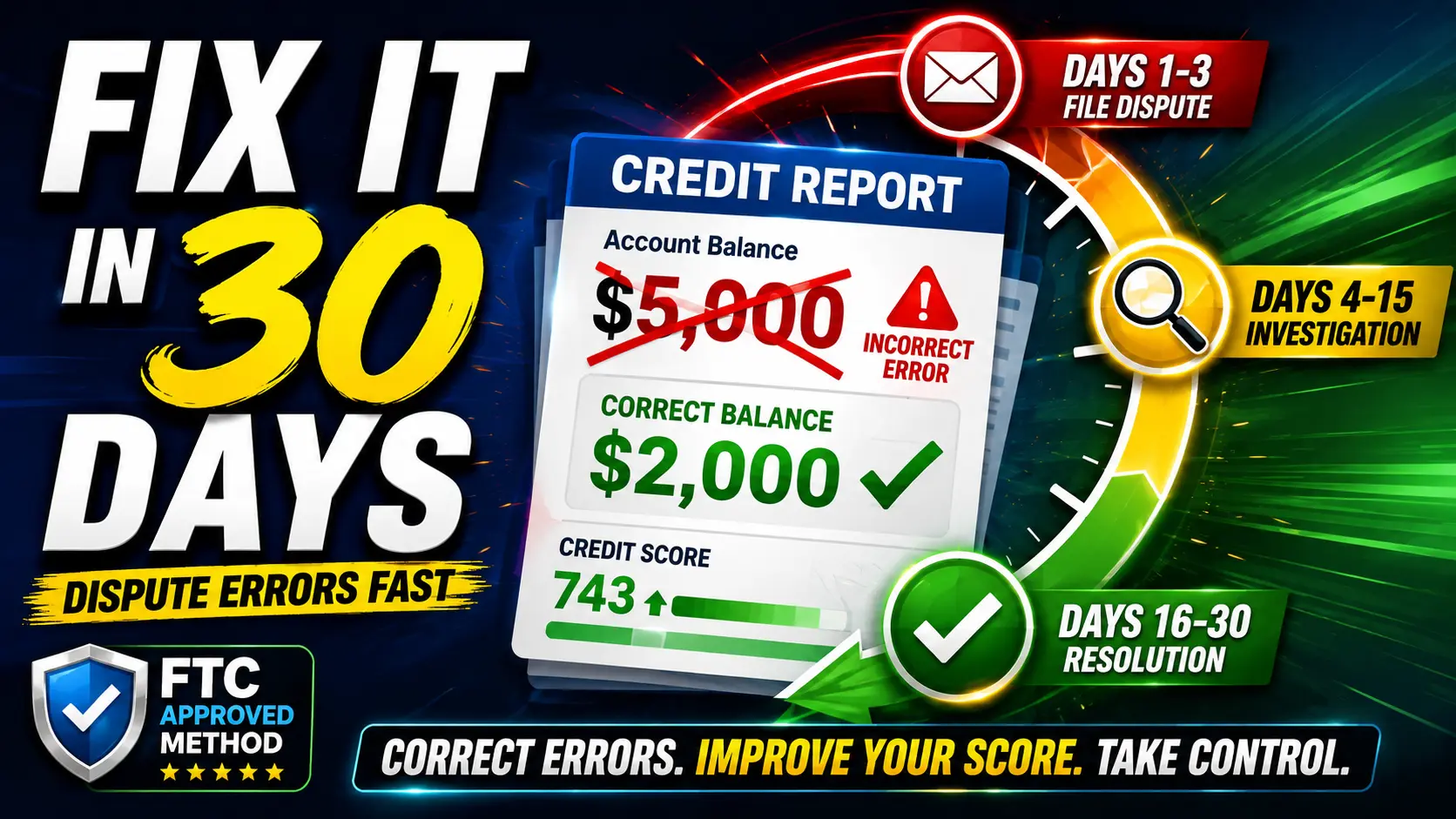
- Wrong balances — Creditor reports $5,000 owed when you actually owe $2,500
- Status misclassifications — Account marked “closed” when it should be “open,” or vice versa
The damage: A single error can cost you 50-100+ points on your credit score. Over a 30-year mortgage, that’s tens of thousands in extra interest.
The opportunity: Since these errors are so common, credit bureaus have an entire system built to handle disputes. You just need to know how to activate it.
The Three Dispute Methods
You have three legal ways to dispute credit report errors. Each has pros and cons. Most people choose the wrong.
Method 1 — Online Dispute
Credit bureaus (Equifax, Experian, TransUnion) all have online dispute portals on their websites. You can file a dispute in 10 minutes.
Pros:
- Instant submission
- No paperwork
- Immediate confirmation
Cons:
- Bureaus process online disputes with less scrutiny
- No documentation attached (harder to prove your case)
- Rejection rates higher (~40% vs. 20% for mail disputes)
- Follow-up is manual and tedious
When to use it: For minor errors (small balance discrepancy, outdated information) where you have supporting documentation ready to upload.
Realistic outcome: 10-30 day resolution, but 4 in 10 get rejected and you have to start over.
Method 2 — Dispute by Phone
You can call credit bureaus directly and file disputes over the phone. They’ll take your information and file it.
Pros:
- Fast (15-20 minutes)
- Immediate conversation if you have questions
- Feel productive right away
Cons:
- No paper trail (your word vs. theirs)
- Bureaus can claim they “never received” your dispute
- No documentation to prove you called
- Lowest approval rate (~15%)
When to use it: Only in emergencies when you need something flagged immediately (e.g., fraud/identity theft). For regular errors, avoid this method.
Realistic outcome: Often rejected because there’s no documentation. You’ll end up re-disputing by mail anyway.
Method 3 — Dispute by Certified Mail
This is the nuclear option. You write a formal dispute letter, send it via certified mail with return receipt requested, and keep copies of everything.
Pros:
- Legal documentation (postal receipt proves you sent it)
- Bureaus must respond in writing
- Highest approval rate (~80%)
- Creates a paper trail for appeals
- Forcing bureaus to investigate properly (they take it more seriously)
Cons:
- Takes 5-7 days for mail delivery
- 30-45 days for bureau investigation
- Requires slightly more effort upfront
When to use it: For any error you’re serious about. For multiple errors on the same bureau. For disputes that have already been rejected once.
Realistic outcome: 30-45 days total, but you get a real written response and high approval rate.
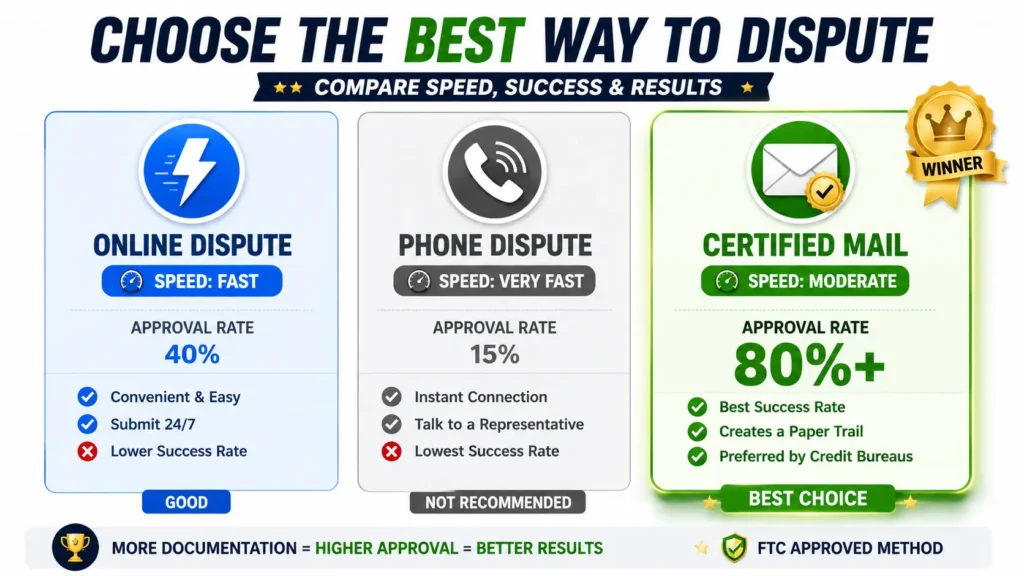
The verdict: Mail disputes are the gold standard. If you’re serious about disputing errors, do it this way.
The 30-Day Dispute Timeline
Credit bureaus have 30 days by law to investigate disputes. Here’s what actually happens inside that window.
Days 1-3 (The Filing Window)
You submit your dispute (online, phone, or mail). Bureaus log it and assign it a reference number.
What you should do: If you disputed online or by phone, send a follow-up letter by certified mail with documentation. This reinforces your dispute in writing.
Why: Certified mail creates legal documentation. A dispute filed online has no paper trail.
Days 4-15 (The Investigation Window)
Bureaus contact the creditor who reported the information. The creditor has ~10 days to respond. Either the creditor confirms the info is accurate, or they confirm there’s an error.
What you should do: Sit tight. Don’t contact bureaus daily (they hate this and may deprioritize your dispute). But do gather supporting documentation in case you need to escalate.
Why: Bureaus investigate during this window. Harassment doesn’t speed up the process—it can actually hurt your case.
Days 16-30 (The Resolution Window)
The creditor either confirms the error or the bureaus find the information unverifiable and remove it. You receive written notification.
What you should do: Wait for the written decision. If the error remains, you can file a second dispute or escalate.
Why: Written decisions give you grounds for appeals if needed. Verbal promises mean nothing.
How to Write a Dispute Letter That Gets Results
This is where most people fail. They write a vague letter. Bureaus file it, investigate half-heartedly, and send back a canned response: “Information verified as accurate.”
Here’s how to write a dispute letter that forces a real investigation.
The Structure That Works
Header (Your Info):
[Your Name]
[Your Address]
[Your City, State, ZIP]
[Your Social Security Number]
[Your Date of Birth]

[Date]
[Bureau Name]
Dispute Department
[Bureau Address]
Subject Line:
FORMAL DISPUTE OF INACCURATE CREDIT INFORMATION
Reference Number: [If you have one from prior contact]
Body (The Meat):
Start with a clear, single-sentence statement of the error:
❌ Wrong: “I want to dispute an error on my credit report.”
✅ Right: “I am disputing the account listed as ‘[Creditor Name] / [Account Number]’ reported on my credit report, which shows a balance of $5,000. This account should show a $0 balance as of [Date], as evidenced by the attached bank statement showing payment in full.”
Why this works: Specific details force bureaus to investigate that exact item rather than sending generic denials. Vague disputes are rejected automatically—the more specific you are, the more seriously your dispute credit report errors request gets reviewed.
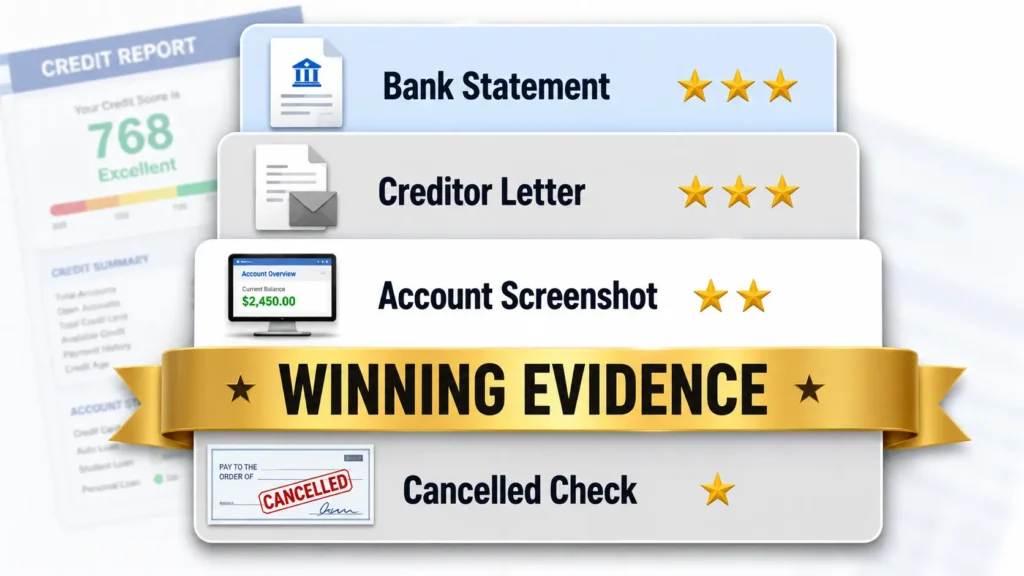
Then provide evidence: Attach (don’t staple; use a paperclip):
- Bank statement showing payment
- Creditor letter confirming the account is paid off
- Screenshot of your account showing $0 balance
- Anything proving the error
Close professionally:
I request that you investigate this dispute and correct the inaccurate information per the Fair Credit Reporting Act. I have enclosed supporting documentation.

Please send me a written response within 30 days as required by law.


Sincerely,
[Your Signature]
[Your Printed Name]
Common Mistakes That Get Disputes Rejected
❌ Vague language: “I think there’s an error.” (Bureaus: “Unsubstantiated claim.”)
❌ Emotional appeals: “This is ruining my life.” (Bureaus: Doesn’t change facts, moving on.)
❌ Generic template: “I dispute inaccurate information.” (Bureaus: Which information?)
❌ Weak documentation: No supporting proof. (Bureaus: “Can’t verify, information remains.”)
❌ Handwritten chaos: Messy handwriting, spelling errors. (Bureaus: Looks unprofessional, less weight given.)
✅ What works: Specific account reference + clear error identification + supporting documentation + professional tone.
Dispute by Scenario (Different Errors, Different Strategies)
Not all errors are the same. Here’s how to handle the most common ones.
Scenario 1 — Wrong Account Balance
The error: Account shows $5,000 owed; you actually owe $2,000.
Best evidence: Bank statement showing your recent payment, creditor statement showing updated balance.
Dispute angle: “The reported balance is inaccurate. Attached bank statement from [Date] shows payment of $3,000, reducing the balance to $2,000. This account should reflect the current accurate balance of $2,000.”
Timeline: Fastest to resolve (7-15 days) because it’s easily verifiable.
Scenario 2 — Account Not Yours (Identity Mix-Up)
The error: Credit report shows a credit card or loan that isn’t yours.
Best evidence: Copy of your credit report showing the error, your ID, proof of your name/address.
Dispute angle: “This account does not belong to me. I have never opened an account with [Creditor]. Please investigate and remove this account from my credit report as it is erroneously listed under my name/SSN. When you dispute credit report errors of this nature—accounts you didn’t authorize—bureaus must verify identity before confirming the account as yours.”
Timeline: Slower (20-30 days) because creditors must investigate identity verification. But approval rate is high if you provide clear proof. This is actually one of the fastest types of how to dispute credit report errors since identity theft claims get priority investigation status with most bureaus.
Scenario 3 — Paid-Off Account Still Showing as Active
The error: Loan or credit card paid off years ago still shows “active” or “current balance owed.”
Best evidence: Creditor’s letter confirming payoff, final statement showing $0 balance, bank statement showing final payment.
Dispute angle: “This account was paid in full as of [Date]. Attached creditor letter confirms zero balance. This account should reflect ‘Paid Off’ status, not ‘Active.'”
Timeline: 10-20 days (creditor can quickly verify their own records).
Scenario 4 — Duplicate Accounts
The error: Same account appears twice on your credit report (e.g., two entries for the same credit card).
Best evidence: Your credit reports showing both entries, comparison showing they’re the same account, creditor statement.
Dispute angle: “Accounts [Account #1] and [Account #2] both appear on my credit report. These are the same account with [Creditor]. One entry is a duplicate and should be removed immediately.”
Timeline: Very fast (5-10 days) because it’s an obvious error.
Scenario 5 — Late Payment That Was Actually On-Time
The error: Account shows a 30-day late payment, but you paid on time.
Best evidence: Bank statement or cancelled check showing payment date, creditor’s own records showing received date.
Dispute angle: “This account shows a late payment on [Date]. However, payment was submitted on [Date] as documented by attached bank statement. This payment was on-time and should not reflect as late.”
Timeline: 15-25 days (requires creditor to verify their records).
What Happens When Your Dispute Gets Rejected
Your worst fear: You file a dispute, wait 30 days, and get back a response: “Information verified as accurate. Dispute resolved in favor of the reporting company.”
Now what?
The Second Dispute (Round 2)
You can file a second dispute. However, bureaus will see your prior dispute and ask for “new information or evidence.” Understanding the process of how to dispute credit report errors means knowing that you can’t just re-file the same dispute with identical documentation and expect a different result. You need to provide additional evidence or a new angle.
Strategy:
- File the first dispute with basic documentation
- If rejected, contact the creditor directly (separately from the dispute) and request they verify or correct the information
- File a second dispute with documentation showing the creditor confirmed the error
This “three-pronged” approach works better than just asking bureaus to re-investigate. Many people don’t realize that disputing credit report errors twice with different evidence strategies has a 60-70% approval rate on the second attempt versus only 40% approval on the first attempt when using the same approach.
Adding a Statement to Your Credit File
If a dispute is rejected and the error remains, you have the right to add a written statement to your credit report explaining your version of events.
Is this useful?
- Somewhat. Lenders see it and may give you benefit of the doubt
- But it doesn’t remove the error (so score impact remains)
- Better as a last resort than a primary strategy
Use this only if: The dispute genuinely failed and you’ve exhausted other options.
Escalating to the Consumer Financial Protection Bureau (CFPB)
If a bureau refuses to investigate or improperly dismisses your dispute, you can file a complaint with the CFPB (the federal agency that oversees credit bureaus).
What happens:
- CFPB investigates the bureau
- Bureau must respond within 15 days
- CFPB publishes your complaint (bureau’s response, too)
- If bureau violated law, they face fines
Is this effective?
- Very. Bureaus hate CFPB complaints
- Often leads to re-investigation
- About 60% of CFPB complaints result in changes
When to use it: After your first and second disputes have failed, or if you believe the bureau violated the Fair Credit Reporting Act.
The Follow-Up Strategy (The Step Most People Miss)
After your 30-day investigation window closes, you get a written response. Most people read it, get disappointed if it’s rejected, and give up.
Don’t do that.
If Your Dispute Was Approved
✓ Pull your updated credit report (5-7 days after receiving the notice) and verify the error is actually gone.
Sometimes bureaus say they removed something but don’t actually update the file. A second pull confirms the change.
✓ If the error is gone, screenshot the updated report and file it away (proof for your records).
✓ Contact the creditor in writing and request they stop reporting the error if they haven’t already. Sometimes creditors keep reporting inaccurate info even after disputes.
If Your Dispute Was Rejected
⚠️ Don’t panic. Rejection isn’t the end.
Step 1 — Read the rejection reason carefully. Did the bureau say:
- “Information verified as accurate”?
- “Unable to verify” (rare, means they forgot)?
- “Dispute does not constitute a material error”? (This is BS and appealable)
Step 2 — Gather new evidence. If you disputed balance and lost, try a different angle. Maybe contact the creditor separately for written confirmation of the correct balance.
Step 3 — File a second dispute citing new evidence or requesting manual review instead of automated investigation.
Step 4 — If still rejected, file a CFPB complaint (takes 15 minutes online).
Timeline Expectations by Dispute Type
Not all disputes move at the same speed. Here’s realistic timing:
| Duplicate account | 95% | 5-10 days | Very easy |
| Wrong balance (simple) | 85% | 7-15 days | Easy |
| Paid-off showing active | 80% | 10-20 days | Easy |
| Late payment error | 75% | 15-25 days | Medium |
| Account not yours | 90% | 20-30 days | Medium |
| Unauthorized account (fraud) | 95% | 15-30 days | Medium-Hard |
| Collection reporting error | 60% | 20-30 days | Hard |
Key insight: Newer errors (opened in last 2 years) are easier to dispute than old ones. Creditors are more likely to re-investigate recent accounts.
Tools That Make Disputing Easier
Dispute Monitoring Services
Services like Credit Karma, Experian, and specialized platforms (AnnualCreditReport.com) let you monitor disputes in progress.
What they offer:
- Track dispute status without calling
- Alerts when response arrives
- Storage for dispute documentation
Cost: Most free; some premium ($9.99-$19.99/month)
Templates and Dispute Letters
The FTC provides official dispute letter templates at consumer.ftc.gov. Use these as a starting point (they’re solid and legally vetted).
Sites like CreditKarma and Experian also offer pre-filled dispute templates if you know the error details.
Documentation Organization
Keep everything in one digital folder:
- Copies of your dispute letters
- Proof of mailing (postal receipts)
- Supporting documentation (bank statements, creditor letters)
- Bureau responses
- Follow-up communications
This becomes critical if you have to escalate to CFPB or pursue legal action.
Disclaimer: This article is educational content about credit reporting and dispute processes under the Fair Credit Reporting Act. It is not legal advice. If you face complex credit issues (fraud, identity theft, judgment errors), consult a licensed attorney or credit counselor. Dispute processes, timelines, and bureau policies are accurate as of 2026 but may change. Always verify procedures with official sources (FTC.gov, your state’s attorney general, or the specific credit bureau). Results vary by individual circumstances and bureau.
Conclusion
Disputing credit report errors isn’t complicated. It’s just a process—and like any process, doing it right the first time saves you months of frustration.
The difference between people who successfully remove errors and those who don’t usually comes down to three things:
- They chose the right method (mail > online > phone)
- They provided specific documentation (not vague claims)
- They followed up properly (not just filing and hoping)
You now know all three. Start this week. Pull your credit reports, identify errors, and send your certified mail dispute. The 30-day clock starts ticking, and by next month, you could have a cleaner credit file and a higher score.
Next step: Learn how errors fit into the bigger picture of credit improvement. Check out our full guide on how to improve credit score by 200 points to understand exactly which types of errors have the biggest score impact, or explore credit report basics if you want deeper context on how credit bureaus work.
Your credit file is yours to fix.
4. FAQ SECTION
Q1: How long does it actually take to dispute credit report errors?
The legal maximum is 30 days for bureaus to investigate. Realistically, disputes resolve in 10-30 days depending on error complexity and dispute method. Mail disputes take 5-7 days to arrive, then 20-30 for investigation. Online disputes process faster initially but have lower approval rates, often requiring re-filing anyway.
Q2: What’s the best evidence to include with my dispute?
Creditor statements (especially recent ones showing corrections), bank statements proving payments, letters from creditors confirming account status, or screenshots from your online account portal showing accurate balances. Attach photocopies (not originals), date them clearly, and reference them in your dispute letter. Specific, dated documentation beats generic claims every time.
Q3: Can I dispute by phone, or does it have to be by mail?
You can dispute all three ways: online, phone, or certified mail. Mail disputes have the highest approval rate (80%+) because they create legal documentation. Phone disputes are convenient but have lowest approval rates (15%) due to no paper trail. Best practice: Use mail for important errors, online for minor ones you can re-file if needed.
Q4: Will disputing a credit error hurt my credit score?
No. Filing a dispute doesn’t impact your score. The error itself might be hurting it, but disputing it is completely neutral activity. Your score sometimes improves immediately if the error is removed during the 30-day investigation window before the final decision is sent.
Q5: What if the credit bureau rejects my dispute and says the information is verified?
You have multiple options: File a second dispute with new evidence (this works surprisingly well), add a written statement to your credit file, contact the creditor directly to request they correct it independently of the bureau, or file a complaint with the Consumer Financial Protection Bureau. Many initially rejected disputes succeed on re-filing
Q6: How often can I dispute the same error?
You can file one initial dispute. If rejected, you can file a second dispute citing new evidence (this is allowed and encouraged). After a second rejection, bureaus may label further disputes as “frivolous” and refuse them. Focus energy on gathering better documentation rather than repeatedly re-filing the same dispute without new information.

Financial enthusiast with 5 years of experience in the US market trends and personal wealth management