
Introduction
To improve your credit score in 30 days, focus on two actions first: pay down your credit card balances below 10% of your limit, and dispute any errors on your credit report. These two moves alone can add 30 to 90 points within a single billing cycle — faster than almost anything else you can do.
The rest of this guide gives you the complete 30-day playbook — ranked by how fast each strategy actually moves the needle, backed by 2026 data from Experian, FICO, and the FTC.
Disclaimer: This article is for informational and educational purposes only. It does not constitute personalized financial, legal, or credit advice. Please consult a licensed financial advisor or credit counselor before making decisions based on this content.
Why Your Credit Score Matters More Than You Think
Most people treat their credit score as something to check once in a while and forget. That is a costly mistake.
Your credit score is not just about qualifying for a credit card. It determines the interest rate on your mortgage, your car loan, and your personal loan. It affects whether a landlord approves your rental application. In some states, it influences your car insurance premium.
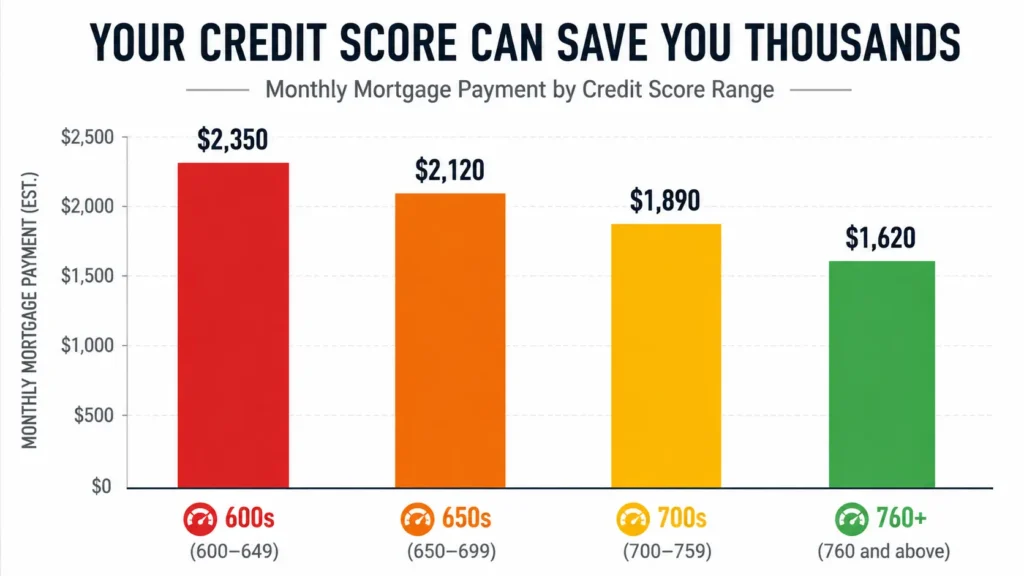
Here is what the difference in score actually costs you in dollars:
| 760 – 850 (Excellent) | ~6.5% | ~$1,896 | — |
| 700 – 759 (Good) | ~6.8% | ~$1,955 | +$59/month |
| 650 – 699 (Fair) | ~7.4% | ~$2,074 | +$178/month |
| 600 – 649 (Poor) | ~8.2% | ~$2,248 | +$352/month |
Rates approximate as of July 2026. Source: CFPB mortgage rate data.
That $352 difference every single month — $4,224 per year — is the real cost of ignoring your credit score. Over a 30-year mortgage, a poor credit score costs you over $126,000 more than an excellent one. Same house. Same loan. Just a different three-digit number.
How Your FICO Score Is Actually Calculated
Before you can improve your credit score in 30 days, you need to understand exactly what moves it. FICO scores — used in over 90% of lending decisions in the US — are calculated from five factors:
| Payment History | 35% | Have you paid every bill on time? |
| Credit Utilization | 30% | How much of your available credit are you using? |
| Length of Credit History | 15% | How long have your accounts been open? |
| Credit Mix | 10% | Do you have different types of credit? |
| New Credit | 10% | Have you recently applied for new accounts? |
Two facts jump out immediately. First, payment history and credit utilization together make up 65% of your score. Second, those two factors are also the fastest to change. Everything else — length of history, credit mix, new credit — moves slowly over months and years.
This is why a 30-day improvement plan focuses almost entirely on utilization and payment timing. The other factors matter for long-term score health, but they will not move your number meaningfully in one month.
“The Consumer Financial Protection Bureau explains how credit scores work and what lenders actually see when they pull your report.”
The 30-Day Credit Score Improvement Plan — Week by Week
Here is how to improve your credit score in 30 days with a concrete week-by-week action plan. No vague advice. Each week has one clear priority.
Week 1 — Know Exactly Where You Stand
Day 1: Pull your free credit reports from all three bureaus at AnnualCreditReport.com. You are legally entitled to one free report per week from each bureau under the Fair Credit Reporting Act. Check Equifax, Experian, and TransUnion separately — they often contain different information and different errors.
Day 2–3: Go through each report line by line. Look for accounts you do not recognize, incorrect balances, payments marked late that were actually on time, or accounts that should have been removed after seven years.
Day 4–7: Write down your current credit utilization on every card. Add up all balances, add up all credit limits, divide. If that number is above 30%, bringing it down is your single highest-priority task this month.
Week 2 — Attack Utilization
If you have cash available, pay down whichever card is closest to its limit first. Then work backward. According to Experian’s 2026 State of Credit report, the average American’s credit utilization jumped to 36.1% — well above the scoring penalty threshold. Most people reading this are absorbing an active scoring penalty right now without realizing it.
Here is the key timing insight most guides miss: pay your balance before your statement closing date, not your due date. Credit card issuers report your balance to the bureaus on your statement closing date — so paying before that date means a lower balance gets reported, which improves your utilization faster.
Week 3 — Dispute Errors
The FTC reports that 1 in 5 consumers has a credit report error significant enough to affect their score. That is 20% of Americans carrying a lower score than they deserve — often by 50 to 100 points.
File disputes directly with each bureau’s website — not third-party services. Bureaus must investigate within 30 days under federal law.
Week 4 — Set and Forget
Enroll every account in autopay for at least the minimum payment. Set a calendar reminder to check your utilization once a month. Request your free credit reports again in 35 days to see the changes reflected.
Strategy #1: Cut Your Credit Utilization Below 10%
This is the single fastest way to improve your credit score in 30 days — and most people underestimate how dramatically it works.
According to Experian, those with the highest credit scores — 800 and above — typically have utilization rates in the single digits. Not below 30%, as most advice suggests. Single digits. Under 10%.
Here is a practical example:
Suppose you have two credit cards. Card A has a $5,000 limit with a $2,800 balance (56% utilization). Card B has a $3,000 limit with a $600 balance (20% utilization). Your combined utilization is $3,400 out of $8,000 available — 42.5%. That is a significant scoring penalty.
Pay Card A down to $400 (8% utilization). Your combined utilization drops to $1,000 out of $8,000 — 12.5%. That single payment could add 30 to 50 points to your score when it gets reported.
Three ways to reduce utilization fast:
- Pay down balances with any available cash, tax refund, or bonus
- Request a credit limit increase on existing cards (more on this below)
- Spread balances across multiple cards rather than concentrating debt on one
“Need cash to pay down those balances? First make sure you have a safety net in place — here is our guide on how to build an emergency fund fast.”
Strategy #2: Dispute Credit Report Errors Immediately
Disputing a credit report error is one of the most underused strategies for people trying to improve their credit score quickly. It costs nothing, takes 30 minutes, and can work faster than almost any other approach.
Under the Fair Credit Reporting Act, credit bureaus must investigate disputes within 30 days and remove any information they cannot verify. If a creditor cannot confirm the accuracy of a negative item, the bureau must delete it.
Common errors worth disputing:
- Payments marked “late” that you actually made on time
- Accounts belonging to someone else with a similar name (mixed files)
- Debts discharged in bankruptcy still showing as owed
- Accounts showing the wrong balance or credit limit
- Negative items older than seven years that should have aged off
How to dispute: Go directly to Equifax.com, Experian.com, or TransUnion.com. Use their online dispute portals. Upload supporting documents — a bank statement showing the on-time payment, for example. Keep a record of every dispute you file and the date you filed it.
“The FTC provides a free step-by-step guide for disputing credit report errors, including sample dispute letters you can use.”
Strategy #3: Never Miss a Payment — Ever
Payment history is the top credit score factor — making up 35% of your FICO score. Just one late payment, defined as 30 days or more past due, can cause your score to drop significantly. And that late mark stays on your report for seven years.
This is the one area where 30 days of perfect behavior does not undo existing damage. A missed payment from last month is already on your report. However, preventing any new missed payments is still critical — because the damage from each additional late payment compounds.
Enroll in autopay for at least the minimum payment on every account today. Even a $25 minimum payment keeps the account current and protects your payment history. You can always pay more manually — but the autopay protects your score from an accidental slip.
One important nuance: paying your electric bill or cell phone on time each month is unlikely to help your credit because these payments are seldom reported to the bureaus. Focus your attention on credit cards, auto loans, student loans, mortgages, and personal loans — these all report monthly.
Strategy #4: Become an Authorized User
This strategy works particularly well if you are new to credit or recovering from a past mistake.
Ask a family member or close friend — someone with excellent credit, a long account history, and low utilization — to add you as an authorized user on one of their credit cards. You do not need to use the card or even hold the physical card. Simply being listed as an authorized user causes that account’s positive history to appear on your credit report.
Becoming an authorized user on a well-managed account can improve your credit score when the primary cardholder’s positive account history is added to your credit report. The effect can show up within one to two billing cycles.
One caution: if the primary cardholder carries a high balance or ever misses a payment, that negative information will also appear on your report. Only take this approach with someone whose credit habits you fully trust.
Strategy #5: Request a Credit Limit Increase
This strategy often gets overlooked because it feels counterintuitive — but it works.
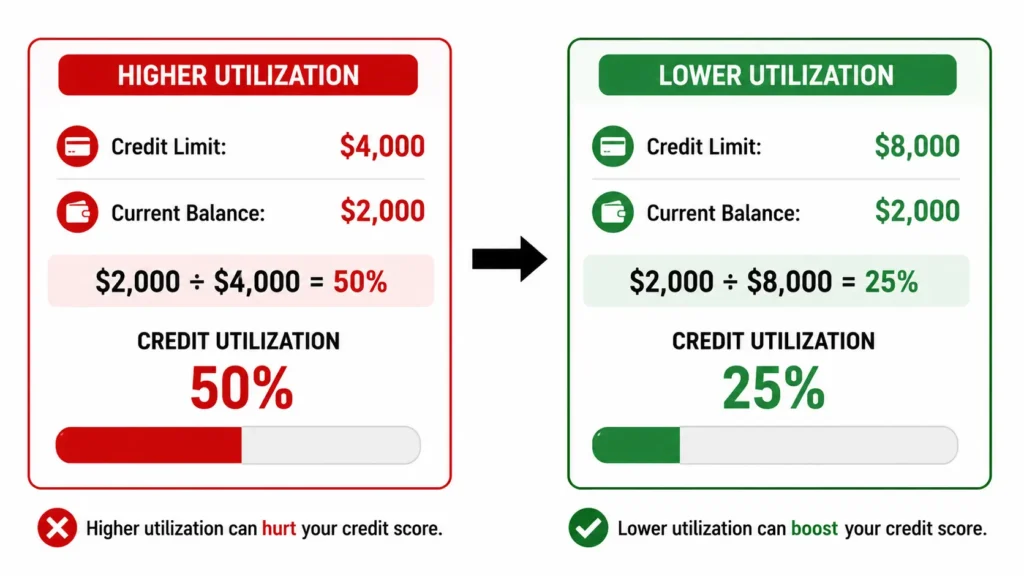
Requesting a higher credit limit on an existing card immediately lowers your utilization ratio, even if your balance stays exactly the same. If you have a $2,000 balance on a $4,000 limit (50% utilization) and your issuer increases your limit to $8,000, your utilization drops to 25% overnight.
Call your credit card issuer and ask for a limit increase. Most issuers will do a soft inquiry rather than a hard pull if you specifically request it — ask before they run the check. If you have been a customer for at least six months and have made consistent on-time payments, approval rates are generally high.
“A better credit score also means lower interest rates on future loans — which leaves more money available to invest. Here is how to start investing $1,000 once your finances are in order.”
What Will NOT Improve Your Credit Score in 30 Days
Before you spend money trying to fix your credit, know what does not work.
❌ Paying a credit repair company Credit repair companies cannot do anything you cannot do yourself for free — and many charge hundreds of dollars per month for services that amount to filing the same dispute letters you could write yourself. Avoid them. The FTC has filed dozens of enforcement actions against credit repair scams. Use the free dispute process directly through the bureaus.
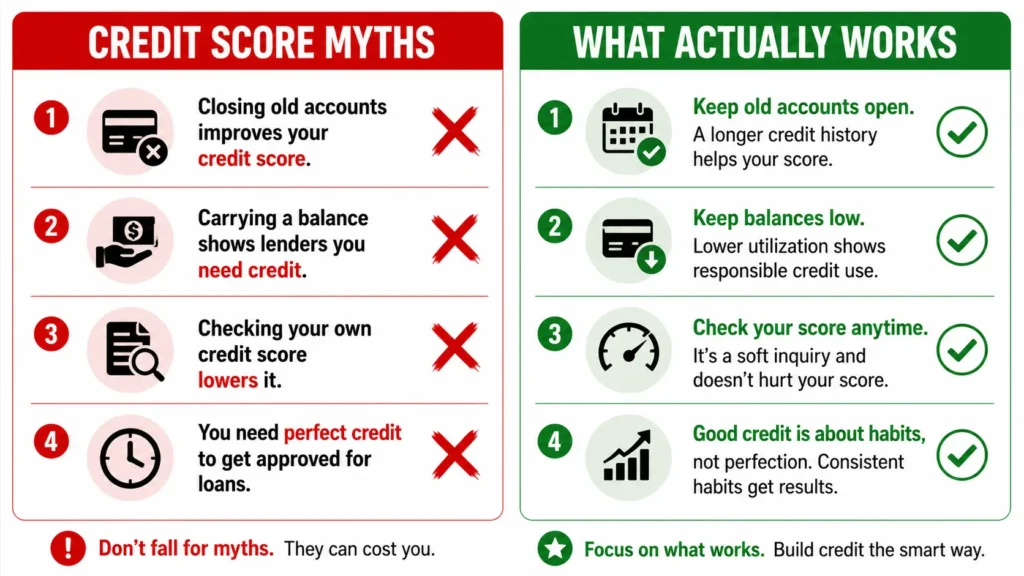
❌ Closing old credit cards Closing an old account reduces your total available credit and can shorten your average credit history length — both of which hurt your score. If the card has no annual fee, keep it open and use it occasionally to prevent the issuer from closing it for inactivity.
❌ Applying for new credit cards to increase your limit Every new credit application creates a hard inquiry, which temporarily lowers your score by five to ten points. Multiple applications in a short window are a red flag to lenders. Request a limit increase on existing cards instead.
❌ Waiting for your score to improve “naturally” Your score will not improve on its own if you are carrying high utilization and have unresolved errors on your report. The strategies above require action.
FAQ — How to Improve Your Credit Score in 30 Days
Q1: How much can I realistically improve my credit score in 30 days?
It depends on your starting point. Combining credit utilization reduction with a successful error dispute can realistically add 30 to 90 points in under 30 days. People with lower starting scores and higher utilization tend to see the biggest jumps. There is no universal number — your results depend on your specific credit profile.
Q2: Does paying off a credit card in full improve my score immediately?
It improves when your issuer reports the new balance to the credit bureaus — which happens on your statement closing date, not your payment due date. To get the fastest improvement, pay your balance before your statement closing date so the lower balance gets reported that same cycle. The score update typically appears within one to three weeks after reporting.
Q3: What is a good credit score in 2026?
For FICO scores ranging from 300 to 850, a good credit score is generally considered 670 to 739. Very good is 740 to 799, and scores 800 and above are considered excellent. Most lenders reserve their best interest rates for borrowers with scores above 760.
Q4: Does checking my own credit score hurt it?
No. Checking your own credit score is a soft inquiry and does not affect your score at all. Hard inquiries — which occur when a lender checks your credit for a loan or card application — can lower your score by five to ten points temporarily. Check your own score as often as you want using free tools like Credit Karma or Experian’s free service.
Q5: How do I dispute a credit report error?
Go directly to Equifax.com, Experian.com, or TransUnion.com and use their online dispute portals. Submit supporting documentation showing the error. Credit bureaus must investigate your dispute within 30 days and remove any information they cannot verify. You can also submit disputes by mail if you prefer a paper trail.
Q6: What is a good credit utilization rate?
When your credit utilization approaches and climbs above 30% of your credit limit, it tends to have a greater negative effect on your scores. Those with the highest credit scores usually have a utilization rate in the single digits. Aim for below 10% if you want to maximize your score, and stay below 30% at minimum.
Conclusion
Improving your credit score in 30 days is genuinely possible — but only if you work on the right things. Forget vague advice like “pay your bills on time and be patient.” The real moves are specific: get your utilization below 10% before your next statement closes, dispute every error you find, and set up autopay so a forgotten bill never damages your history again.
Combining utilization optimization with a successful credit report dispute can realistically add 30 to 90 points before the month is out — no credit repair company, no gimmicks, no fees. Just deliberate action.
Start today. Pull your free report at AnnualCreditReport.com. Check your utilization on every card. Pick the highest card and pay it down. That single action, done today, is where a better credit score begins.
Your next step: Now that you understand how to improve your credit score, it is time to put a stronger financial foundation in place.
📌 Read Next: [How to Build an Emergency Fund Fast — 30-Day Plan ]
📌 Also Read: [How to Invest $1,000 for Beginners — 5 Smart Moves That Actually Work ]

Financial enthusiast with 5 years of experience in the US market trends and personal wealth management