

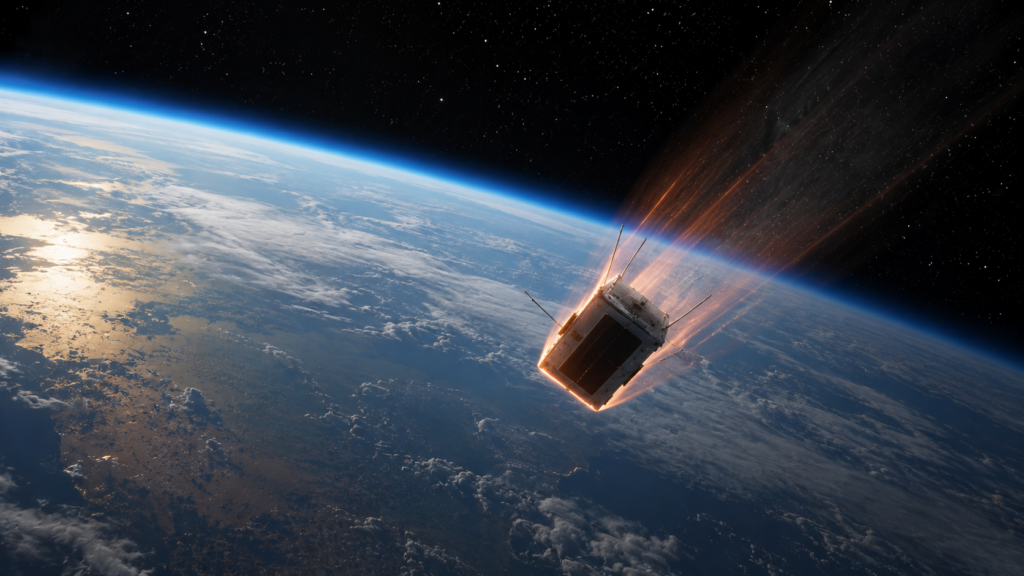
Half of SpaceX’s satellite fleet is dropping in altitude this year. Not because of a failure. Because of math. As solar activity fades and atmospheric drag drops with it, a dead satellite left at 550 kilometers can linger up to four years before it burns up. That’s the problem driving the biggest SpaceX Starlink satellite deorbit initiative the company has run to date.

Why 4,400 satellites are moving down
Michael Nicolls, Starlink’s VP of engineering, announced the plan in a post on X in early January. Around 4,400 satellites currently flying at 550 km will drop to roughly 480 km over the course of 2026. Nicolls tied the move directly to solar minimum — as the sun’s 11-year cycle quiets down, thinner atmosphere at higher altitudes means dead hardware falls slower. Lower orbits fix that. A SpaceX Starlink satellite deorbit at 480 km takes a few months instead of years.
There’s a second reason, and it’s just as practical. Below 500 km, there’s less debris and fewer planned constellations sharing the lane. Fewer neighbors, lower collision odds.
The incident that pushed things forward
This wasn’t a purely proactive move. In December 2025, Starlink-35956 suffered an in-orbit anomaly — a propellant tank vent that released a handful of slow-moving debris fragments. SpaceX said the satellite stayed intact and would fully burn up within weeks. LeoLabs, an independent tracking firm, backed that read, though it flagged the event as consistent with an internal energetic source rather than a strike from debris.
SpaceX paused new launches briefly, then resumed them within days. But the anomaly, paired with a UN Security Council meeting where China and Russia openly criticized Starlink’s size, gave the SpaceX Starlink satellite deorbit plan added urgency. Beijing’s delegate called the constellation a “safety and security” concern days before Nicolls’ announcement went public.
What the FCC filing actually shows
SpaceX’s most recent semi-annual compliance filing, covering December 2025 through May 2026, confirms 260 Starlink satellites completed controlled atmospheric disposal in that window. Most were early-generation v1.0 and v1.5 units launched between 2019 and 2021, retired on schedule rather than pushed out by failure. SpaceX reported a disposal reliability rate above 99%, comfortably clearing the FCC’s 95% threshold for post-mission disposal.
Nearly all of that SpaceX Starlink satellite deorbit activity fits a pattern: age out, deorbit, replace with newer hardware. The company is already backfilling those lower shells with larger Starlink v2 Mini and Block 3 satellites.
The environmental question nobody’s fully answered
Every deorbit burns metal in the upper atmosphere, and that’s where scientists start raising eyebrows. Alumina particles released during reentry could alter stratospheric albedo and contribute to localized ozone depletion, according to researchers tracking the trend. Environmental groups are using the rising SpaceX Starlink satellite deorbit numbers to push the FCC toward requiring full environmental impact statements for megaconstellation operators — something currently exempted under a NEPA categorical exclusion.
Nobody expects that fight to resolve quickly. But the volume keeps climbing. With close to 10,000 operational satellites already in orbit and thousands more planned, the atmospheric footprint of routine SpaceX Starlink satellite deorbit activity is becoming its own regulatory question, separate from collision risk entirely.
What this means going forward
Only two Starlink satellites are currently nonfunctional and awaiting natural decay, according to Nicolls — a fleet reliability record most operators can’t match. That reliability is exactly why the lowering plan matters: SpaceX is optimizing for the rare failure, not fixing a widespread one. Expect the pace of controlled deorbits to keep climbing through 2026 and 2027 as older satellites retire on schedule and the lower-orbit shell becomes the new normal.
FAQs
Q1. Does satellite internet keep working during a SpaceX Starlink satellite deorbit?
Ans: Yes. SpaceX times orbital shifts to preserve coverage, migrating capacity gradually so Starlink internet service continues without interruption for users.
Q2. Can satellite imagery track a SpaceX Starlink satellite deorbit in progress?
Ans: Yes. Companies like LeoLabs and Vantor have imaged Starlink satellites during anomalies and reentry, confirming whether a spacecraft stays intact or breaks apart before it burns up.
Q3. Is there such a thing as a satellite deodorizer?
Ans: No — that’s a common typo for “deorbit.” A SpaceX Starlink satellite deorbit is a controlled maneuver that lowers a satellite’s orbit until atmospheric drag pulls it down and it burns up.
Q4. How long does a SpaceX Starlink satellite deorbit take?
Ans: At 480 km, a few months. At the older 550 km altitude, natural decay could take up to four years, which is why SpaceX lowered the operating shell in the first place.
Q5. Do deorbited Starlink satellites reach the ground?
Ans: Almost never. SpaceX designs satellites to fully demise during atmospheric reentry, burning up completely before any debris could reach the surface.

Financial enthusiast with 5 years of experience in the US market trends and personal wealth management