
Introduction
The term “passive income jobs” is slightly misleading—and that’s actually useful to know upfront. Passive income isn’t a traditional job. It’s a system you build that generates income without continuous active work. The “job” part is the upfront effort: creating content, building an audience, investing capital, or developing a skill. Once you build that foundation, income flows with minimal ongoing effort. This guide covers nine passive income jobs ranked by startup effort, with honest timelines and realistic earnings for 2026.
The Honest Truth About Passive Income Jobs
Most passive income articles skip the uncomfortable reality: every passive income stream requires significant upfront work before it becomes passive. The timeline varies dramatically by method.
The upfront investment spectrum:
Content-based passive income jobs (YouTube, blogging, writing) require 6-18 months of active creation before meaningful passive income appears. Capital-based passive income (dividends, real estate) requires money upfront but generates income relatively quickly once invested. Skill-based passive income (courses, templates, software) takes weeks to months to create, then runs passively.
Understanding which category fits your current situation—time-rich or capital-rich—determines which passive income job makes sense to start.
According to Bureau of Labor Statistics gig economy research, self-employment and alternative work arrangements have grown significantly—validating why passive income jobs have become a serious financial planning topic for millions of Americans.
Passive Income Jobs That Start With Time
These passive income jobs require your time and expertise primarily upfront, making them accessible even with zero starting capital.
Job 1 — Content Creator (YouTube/Podcast)
Building a YouTube channel or podcast is one of the most scalable passive income jobs available in 2026. Old content keeps earning long after you create it. A video from 2022 can still generate $500/month in 2026 from ad revenue and affiliate links.
Revenue streams for content creators:
- YouTube AdSense: $1-15 per 1,000 views (varies by niche; finance = $8-15 RPM)
- Sponsorships: $500-5,000 per video at 50,000+ subscribers
- Affiliate commissions: $50-500/month per promoted product
- Digital products sold through content: Unlimited ceiling
Realistic income timeline:
| Stage | Timeline | Monthly Income |
| Building phase | Months 1-12 | $0-$50 |
| Early monetization | Months 13-18 | $100-$500 |
| Established channel | Months 19-36 | $500-$5,000+ |
Why it qualifies as passive: A library of 100 videos earns 24/7 without you filming anything new. That’s the definition of passive income jobs done right.
Job 2 — Blogger/Niche Website Owner
A niche website earns passive income through display ads, affiliate marketing, and digital product sales. Unlike social media, website traffic compounds through SEO—articles written in 2024 rank and earn in 2026 without updates.
Income sources for bloggers:
- Display ads (Mediavine, AdThrive): $20-50 per 1,000 monthly visitors
- Affiliate commissions: 3-50% per sale depending on product
- Digital products: 100% margin, unlimited sales
Realistic income: A website reaching 50,000 monthly visitors earns $1,000-$2,500/month from ads alone. Affiliate income can double or triple that.
Startup requirement: Domain + hosting ($100-200/year). Content creation time: 3-5 hours per article, 2-4 articles per month minimum for the first year.
Key SEO insight: Finance, health, and technology niches pay the highest ad rates. Micro-niches (specific hobbies, specific professions) have lower competition and reach rankings faster.
Job 3 — Course Creator
If you have expertise in any teachable topic—software, cooking, fitness, marketing, music—creating an online course can generate passive income indefinitely after the initial creation period.
Platform options and fees:
| Platform | Your Revenue Share | Built-in Audience | Best For |
| Udemy | 37-97% | Yes (millions) | Beginners, competitive topics |
| Teachable | 95%+ | No (bring your own) | Established creators |
| Skillshare | Royalty per minute | Yes | Creative skills |
| Podia | 100% | No | Full-price premium courses |
Realistic income: A well-produced Udemy course in a competitive category earns $200-2,000/month passively after launch. Top Udemy instructors earn $10,000+/month from course libraries.
Creation time: 40-100 hours upfront for a comprehensive course. Near-zero maintenance after launch.
Job 4 — Digital Product Seller
Templates, ebooks, printables, Notion dashboards, Lightroom presets, design assets—anything digital that solves a problem can become a passive income job through platforms like Etsy, Gumroad, or your own website.
What makes digital products ideal passive income jobs:
- Zero inventory or shipping costs
- Infinite scalability (same file sold unlimited times)
- Works while you sleep across all time zones
- Create once, sell for years.
Realistic income by product type:
- Resume templates: $5-15 each, $200-800/month with a catalog of 20+ designs
- Notion templates: $10-30 each, $300-1,500/month for popular productivity tools
- Lightroom presets: $15-45 per pack, $200-600/month with photography audience.
- Ebooks: $9-29 each, $100-500/month with marketing effort
Job 5 — Affiliate Marketer
Affiliate marketing is the passive income job with the highest ceiling and the most patience required. You recommend products through content. Readers purchase. You earn commission. Old content keeps earning as long as it ranks.
The affiliate marketing income reality:
Month 1-6: Near zero (building content, waiting for SEO traction)
Month 7-12: $100-500/month (early rankings appear)
Months 13-24: $500-3,000/month (compound SEO growth)
Month 24+: $1,000-10,000+/month (established authority site)
Best affiliate niches for highest commissions in 2026: Software/SaaS ($50-200 per signup), financial products ($50-500 per account opened), education ($20-100 per enrollment), travel ($20-150 per booking).
For more detail on how affiliate income combines with other passive streams, our guide on how to build passive income shows the complete strategy that turns one income stream into multiple compounding sources.
Passive Income Jobs That Start With Capital
These passive income jobs require money upfront but generate income relatively quickly once invested—without ongoing creative effort.
Job 6 — Dividend Investor
Dividend investing is the most straightforward passive income job: buy shares in companies that pay quarterly dividends and earn recurring payments without doing anything.
2026 dividend landscape:
- Dividend ETFs (VYM, SCHD): 3-4.5% annual yield
- Individual dividend stocks: 2-8% depending on company
- REITs: 4-8% average dividend yield
Income by investment amount:
| Invested | Yield | Annual Income | Monthly Income |
| $10,000 | 4% | $400 | $33 |
| $25,000 | 4% | $1,000 | $83 |
| $100,000 | 4% | $4,000 | $333 |
| $500,000 | 4% | $20,000 | $1,667 |
The compounding truth: Reinvesting dividends (DRIP) turns these numbers dramatically higher over 20-30 years. The passive income job here is patience.
For regulatory guidance on dividend investing and what protections apply to your investment accounts, the SEC’s investor education resources explain shareholder rights and dividend income structures.
Job 7 — Real Estate Investor
Real estate generates passive income through two channels: monthly rental cash flow and long-term property appreciation. With property management companies handling day-to-day operations, rental income becomes genuinely passive.
Entry points by capital level:
- $10-$1,000: Real estate crowdfunding (Fundrise, 8-12% historical returns)
- $10,000-$30,000: REITs (4-8% dividend yield, stock market liquidity)
- $50,000+: Rental property with property manager (5-8% cash-on-cash return)
For the complete breakdown of real estate passive income paths, our guide on how to build passive income with real estate covers every entry point from $10 crowdfunding to full rental property ownership.
Job 8 — High-Yield Savings and Bond Laddering
In 2026, high-yield savings accounts pay 4.0-4.8% APY and Treasury bonds offer similar returns. For risk-averse people seeking passive income jobs with zero market volatility, this is the most accessible starting point.
The bond ladder strategy:
- Invest equal amounts in 1-year, 2-year, 3-year, and 5-year Treasury notes
- As each bond matures, reinvest at current rates.
- Creates predictable, consistent passive income regardless of market conditions
Realistic income:
- $20,000 in HYSA at 4.5% = $900/year ($75/month)
- $50,000 in Treasury ladder at 4.3% average = $2,150/year ($179/month)
Job 9 — Peer-to-Peer Lending
Platforms like Prosper and LendingClub allow you to lend money directly to borrowers and earn interest payments. Returns range from 5- 10% depending on the borrower’s risk grade.
How it works as a passive income job:
- Invest $1,000+ minimum across multiple loans.
- The platform handles all collection, payment processing, and credit checks.
- You receive monthly principal + interest payments automatically.
Realistic returns: 5-9% net annual returns after defaults and platform fees. Higher than savings, lower than equity markets, with a different risk profile.
Important caveat: P2P lending carries default risk. Borrowers can stop paying. Diversifying across 50+ loans significantly minimizes the impact of individual defaults.
Passive Income Jobs Comparison: Which Fits You?
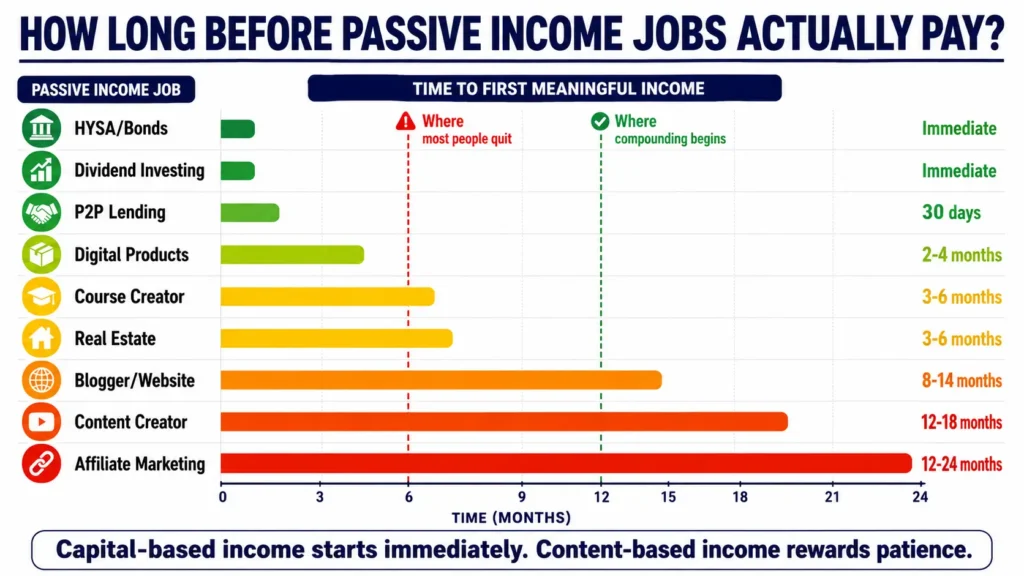
| Passive Income Job | Startup | Capital Needed | Time to First Income | Monthly Ceiling |
| Content Creator | Very High | $0-500 | 12-18 months | Unlimited |
| Blogger | High | $100-200 | 8-14 months | $5,000+ |
| Course Creator | High | $0-500 | 3-6 months | $10,000+ |
| Digital Products | Medium | $0-100 | 2-4 months | $3,000+ |
| Affiliate Marketing | High | $0-500 | 12-24 months | Unlimited |
| Dividend Investor | Low | $5,000+ | Immediate | Based on capital |
| Real Estate | Low | $10-50,000+ | Immediate | Based on capital |
| HYSA/Bonds | Zero | $5,000+ | Immediate | Based on capital |
| P2P Lending | Low | $1,000+ | 30 days | Based on capital |
The Right Starting Point by Life Situation
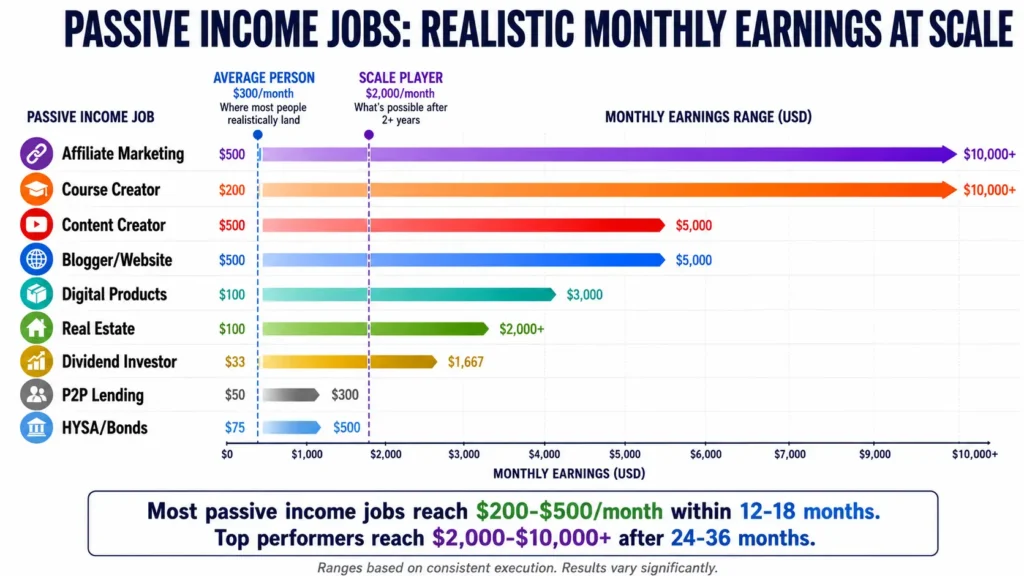
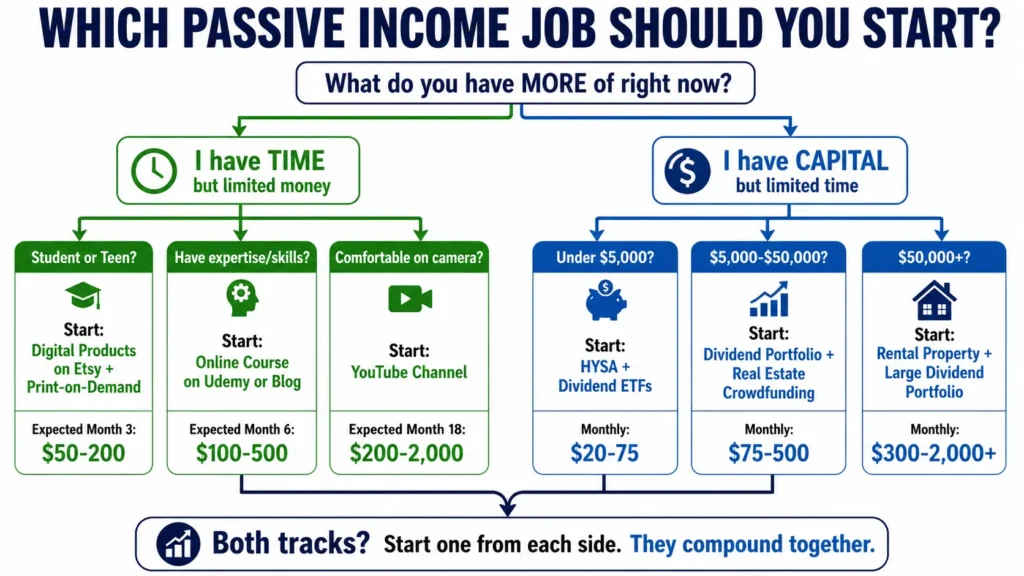
If you’re a student or young professional with more time than money: Start with digital products (fastest to first income) + one content platform (YouTube or blog for long-term compounding).
If you have $5,000-$25,000 saved: Split between HYSA (immediate income) and dividend ETFs (growing income). Add one time-based passive income job alongside.
If you have $50,000+: Evaluate rental real estate or real estate crowdfunding. Your capital can generate $300- $ 500/month immediately.
If you’re a teen or early career (limited time + money): Passive income jobs for teens work best when you start with print-on-demand (zero capital) or selling digital products (minimal investment). Both fit around school schedules.
For detailed strategies specific to younger beginners, our guide on passive income jobs for students and teens covers the exact combination that fits school schedules
Disclaimer: This article provides educational information about passive income strategies and income-generating activities. It is not financial, investment, or tax advice. All income figures represent realistic ranges based on typical outcomes—not guarantees. Investment strategies carry risk, including potential loss of principal. Results vary significantly based on effort, niche, capital amount, market conditions, and individual execution. Consult a licensed financial advisor before making investment decisions. Tax treatment of passive income varies—consult a CPA for your specific situation.
Conclusion
Passive income jobs aren’t shortcuts—they’re a category of work that pays differently. Instead of trading time for money indefinitely, you trade time or capital once to build an asset that generates income repeatedly. The nine methods here cover every starting situation: broke but time-rich, capital-rich but time-poor, teenage beginner, or mid-career professional wanting supplemental income.
The most important decision isn’t which passive income job to pick—it’s picking one and committing to it for 12+ months before evaluating. Every method here has made real people real money. None of them work for people who quit at month 3.
Ready to go deeper on one specific path? Our complete guide on how to build passive income shows exactly how to combine multiple passive income jobs into a diversified income portfolio—with the 12-month action plan that actually gets results- or explore passive income apps if you want to layer zero-effort app income alongside these bigger income streams.
Your passive income career starts with one decision. Make it today.
FAQ Section
Q1: What are the best passive income jobs from home?
A: The best passive income jobs from home depend on your starting point. With time but little money: content creation, blogging, or digital products. With capital: dividend investing or real estate crowdfunding. For teens: print-on-demand or selling digital templates. No single “best” exists—the best is whatever you’ll execute consistently for 12+ months.
Q2: How long does it take passive income jobs to start paying?
A: Capital-based passive income (dividends, savings) starts immediately. Content-based passive income jobs (YouTube, blogging, courses) typically take 6-18 months before meaningful income appears. Digital products can generate first income within 60-90 days. The mistake most people make: evaluating results too early and quitting before compound growth begins.
Q3: Can teens really build passive income jobs?
A: Yes. Print-on-demand (Redbubble, Merch by Amazon), selling digital templates on Etsy, and creating YouTube content require no minimum age and zero startup capital. Teens have a natural advantage: time. Starting passive income habits at 16-17 creates dramatically different financial outcomes than starting at 26-27.
Q4: Are passive income jobs actually passive?
A: Not fully, especially at the start. Every passive income stream requires active upfront work—writing, creating, investing, building. The “passive” element comes after you build the foundation. Content creators work 10-20 hours/week for 12-18 months before income becomes truly passive. Investors need capital, which requires earning and saving first. Honest framing: passive income jobs are semi-passive until your asset library or investment portfolio reaches sufficient scale.
Q5: What passive income jobs generate the most money?
A: Long-term highest ceiling: successful YouTube channels or affiliate marketing websites ($10,000-$100,000+/month for top performers). Most reliable for ordinary people: dividend investing at scale ($1,000-$4,000/month on $300,000-$1,000,000 portfolio). Fastest to meaningful income: digital products or courses ($500-$2,000/month within 6-12 months of consistent effort).
Q6: Do passive income jobs get taxed?
A: Yes—all passive income is taxable. Dividend income is taxed at qualified dividend rates (0-20% depending on bracket). Rental income has complex treatment, with available depreciation deductions. Digital product and course income is self-employment income. Content creator earnings are self-employment income. Each type has different tax treatment. Consult a CPA before scaling any passive income job significantly. The IRS passive activity and at-risk rules guide explains exactly how different passive income types are classified and taxed under US law.

Financial enthusiast with 5 years of experience in the US market trends and personal wealth management