
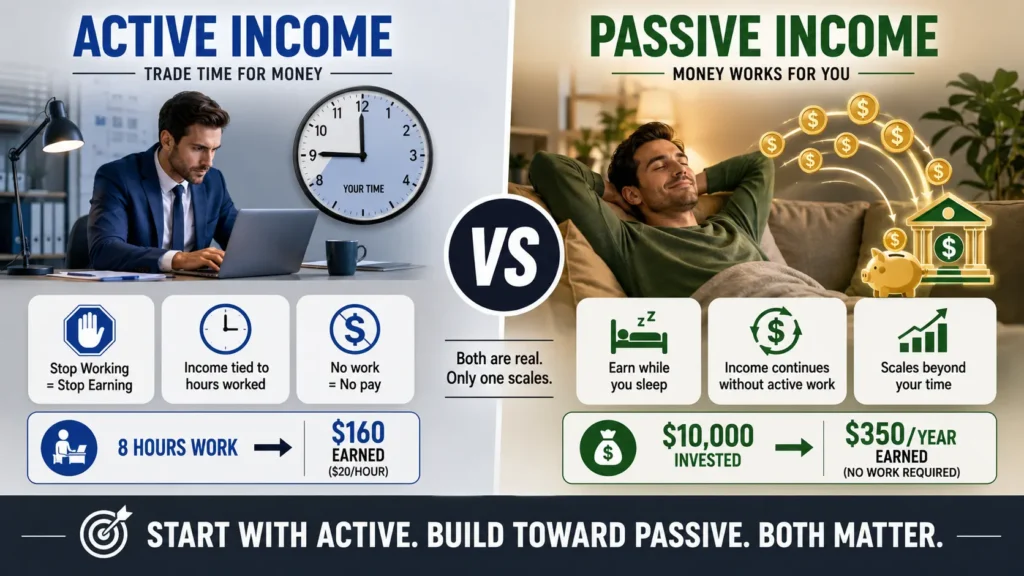
Build passive income and earn money while you sleep.” You’ve heard this promise a thousand times. Here’s the reality: passive income is real, but the “passive” part is a lie—at least in the beginning. Every passive income stream requires active upfront investment, whether that’s money, time, or expertise. The difference between people who build real passive income and those who don’t? They understand which active effort eventually becomes passive, and they execute consistently for 12-36 months before expecting results.
This guide shows you how to build passive income the way it actually works—not the fantasy version where you make a YouTube video and retire, but the realistic version where you make deliberate choices, invest correctly, and build income streams that compound over years. We’ll cover the top strategies by investment type (money vs. time), realistic income expectations, and the critical mistakes that prevent most people from ever building real passive income.
By the end, you’ll know exactly which passive income path fits your current situation and what “success” realistically looks like for each.
The Reality Framework: Active vs. Passive
Before building anything, understand what passive income actually is—and what it isn’t.
The Two Types of Passive Income
Type 1: Money-First Passive Income
You invest capital (cash) upfront. The money works while you sleep.
- Dividend stocks (invest $10,000, earn $300-500/year in dividends)
- High-yield savings/bonds (invest $10,000, earn $400-500/year)
- Real estate (invest $30,000 down payment, earn $400-800/month in rental income)
- REITs (invest $5,000, earn $150-250/year in distributions)
Requires: Money. Not time, necessarily.
Type 2: Time-First Passive Income
You invest time, effort, and expertise upfront. Eventually the asset generates income while you sleep.
- Digital products (spend 200 hours creating a course, earn $200-2,000/month ongoing)
- Affiliate marketing (spend 12 months building audience, earn $500-5,000/month ongoing)
- Print-on-demand (spend 50 hours creating designs, earn $100-500/month ongoing)
- YouTube channel (spend 18 months creating content, earn $1,000-10,000/month ongoing)
Requires: Time. Not necessarily money.
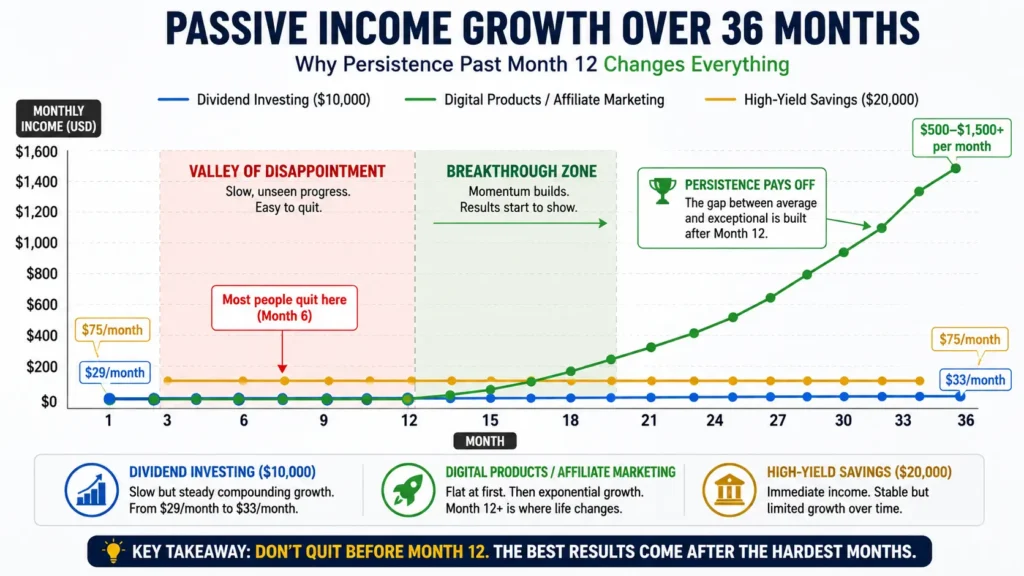
The truth: Most people want Type 2 (time-first) because they don’t have capital. But Type 2 takes 12-36 months before any significant income appears. Knowing this prevents quitting too early.
The Passive Income Ladder: Starting Point to Scale
Not all passive income strategies work for all starting points. Here’s the hierarchy:
Level 1 — No Money, No Audience ($0 Invested)
Best options:
- Selling digital products (using free platforms like Gumroad, Etsy)
- Print-on-demand (Redbubble, Merch by Amazon—zero cost to start)
- Affiliate marketing through social media (zero cost if using organic reach)
Expected income after 12 months: $100-500/month (if executed consistently)
Why it’s slow: No amplification (no paid ads, no existing audience). Growth depends on organic reach and the algorithm.
Best for: Complete beginners with more time than money. If you’re also carrying debt while building this income, our guide on using time-first income for debt payoff shows exactly how to direct these early earnings toward eliminating debt before scaling passive income.
Level 2 — Small Capital ($1,000-$5,000 Invested)
Best options:
- High-yield savings accounts (4.5-5.0% APY in 2026)
- Dividend ETFs (low-cost funds paying 1.5-3.5% annually)
- Starting a blog/website with domain + hosting investment
- Udemy course creation (small investment in equipment)
Expected income after 12 months:
- Savings/ETFs: $45-175/year (modest but zero effort)
- Blog/course: $200-800/month (with consistent content)
Why it works: Small capital amplifies effort. A $2,000 investment in blog hosting + equipment removes the “free tier” limitations.
Best for: People with starter savings who want to build time-first income with a small capital boost. Not sure whether to invest this $1,000-$5,000 or use it for debt payoff? Our article on investing small capital while paying debt breaks down the exact split that makes sense for your situation.
Level 3 — Significant Capital ($10,000-$50,000 Invested)
Best options:
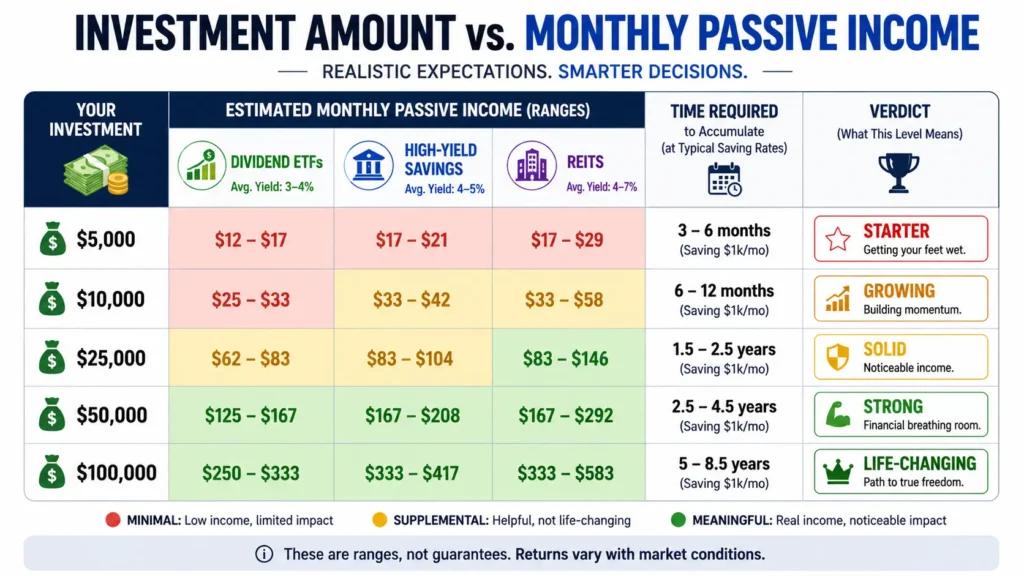
- Dividend stocks/ETFs ($10,000 at 3% yield = $300/year; $50,000 = $1,500/year)
- Real estate crowdfunding (platforms like Fundrise, starting at $10)
- Bonds and Treasury notes (currently 4-5% return)
- REITs (5-8% average dividend yield)
Expected income after 12 months:
- $10,000 invested at 4% = $400/year ($33/month)
- $50,000 invested at 4% = $2,000/year ($167/month)
Reality: $167/month isn’t “retire by 40” income. But it compounds. At 7% total return reinvested, $50,000 becomes $100,000 in 10 years, generating $4,000/year.
Best for: People with established savings wanting money-first passive income that compounds.
Level 4 — Real Capital ($100,000+)
Best options:
- Rental real estate (cash-flow positive properties)
- Angel investing (startups)
- Large dividend portfolio ($200,000+ for meaningful passive income)
Expected income:
- $100,000 real estate investment generating $8,000-15,000/year net
- $200,000 dividend portfolio at 3.5% = $7,000/year ($583/month)
Reality: This is where passive income becomes life-changing. But getting here requires years of building Level 1-3 first.
Best for: People with significant capital who’ve outgrown lower-level strategies.
The Top 8 Passive Income Strategies
Let’s get specific. Here are the eight strategies that actually generate meaningful passive income, ranked by long-term potential.
Strategy 1 — Dividend Investing
You buy shares in companies that pay dividends (quarterly cash payments to shareholders). The more shares you own, the more dividend income you receive.
How it works:
- Buy dividend-paying stocks or ETFs
- Reinvest dividends (DRIP—dividend reinvestment plan) for compound growth.
- After 10-15 years, the portfolio generates meaningful passive income.
Real numbers:
| Investment | Dividend Yield | Annual Income | Monthly Income |
| $10,000 | 3.5% | $350 | $29 |
| $50,000 | 3.5% | $1,750 | $146 |
| $100,000 | 3.5% | $3,500 | $292 |
| $500,000 | 3.5% | $17,500 | $1,458 |
Best platforms: Fidelity, Vanguard, Charles Schwab (low-cost index funds) One thing most people miss: a stronger credit score gives you access to margin accounts and better financial products that amplify investing returns. Our guide on improving credit score to access better investment accounts shows how credit directly impacts your investing capability.
“For detailed information on how dividend ETFs and investment products are regulated and what disclosures to look for, the SEC provides comprehensive investor education resources.”
Timeline to meaningful income: 10-20 years of consistent investing
Realistic expectation: Not “retire immediately.” But an excellent long-term compounding passive income strategy. Dividend ETFs like VYM or SCHD have historically shown 3-4% yields with capital appreciation.
Strategy 2 — High-Yield Savings & Treasury Bonds
The simplest passive income: put money in high-yield accounts or government bonds—no investment expertise required.
Current rates (2026):
- High-Yield Savings: 4.0-4.8% APY (varies by institution)
- 1-Year Treasury Note: 4.2-4.8%
- 5-Year Treasury Note: 4.0-4.5%
- I-Bonds: Variable (tied to inflation)
Expected income:
| Investment | Rate | Annual Income |
| $5,000 | 4.5% | $225 |
| $20,000 | 4.5% | $900 |
| $50,000 | 4.5% | $2,250 |
Best platforms: Marcus by Goldman Sachs, Ally Bank, TreasuryDirect.gov
Timeline to meaningful income: Immediate (but limited by capital)
Realistic expectation: Perfect for emergency fund growth or parking money while building other income streams. Not life-changing at small amounts, but genuinely passive.
Strategy 3 — Real Estate (Best for High Return, High Effort)
Rental real estate generates monthly rental income that (ideally) exceeds mortgage payment, taxes, insurance, and maintenance.
The basic equation:
- Monthly rent: $1,500
- Mortgage payment: $900
- Taxes + insurance: $300
- Maintenance reserve: $150
- Net monthly cash flow: $150
Reality: $150/month per property sounds small. But over 30 years, the property appreciates while the mortgage stays fixed. At year 30, you own a paid-off property generating $1,500/month (no mortgage).
Alternative: Real estate crowdfunding
Not ready to buy property? Platforms like Fundrise let you invest in real estate starting at $10, with historical returns of 8-12% through diversified portfolios. This is how to build passive income in real estate without buying a property outright.
Timeline to meaningful income: 5-10 years for rental equity to build significantly
Realistic expectation: Requires significant capital, property management (not fully passive), and real estate market knowledge. But provides one of the best long-term returns.
Strategy 4 — Digital Products
You create a digital product once and sell it repeatedly. The product does the work after you create it.
Types of digital products:
- Online courses (Teachable, Udemy, Podia)
- Ebooks and guides (Gumroad, Amazon KDP)
- Templates (Etsy, Gumroad)
- Software/apps (requires coding or a developer partnership)
- Photography/art licenses (Adobe Stock, Shutterstock)
Real income ranges:
| Product Type | Setup Time | Average Monthly Income (After 12M) | Ceiling |
| Online course | 3-6 months | $500-3,000 | Unlimited |
| Ebook | 1-3 months | $100-800 | Moderate |
| Templates | 2-4 weeks | $200-1,500 | Moderate |
| App/software | 6-18 months | $500-20,000+ | Very high |
| Stock photography | 2-4 months | $50-500 | Moderate |
The critical factor: Distribution. Creating a product is 20% of the work. Building an audience (SEO, social media, email list) to sell it is 80%.
Timeline to meaningful income: 12- 24 months of consistent content + marketing
Realistic expectation: Excellent passive income potential for people with expertise, but requires sustained active work before income appears.
Strategy 5 — Affiliate Marketing (Best for Content Creators)
You recommend products/services. When someone buys through your link, you earn a commission (typically 3-15% depending on industry).
How it works:
- Build an audience (blog, YouTube, social media, email list)
- Recommend relevant products your audience needs
- Earn commission on every sale your link generates.
Realistic commission examples:
- Amazon Associates: 1-10% per sale
- Software/SaaS (Bluehost, ConvertKit): $50-200 per signup
- Financial products (credit cards, brokerages): $100-500 per approved application
- Online courses: 30-50% commission
Real income timeline:
| Month | Traffic/Audience | Monthly Income |
| 1-6 | Building | $0-50 |
| 7-12 | Growing | $100-500 |
| 13-18 | Established | $500-2,000 |
| 24+ | Authority | $2,000-10,000+ |
Timeline to meaningful income: 18-24 months consistently creating content
Realistic expectation: Works best when you have genuine expertise and audience trust. Commission income varies wildly. Requires consistent content creation (not truly passive for years).
Strategy 6 — YouTube / Podcast (Best for Long-Term Brand Building)
Create content consistently. Build an audience. Monetize through ads, sponsorships, and products.
YouTube monetization streams:
- AdSense revenue (requires 1,000 subscribers + 4,000 watch hours for eligibility)
- Sponsorships ($500-5,000 per video for established channels)
- Affiliate links in descriptions
- Merchandise
- Channel memberships
Realistic income timeline:
| Subscribers | Monthly Views | AdSense Monthly | Sponsor Monthly |
| 10,000 | 50,000 | $100-300 | $500-1,000 |
| 50,000 | 200,000 | $500-1,500 | $2,000-5,000 |
| 100,000 | 500,000 | $1,500-5,000 | $5,000-15,000 |
Earnings per 1,000 views (RPM): $1-10 depending on niche (finance = $8-15 RPM)
Timeline to meaningful income: 18-36 months of weekly content publication
Realistic expectation: Requires significant initial time investment. First 12 months: mostly zero income. But once established, channels can become genuinely passive as old videos keep generating views without new work.
Strategy 7 — REITs (Real Estate Investment Trusts)
REITs are companies that own real estate and are required to distribute 90% of taxable income to shareholders as dividends. You own real estate income without owning property.
How to invest: Buy REIT stocks through any brokerage account.
Historical REIT yields: 4- 8% annual dividend income
REIT types:
- Residential REITs (apartments, single-family)
- Commercial REITs (offices, retail)
- Healthcare REITs (hospitals, senior housing)
- Industrial REITs (warehouses, logistics)
- Mortgage REITs (higher yield, higher risk)
Expected income:
| Investment | REIT Yield | Annual Dividend |
| $5,000 | 5% | $250 |
| $20,000 | 5% | $1,000 |
| $50,000 | 5% | $2,500 |
Timeline to meaningful income: Immediate (if you have capital)
Realistic expectation: REITs provide real estate exposure without property management. Good for diversification. But share prices fluctuate (market risk), so it’s best held long-term.
Strategy 8 — Print-on-Demand (Best for Creatives)
Design products (t-shirts, mugs, phone cases). Upload to platforms—the platform prints and ships when customers buy. You earn royalties per sale.
Top platforms: Redbubble, Merch by Amazon, Society6, Printful + Shopify
Realistic royalty per item: $2-8 per sale depending on product and price point
Income reality:
- 100 sales/month × $5 average royalty = $500/month
- Getting to 100 sales requires 200-500 designs actively listed.
Timeline to meaningful income: 6-12 months of consistent design uploads
Realistic expectation: Low income ceiling unless you scale massively (1,000+ designs). Best as supplemental passive income ($200-500/month), not primary income.
The Biggest Passive Income Mistakes
Understanding failure patterns prevents them.
Mistake 1: Quitting at Month 3
Every passive income stream has a “valley of disappointment” between months 3-12 where you’ve done significant work but see little income. This is where 80% of people quit—right before compound effects start appearing.
The data: Affiliate marketers who quit before month 18 rarely see meaningful income. Those who persist past month 18 often see exponential growth.
Prevention: Set a 24-month minimum commitment to any strategy. Don’t evaluate success at month 6.
Mistake 2: Spreading Across Too Many Strategies
You start dividends, then add a blog, then start a YouTube channel, then try print-on-demand—all simultaneously.
Result: All four get 25% of your attention. None reach escape velocity.
Prevention: Pick ONE strategy for 12 months. Build it to $500+/month. Then add a second stream.
Mistake 3: Expecting “Passive” Without Active Foundation
You buy $5,000 in dividend stocks expecting meaningful income immediately. $5,000 × 3.5% yield = $175/year = $14.58/month.
Reality: Meaningful passive income requires either significant capital OR significant time, usually both.
Prevention: Understand which category your strategy falls in. Set realistic income expectations before starting.
Mistake 4: Ignoring Tax Implications
Passive income is taxed. Differently depending on the type.
Tax reality:
- Dividends: 0-20% (qualified dividends get favorable rates)
- REIT dividends: Taxed as ordinary income (higher rate)
- Rental income: Complex (depreciation deductions available)
- Digital product income: Self-employment tax applies
Prevention: Consult a CPA before scaling any passive income stream. Tax efficiency compounds alongside income.
The 12-Month Passive Income Action Plan
Here’s exactly what to do to build passive income starting from zero.
Month 1-2: Audit and Choose
Determine your starting category: money-first (do you have $5,000+ to invest?) or time-first (do you have 10-15 hours/week to dedicate?). Pick ONE strategy. Not two. One.
Month 3-6: Build Foundation
- Money-first: Open a brokerage account, establish automated monthly investments
- Time-first: Create content/product consistently (weekly minimum)
Month 7-12: Optimize and Document
- Track what’s working (which content drives traffic, which investments yield best)
- Systematize production (templates, processes, batch creation)
- Resist adding new streams until current strategy hits $300-500/month.
Month 13-24: Scale and Diversify
- Once primary stream reaches $500+/month, add complementary stream.
- Reinvest all passive income into growth (don’t spend it yet)
- Build second stream using income from first stream.
Month 25+: Compound and Protect
- Multiple income streams operating simultaneously
- Diversified risk
- Focus on protecting and growing existing streams vs. launching new ones
Disclaimer: This article is educational content about passive income strategies and financial concepts. It is not investment advice, financial advice, or tax advice. All investment strategies carry risk, including potential loss of principal. Past performance doesn’t guarantee future results. Specific income figures are illustrative and represent typical ranges, not guarantees. Before investing, consult a licensed financial advisor. Before starting any business or digital income strategy, consult relevant professionals. Tax treatment of passive income varies—consult a CPA. Information reflects 2026 market conditions and may change.
Conclusion
Building passive income isn’t a shortcut to wealth—it’s a long-term investment strategy that requires patience, consistency, and realistic expectations. The people who succeed at building passive income don’t choose the “easiest” strategy; they choose the strategy that fits their current capital and time situation and execute it for 12-36 months before expecting meaningful results.
Whether you start with $100 in dividend ETFs or 10 hours per week building a digital product, the compound effect is identical: small consistent actions accumulate into real income streams over time.
Your action this week: Identify which level fits your situation (money-first vs. time-first), pick ONE strategy from this guide, and start. Not next month. This week.
Ready to take the next step? Check out our deep dive on how to make extra money to pay off debt to see how to strategically deploy your first passive income stream toward debt elimination, or explore how to pay off debt and save money simultaneously to see exactly how passive income fits into your broader financial picture alongside emergency savings and debt payoff.
Passive income isn’t a dream. It’s a decision, followed by 24 months of execution.
FAQ Section
Q1: How much money do I need to start building passive income?
A: Zero required for time-first passive income (digital products, affiliate marketing, YouTube). For money-first, you can start with $10 (REIT crowdfunding through Fundrise) or $100 (dividend ETFs). Meaningful passive income from investments typically requires $50,000+ for life-changing results ($1,500-2,000/year at 3-4% yield).
Q2: What’s the fastest passive income to build?
A: High-yield savings accounts generate income immediately (4-5% APY currently). For time-based income, digital products (templates, ebooks) can generate first income within 60-90 days if you have an existing audience. YouTube and affiliate marketing take at least 12-24 months for meaningful income.
Q3: Can you build passive income with no money?
A: Yes, through time-first strategies. Print-on-demand, digital products on Gumroad/Etsy, affiliate marketing through free social platforms, and content creation require little to no startup capital. Results take longer but eliminate financial risk. The investment is time.
Q4: How much passive income do you need to retire early?
A: Depends on your expenses. The 4% rule suggests multiplying annual expenses by 25 to determine the required portfolio. If you spend $40,000/year, you need $1,000,000 generating 4% ($40,000/year). Some early retirees combine passive income streams (dividends + rental + digital products) to reach this threshold faster.
Q5: Is passive income taxable?
A: Yes. Dividend income is taxed at 0-20% depending on your income bracket and dividend type. Rental income has complex tax treatment but offers depreciation deductions. Digital product/affiliate income is self-employment income and subject to self-employment tax. All passive income should be reported. Consult a CPA for optimization.
Q6: What’s the most reliable passive income for beginners?
A: High-yield savings or Treasury bonds for money-first beginners (safest, guaranteed by FDIC or the U.S. government). For time-first beginners: digital products on established platforms (Etsy, Gumroad) where traffic already exists, reducing the audience-building burden.

Financial enthusiast with 5 years of experience in the US market trends and personal wealth management