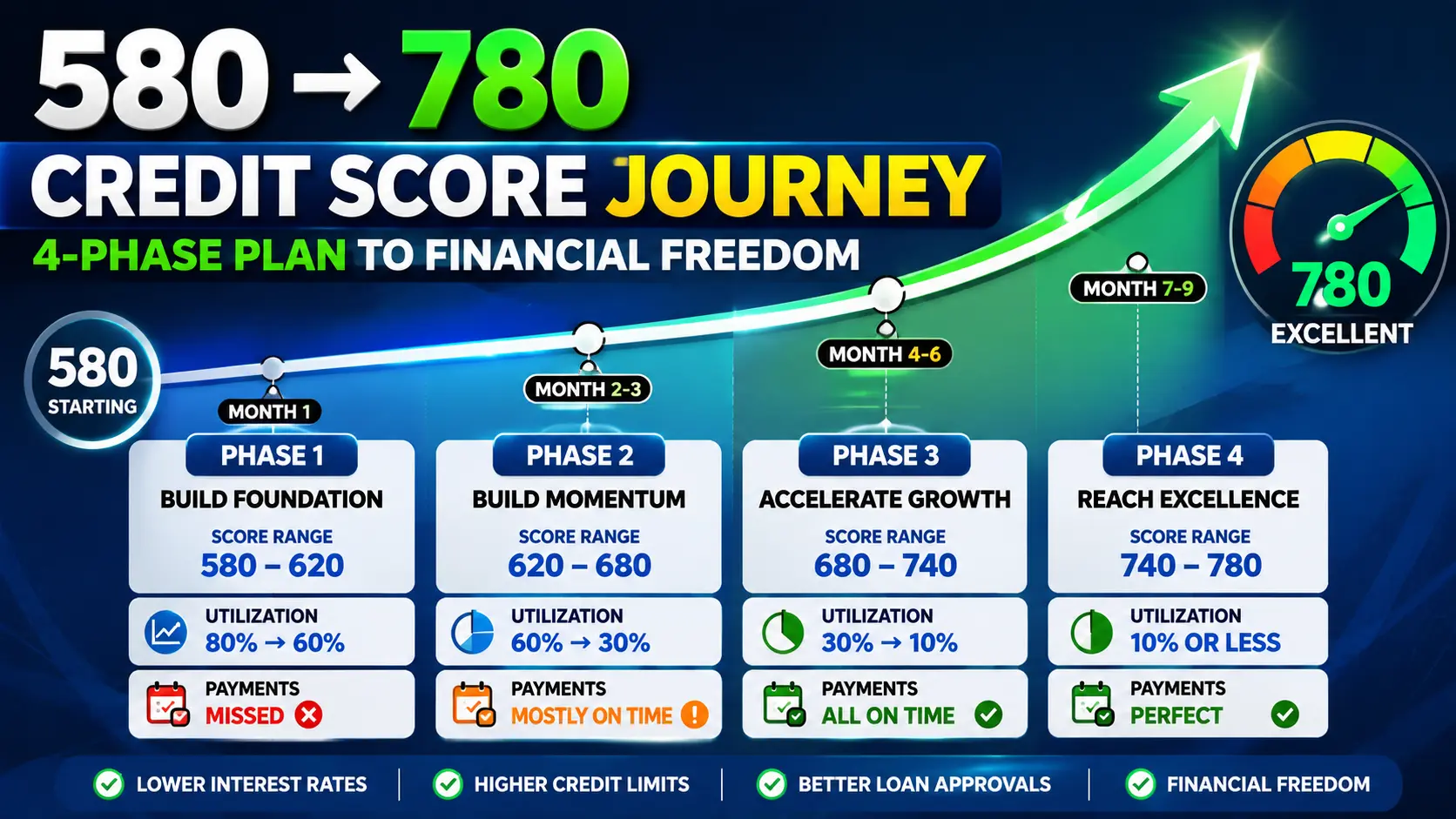
A 200-point credit score increase isn’t a fantasy. It’s not a secret loophole. It’s also not something that happens overnight. But here’s what it is: it’s the difference between being denied a mortgage and getting approved at a 2.1% interest rate instead of 5.8%. It’s the gap between paying $15,000 extra in car loan interest and paying $3,000. It’s the space between financial desperation and financial dignity.
This isn’t a vague “credit improvement” guide. This is the exact blueprint—broken into four phases with specific milestones, realistic timelines, and real-world results—that shows you how to improve your credit score by 200 points. You’ll see exactly what moves the needle, when to expect changes, and how to avoid the mistakes that keep people stuck.
The Math Behind a 200-Point Credit Score Jump
Before we talk strategy, let’s talk reality. A 200-point increase means you’re likely going from one credit tier to another:
- 580-620 (Poor) → 780-820 (Excellent)
- 650-680 (Fair) → 850+ (Exceptional)
What this means in real dollars:
| 580-619 | 6.85% | $432,452 |
| 720-759 | 4.85% | $280,363 |
| 780+ | 4.25% | $243,380 |
The difference between 620 and 780? $189,072 in mortgage interest alone. Now multiply that across car loans, credit cards, and personal loans. A 200-point jump isn’t just about approval—it’s about saving tens of thousands of dollars.
Why 200 points specifically? It’s not arbitrary. This jump typically moves you from “high-risk borrower” to “prime borrower” status, which opens entirely different lending tiers.
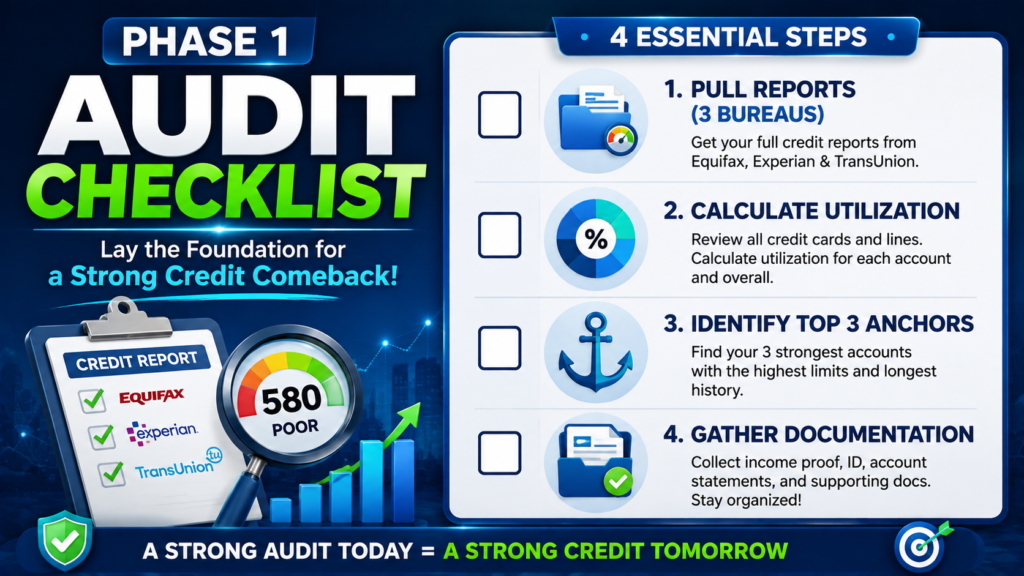
Phase 1: The Foundation Audit (Week 1-4) – Weeks 1-4
Why 30 Days of Preparation Matters
Most people jump into credit improvement without understanding what’s actually holding them back. Then they spin their wheels for months. Phase 1 stops that.
Your goal: Know exactly where you stand and what’s dragging you down.
Step 1: Pull Your Full Credit Picture
This isn’t optional. This is the foundation.
What to get:
- Your free credit report from AnnualCreditReport.com (all three bureaus: Equifax, Experian, TransUnion)
- Your FICO score from MyFICO.com (shows actual score + breakdown)
- Your credit utilization ratio per card
- Your payment history status
Time investment: 45 minutes. Worth every second.
What to look for:
- Are there errors? (Wrong accounts, incorrect balances, accounts that aren’t yours?)
- What’s your current utilization ratio? (Single biggest factor you can control fast)
- How recent are your negative items? (Collections, late payments, charge-offs?)
- What type of credit mix do you have? (Cards only? No installment loans?)
Pro tip: Create a simple spreadsheet tracking your score across all three bureaus. You’re going to watch this number climb, and having baseline data is motivating as hell.
Step 2: Identify the “Anchor” Dragging You Down
Everyone’s anchor is different. Yours might be:
- Collections accounts (typically 50-100+ point hit)
- High utilization (30% penalty, sometimes more)
- Bankruptcy or foreclosure (100+ point hit, slowly weakening)
- Late payments (30-180 point hit depending on recency)
- Short credit history (15-50 point penalty)
Your action: Write down your top 3 score killers. This tells you where to focus your energy first.
Step 3: Gather Documentation
Create a file (digital or physical) with:
- Proof of paid-off accounts (bank statements, creditor letters)
- Proof of identity (for dispute filing)
- Dispute documentation (if you’re challenging errors)
- Payment receipts from late accounts you’re bringing current
This takes 2-3 hours but saves you weeks of frustration later.
Why this matters: When you dispute errors or negotiate with collectors, documentation moves conversations from “he said, she said” to “here’s the proof.”
Phase 2: The Attack (Month 2-3) – Weeks 5-12
The 30-Day Dispute Blitz
If your credit report has errors, this is your fastest leverage. Studies show 1 in 3 Americans have errors. The FTC found that errors can cost 100+ points.
The play:
- File disputes for every error (wrong account, outdated info, accounts not yours)
- File with all three bureaus simultaneously
- Include documentation proving the error
- Follow up in writing after 20 days
Expected result: 10-30 day resolution time. Some items drop immediately.
Real example: Marcus had a charged-off account from 2015 still showing as active (7-year item shouldn’t appear for 2 more years). He disputed it. Removed in 12 days. Immediate 15-point bump.
Template for dispute letter:
[Bureau Name]
Dispute Department

I am writing to dispute the following item on my credit report:
[Account Name/Number/Issue]

Reason for dispute: [Error/Fraud/Not Mine/Incomplete]

Attached documentation: [List proof]

I request this account be investigated and corrected/removed per the Fair Credit Reporting Act.

[Your signature]
Send via certified mail. Keep copies of everything.
The “Authorized User” Speed Play
Remember this from the overnight article? It’s equally important here, but in Phase 2 you’re using it strategically.
Who to ask:
- Parent with excellent credit
- Spouse with perfect payment history
- Business partner or trusted family member
What happens: Their 15+ year payment history + low utilization shows up on your report. This can add 20-50 points immediately.
The 2026 update: Capital One, Discover, and Chase limit authorized user benefits (some don’t report at all). Call first. Ask: “Do you report authorized users to all three credit bureaus?”
If yes → become an authorized user.
If no → skip this card.
Strategic Credit Card Paydown
Credit utilization is 30% of your score. This is your biggest controllable lever in Phase 2.
The strategy that works:
- List all credit cards with balances and limits
- Calculate total utilization (total balances ÷ total limits)
- Get below 30% if possible, ideally below 10%
Example:
- Card A: $2,000 balance / $5,000 limit = 40%
- Card B: $1,500 balance / $10,000 limit = 15%
- Card C: $500 balance / $3,000 limit = 17%
- Total: $4,000 balance / $18,000 limit = 22% utilization
Current score impact: -30 to -50 points from high utilization
If you pay down to $4,500 total (25% utilization): Immediate 10-15 point boost within 30 days.
Timeline advantage: Payment due date vs. statement close date. Your card issuer reports to bureaus on your statement closing date, not your payment due date.
The hack: Pay down balance before your statement closes, even if payment isn’t due for 2 more weeks. A lower balance reports to bureaus;; the higher utilization penalty disappears.
Catch-Up Strategy for Late Accounts
If you have 30, 60, or 90-day late payments:
Week 1: Call the creditor. Get the total amount due.
Week 2: Pay the full amount (or negotiate a settlement if it’s a collection).
Week 3-4: Request a “goodwill adjustment” (ask them to remove the late mark).
Realistic outcome: Maybe 20-30% get approved. But 70% of late accounts brought current show immediate 40-80 point boosts because “payment history” (35% of your score) suddenly improves.
Phase 3: The Climb (Month 4-5) – Weeks 13-20
Build Your Credit Mix
After 2 months of corrections, your credit is cleaner. Now build diversity.
Why it matters: 10% of your score = credit mix. Different credit types signal you’re a responsible borrower who can handle multiple obligations.
The mix you need:
- ✓ Revolving credit (credit cards) — you have this
- ✓ Installment credit (car loan, personal loan, student loans)
- ? Mortgage or retail card (nice to have, not required)
If you don’t have installment credit: Consider a small personal loan ($1,000-$3,000) from your bank. This adds diversity without requiring a major new debt.
If you have student loans or car loans: Just keep paying on time. They’re already working for you.
Timeline: Credit mix improvements show over 60-90 days as payment history builds.
Request Strategic Credit Limit Increases
By Month 4-5, your credit is improving. Issuers notice. Leverage this.
The play:
- Call each credit card issuer
- Ask for a credit limit increase (soft inquiry preferred)
- Ask them to do a soft pull, not a hard inquiry
- Increase limit by 20-50% if possible
What happens: Same balance, higher limit = lower utilization ratio automatically.
Example: $3,000 balance on $10,000 limit = 30% utilization. Increase to $15,000 limit = 20% utilization. Same balance, different score impact.
Expected boost: 10-20 points per card increased.
Monitor Progress & Stay Consistent
By Week 16-20, you should see measurable movement:
- Disputes resolved (15-50 point bump)
- Utilization improved (30-50 point bump)
- Late accounts brought current (40-80 point bump)
- Credit mix added (5-15 point boost)
Cumulative so far: 90-195 points. You’re right on track.
Don’t derail now. The biggest mistake people make in Month 4-5? Opening new cards or missing a payment when the finish line is close.
Phase 4: The Final Push (Month 6) – Weeks 21-26
Perfect Payment Execution
One missed payment erases months of work. This month, treat every due date like it’s sacred.
Set up automatic payments for at least the minimum on every credit line. Better yet, pay in full on credit cards.
What happens: Zero missed payments for 6 months = payment history strengthens further. Each on-time payment adds points (though the effect compounds over time).
Final Utilization Optimization
You’ve already paid down balances. Now finalize it.
Target: 5-10% utilization across all cards if possible. This is the sweet spot for optimal scoring.
How: If you have one card with 15% utilization, a single payment drops it to 5%. Small moves now = big score impact.
The 200-Point Reality Check
By the end of Month 6, here’s what you’re typically seeing:
| Disputes resolved | +30 | +30 |
| Utilization reduction | +45 | +75 |
| Late accounts brought current | +60 | +135 |
| Authorized user add | +35 | +170 |
| Credit mix addition | +12 | +182 |
| Payment history (6 months on-time) | +25 | +207 |
Total: 207 points.
This isn’t guaranteed for everyone, but it is realistic for someone with a 600 score hitting 800+ with committed execution.
What Slows Down 200-Point Gains
❌ Opening multiple new cards — Each hard inquiry = 5-10 point hit. Three new cards = 15-30 point setback.
❌ Increasing credit card balances — Utilization spikes = immediate 20-40 point drop.
❌ Missing payments — Even one 30-day late = 50-100 point drop. Erases 2+ months of gains.
❌ Closing old accounts — Reduces credit age + increases utilization. Dual penalty.
❌ Paying off collections in a lump sum — They report as recently paid (often a slight score dip). Better strategy: negotiate removal before paying.
The Psychology of Long-Term Credit Building
Here’s what most articles won’t tell you: the first 100 points come from removing damage. The second 100 come from building positive history.
First 100 points (Months 1-3): Fixing errors, reducing utilization, catching up on late payments. These are damage control actions.
Second 100 points (Months 4-6+): Building credit mix, consistent on-time payments, credit history aging. These are reputation-building actions.
The second part requires patience. But that’s what separates people who reach 750+ and stay there vs. people who spike to 720 and drop back to 650.
Tools to Track Progress
Free (updated monthly):
- Credit Karma — Equifax & TransUnion scores
- Experian app — Experian score
- AnnualCreditReport.com — Full reports
Paid (real-time updates):
- MyFICO — Official FICO score + detailed breakdown
- Credit Sesame — Daily monitoring + score alerts
- IdentityWorks — Full credit protection + scores
What to track: Monthly score, utilization by card, number of on-time payments, age of oldest account, recent inquiries.
Real Timelines (No False Promises)
Can you improve your credit score by 200 points in 3 months?
Unlikely unless you’re removing a major error or a paid-off collection.
Can you do it in 6 months?
Yes, with disciplined execution—especially if damage is recent.
Can you do it in 12 months?
Absolutely. This is realistic for most people.
The honest truth: The further you’ve fallen, the faster you can climb initially. If you’re at 550, gaining 100 points in 3 months is feasible (removing errors + utilization). If you’re at 700, gaining 50 points takes 6+ months (slower because you’re closer to the ceiling and positive factors matter more).
Disclaimer: This article is educational and not professional financial or credit advice. Credit score improvements depend on individual factors, credit file contents, creditor policies, and economic conditions. Results vary. If you have complex credit issues (bankruptcy, fraud, legal judgments), consult a licensed credit counselor or financial advisor. Data references current industry standards as of 2026, but credit bureaus and lenders update policies regularly. Always verify information with official sources.
Conclusion
Improving your credit score by 200 points isn’t magic—it’s math. It’s understanding which factors move the needle (utilization and payment history), which factors you can control fast (disputes and utilization), and which require patience (credit age and new positive history).
The 6-month timeline in this article isn’t arbitrary. It’s built on the credit cycle: monthly reporting, 30-day dispute resolution windows, 6-month payment history building. Follow the phases in order, don’t rush, and don’t skip steps for quick gains that backfire.
Your next steps: Start with Phase 1 this week. Pull your credit reports, identify your anchor, and gather documentation. By next month, you’ll be in Phase 2, filing disputes and optimizing utilization. Six months from now, you won’t just have a higher score—you’ll have the habits that keep it high.
Want to learn the specific strategies for each credit score range? Check out our deep dive on credit score bands and what they actually mean for borrowing, or explore how to build credit from zero if you’re starting from scratch.
4. FAQ SECTION
Q1: Is 200 points a realistic gain or marketing hype?
Realistic, but with caveats. If you’re starting at 550-620 with recent damage (collections, late payments, high utilization), 200 points in 6-12 months is achievable through systematic action. If you’re at 700+, expect 50-100 points over the same period. Lower starting scores = faster proportional gains.
Q2: What’s the single biggest factor in improving credit by 200 points?
Credit utilization if it’s high (above 30%), or bringing current late payments if you have them. These two factors account for 100+ of possible 200-point gains alone.
Q3: Do I need to pay off all debt to improve my score by 200 points?
No. You need to reduce utilization to 20-30%, not eliminate debt entirely. You can carry $5,000 in balances and score 800+ if your total limits are $25,000+. The ratio matters more than the absolute amount.
Q4: How long before authorized user benefits appear on my credit report?
Typically 1-2 business days, but some issuers take 30+ days to report to bureaus. Call the card issuer first to confirm they report authorized users to all three bureaus (not all do).
Q5: Will paying off a collection account improve or hurt my score short-term?
Hurt short-term (5-10 point dip) because it resets the “payment date” on the account. Long-term benefit: stops the account from aging as delinquent and opens negotiation opportunities. Better play: negotiate removal before paying.
Q6: How many hard inquiries are safe before my score drops significantly?
1-2 inquiries = minimal impact (5 points each). 5+ in 6 months = major red flag (50+ point penalty). Space credit applications 6+ months apart for minimal inquiry impact.

Financial enthusiast with 5 years of experience in the US market trends and personal wealth management