
Introduction
Most people think building passive income with real estate means buying a rental property, finding tenants, and collecting checks. That’s one path—but it’s also the most expensive, most management-intensive, and most inaccessible option for most people. Here’s what the real estate passive income landscape actually looks like in 2026: you can start with $10, earn 5-12% annual returns, and never deal with a single tenant complaint.
This guide covers five distinct ways to build passive income with real estate—ranked from lowest capital required to highest—with realistic return expectations, actual risk levels, and the honest tradeoffs most articles skip.
Why Real Estate Works for Passive Income
Real estate has historically been one of the most reliable passive income generators for one simple reason: people always need places to live and work. Unlike stocks, real estate generates income through two channels simultaneously—cash flow (monthly rent or distributions) and appreciation (property value growth over time).
According to the National Association of Realtors, residential real estate has averaged 4-5% annual appreciation over the past 30 years, while generating 5-8% rental yield in most US markets. Combined, this creates total returns of 8-12% annually for patient investors—comparable to the stock market but with a physical asset backing the investment.
But here’s what changed dramatically in the last decade: you no longer need $50,000-$100,000 to participate. Technology has democratized real estate investing in ways that genuinely benefit beginners.
Path 1 — REITs (Best for Beginners With Any Budget)
Real Estate Investment Trusts (REITs) are publicly traded companies that own income-producing properties. By law, REITs must distribute at least 90% of taxable income to shareholders as dividends. You buy shares like a stock, and you receive quarterly dividend payments.
Why this is the easiest way to build passive income with real estate:
- Start with as little as $1 (fractional shares)
- No property management, no tenants, no repairs
- Instant diversification across dozens of properties
- Liquid (sell anytime, unlike actual property)
2026 REIT dividend yields by sector:
| REIT Type | Average Dividend Yield | Risk Level |
| Residential REITs | 3-5% | Low-Medium |
| Industrial REITs (warehouses) | 3-5% | Low |
| Healthcare REITs | 4-6% | Medium |
| Mortgage REITs | 8-12% | High |
| Retail REITs | 4-7% | Medium-High |
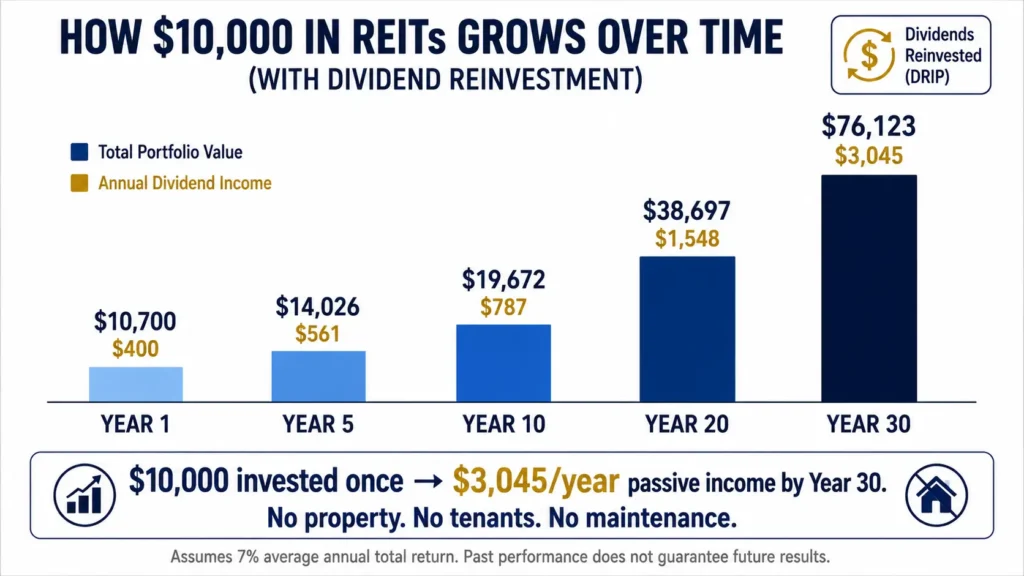
Realistic income example: $10,000 in a diversified REIT ETF like VNQ (Vanguard Real Estate ETF) at 4% yield = $400/year ($33/month). Not life-changing immediately, but compounding over 10-15 years creates meaningful passive income.
Best platforms: Fidelity, Vanguard, Charles Schwab (all commission-free)
The honest tradeoff: REIT share prices fluctuate with the stock market. You’re getting real estate income with stock market volatility. For pure complete passive income without price anxiety, crowdfunding might suit you better.
Path 2 — Real Estate Crowdfunding
Crowdfunding platforms pool money from multiple investors to fund real estate projects—residential developments, commercial properties, or mixed-use buildings. You earn returns through interest payments or profit-sharing when properties sell.
If you’re carrying debt while considering crowdfunding, our guide on investing while managing debt shows exactly when to invest vs. pay debt first
Top platforms in 2026:
- Fundrise: $10 minimum, 8-12% historical returns, diversified portfolio
- RealtyMogul: $5,000 minimum, commercial focus, higher yield potential
- Arrived Homes: $100 minimum, single-family rentals, 4-7% yield
What makes this different from REITs: Your money goes into specific properties or portfolios, not publicly traded stocks. Returns aren’t tied to daily stock market movements. This makes crowdfunding less volatile, though also less liquid (most platforms lock money for 3-5 years).
Realistic income example: $5,000 in Fundrise at 9% historical return = $450/year ($37.50/month). Accessible, diversified, genuinely passive.
The honest tradeoff: Illiquidity. If you need money before the investment period ends, you may face penalties or be unable to withdraw. Only invest what you genuinely won’t need for 3-5 years.
Path 3 — Rental Property
Traditional rental property remains the most powerful way to build long-term passive income with real estate—but it requires the most upfront capital and active involvement. Before becoming a landlord, understanding apartment debt from the tenant side helps you screen tenants and prevent cash flow problems
The cash flow equation:
- Monthly rent: $1,800
- Mortgage (P+I): $1,100
- Property taxes + insurance: $350
- Maintenance reserve (10% of rent): $180
- Net monthly cash flow: $170
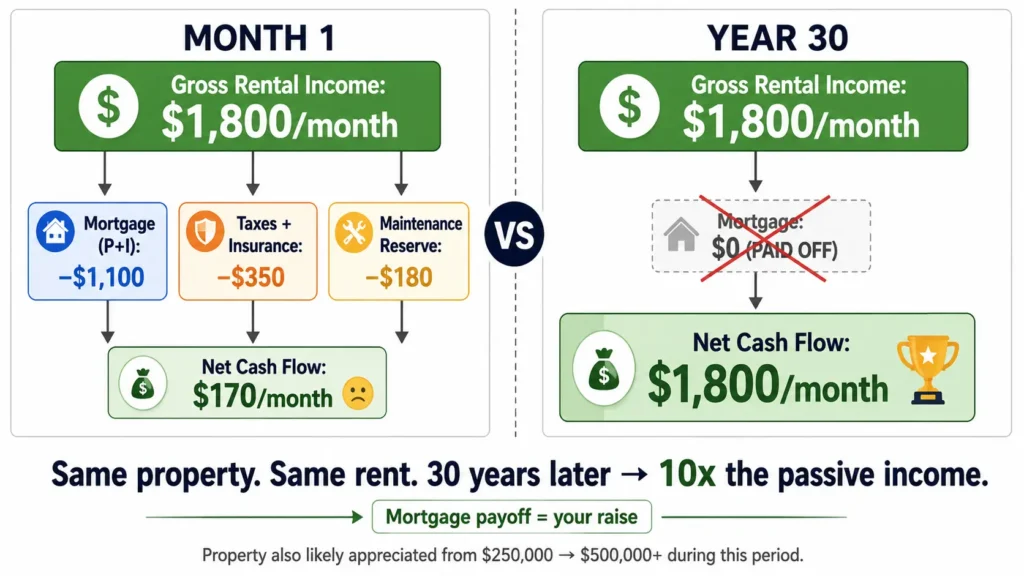
$170/month sounds modest. But after 30 years, the mortgage is paid. That same property now generates $1,800/month in income. Plus, the property likely appreciated from $250,000 to $500,000+. This is why rental real estate builds generational wealth despite modest monthly cash flow early on.
Capital required in 2026: 20-25% down payment for investment properties. On a $250,000 property: $50,000-$62,500 down payment plus closing costs ($5,000-$8,000).
Reducing the management burden: Hiring a property management company (8-12% of monthly rent) converts rental income from active to genuinely passive. Yes, it reduces cash flow, but it removes the “2 AM tenant call” problem entirely.
The honest tradeoff: Concentration risk. All your capital is in one property, one location, one market. Vacancy months, major repairs, or bad tenants can erase years of cash flow. Diversification matters.
Path 4 — Short-Term Rentals
Platforms like Airbnb and VRBO transformed real estate income by allowing property owners to earn 2-3x traditional rental income from short-term guests. A property generating $1,800/month in long-term rent might earn $3,500-$4,500/month as a short-term rental in the right market.
2026 short-term rental reality check:
Many cities now restrict short-term rentals through local ordinances. Before pursuing this strategy, verify your city’s regulations and HOA rules. Noncompliance can result in fines that eliminate all profit.
What makes STR passive vs. active: Co-hosting services and property management companies handle guest communication, cleaning coordination, and maintenance for 20- 30% of revenue. With professional management, short-term rental income becomes genuinely passive—at a cost.
Realistic income (managed property): $3,500/month revenue – 25% management fee = $2,625 – expenses = $1,200-$1,800 net. Compare to $170/month traditional rental. The yield difference justifies the higher management cost for many investors.
The honest tradeoff: Short-term rental income is inconsistent. Peak season fills calendars; off-season creates vacancy. Budget conservatively (assume 60-65% occupancy) to avoid cash flow surprises.
Path 5 — Real Estate Notes and Lending
When most people buy property, they get a mortgage. Someone funds that mortgage—and that someone earns interest. Real estate note investing means you become the lender.
How it works: You loan money (directly or through platforms) to real estate investors or buyers. They pay interest monthly. The property itself secures the loan.
Expected returns: 6-12% annually, depending on loan type, borrower creditworthiness, and platform
Minimum investment: Varies ($1,000-$25,000 depending on platform)
Why this is passive: You review the loan once, fund it, and collect monthly payments. No property ownership, no management, no tenants. Pure income stream backed by real estate collateral.
The honest tradeoff: If the borrower defaults, you may own a property you didn’t want (through foreclosure). Vet platforms carefully and diversify across multiple loans to reduce this risk.
Choosing Your Real Estate Passive Income Path
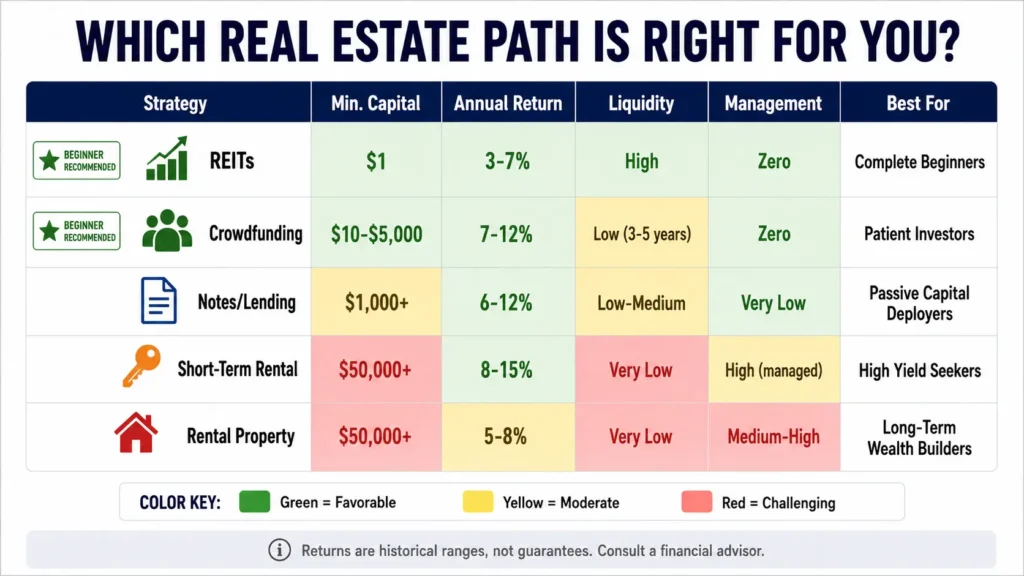
| Path | Minimum Capital | Annual Return | Liquidity | Management Effort |
| REITs | $1 | 3-7% dividend | High (sell anytime) | Zero |
| Crowdfunding | $10-$5,000 | 7-12% | Low (3-5 year lock) | Zero |
| Rental Property | $50,000+ | 5-8% cash-on-cash | Very Low | Medium-High |
| Short-Term Rental | $50,000+ | 8-15% | Very Low | High (or managed) |
| Real Estate Notes | $1,000+ | 6-12% | Low-Medium | Very Low |
The selection framework is simple: How much capital do you have? How liquid do you need to stay? How involved do you want to be?
You’re starting with under $5,000: REITs or Fundrise. If you have $50,000+: evaluate rental property in your local market. you want maximum passivity regardless of capital, consider REITs or notes.
If capital is the barrier, our guide on bridge income before real estate investing shows how to build your first $5,000-$10,000 for crowdfunding
Disclaimer: This article is educational content about real estate passive income strategies. It is not investment, financial, or legal advice. Real estate investments carry risk, including potential loss of principal. REIT dividends fluctuate with market conditions. Crowdfunding platforms vary in security and historical returns. Rental income depends on local market conditions, vacancy rates, and expense management. Consult a licensed financial advisor and real estate attorney before making investment decisions. All return figures represent historical ranges, not guarantees.
Conclusion
Building passive income with real estate doesn’t require a $300,000 property or a landlord license. It requires understanding which of five distinct paths fits your current capital, timeline, and involvement preference—then consistently starting with that path.
Begin where you are. $100 in a REIT today compounds into $400+ in a decade. $5,000 in crowdfunding today generates $500/year in income while you learn. $50,000 in a rental property today becomes $150,000+ in equity by retirement. The path matters less than starting.
Want to see how real estate passive income fits into your complete financial picture? Our pillar guide on how to build passive income covers all eight passive income streams together—showing how real estate income combines with dividends, digital products, and other streams to build genuine financial independence.
Your real estate passive income journey starts with one step. Make it today.

Financial enthusiast with 5 years of experience in the US market trends and personal wealth management