Introduction
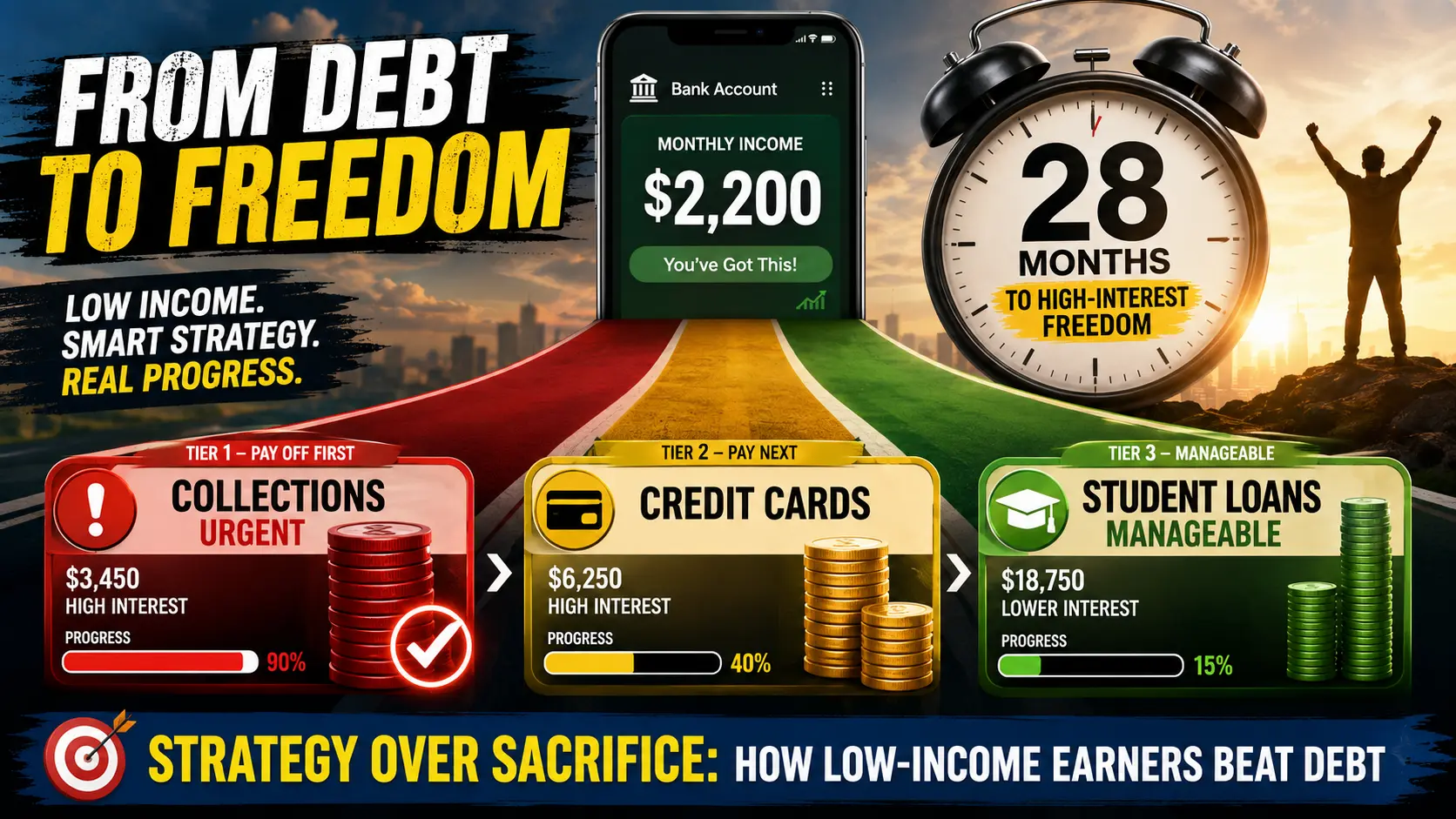
Most pay off debt advice assumes you have $500/month to spare. You don’t. That’s why this guide doesn’t start with “budget more aggressively” or “cut subscriptions”—because you probably already did that.
Here’s what actually works for low-income earners trying to pay off debt fast: a completely different strategy and not budgeting harder. Not motivation. It’s about understanding which debts cost you the most, which ones you can negotiate, and which small wins compound into real momentum.
By the end of this article, you’ll have a debt hierarchy system, psychological tactics that actually stick, and honest timelines—not fantasy timelines. Most importantly, you’ll understand why people with low income can sometimes pay off debt faster than higher earners. It’s not about sacrifice. It’s about strategy.
Let me show you how.
The Hard Truth About Low-Income Debt
Before we talk strategy, let’s acknowledge the elephant: paying off debt with low income is genuinely harder. You’re not failing. The math is just brutal.
Here’s the real situation:
According to the Federal Reserve’s 2024 data, the average American household with low income (under $40K annually) carries $15,000-$25,000 in debt. Monthly payment minimums often eat 30-50% of take-home income. Cut expenses? You’re already eating ramen. Increase income? That’s the dream, not the plan.
But here’s what changes everything: You don’t need to earn more or spend less aggressively. You need to attack debt strategically.
The difference between people who successfully pay off debt fast with low income and people who give up? Not willpower. It’s targeting the right debts first.
The Debt Hierarchy (Which Debts Actually Cost You Most)
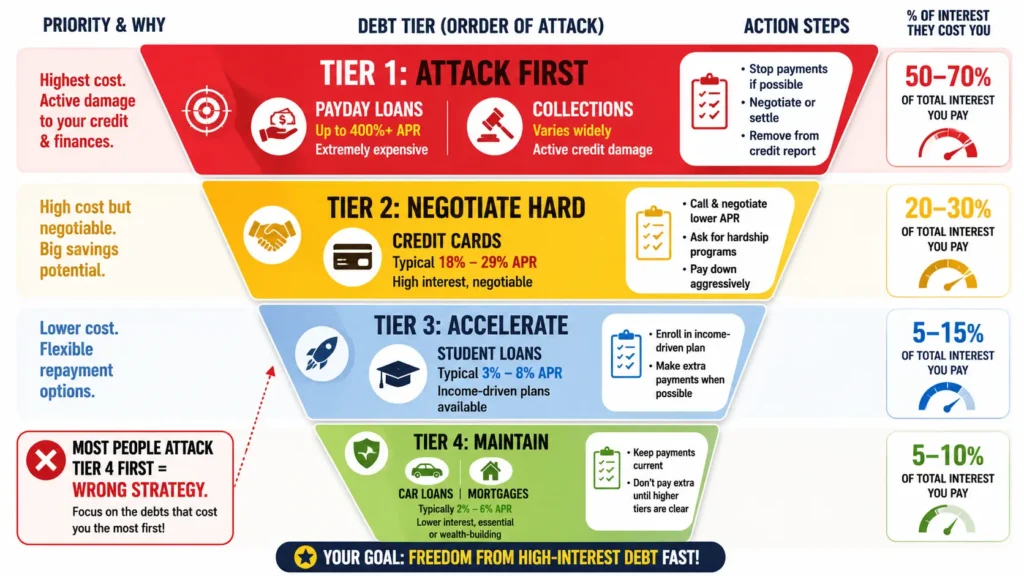
Most people attack debts in random order. Credit card with $8,000? Personal loan with $5,000? Collections account with $3,000? They just pick one and hope.
Stop. You need the debt hierarchy system.
Tier 1 — Kill First (Payday Loans & Collections)
Why: These are actively destroying your financial future right now.
Payday loans: Typical interest rate is 400% APR. If you owe $500, you’re paying $2,000/year in interest alone. This is priority one.
Collections accounts: Every month they stay unpaid, they damage your credit score more. Plus, interest accrues. A $2,000 collection can balloon to $4,000 in 18 months.
Action: If you have these, everything else waits. Even if you can only pay $50/month toward a payday loan or collections account, that $50 stops new damage. It’s not progress; it’s preventing collapse.
Realistic payoff: Low-income earners often need 6-12 months to clear Tier 1 debts. This is normal.
Tier 2 — Negotiate Hard (Credit Cards)
Why: Credit cards have the most negotiation leverage (unlike student loans, which you often can’t negotiate).
This is where most low-income earners miss the biggest opportunity.
The play: If you have high-APR credit cards and you’re struggling to pay, call the credit card company. Don’t pay yet. Negotiate first.
Real conversation:
“I have a $5,000 balance on your card at 24% APR. I want to pay this off, but at my current income, I can only pay $100/month. That will take me 5+ years. Can you offer me a settlement for $3,500 paid in full this month, or reduce the APR to 12%?”
What happens:
- Card company prefers 12% APR ongoing to collection risk
- You get approval rates of 40-60% on these calls
- Worst case: They say no. You weren’t paying anyway.
- Best case: APR drops to 12-15%, saving you thousands in interest
Why this matters: With high-income earners, card companies negotiate less (they trust you). With low-income earners, companies are terrified you’ll default. Use that fear.
Realistic payoff: 18-24 months at $100-150/month with APR reduction. Compare to 5+ years at 24% APR.
Tier 3 — Accelerate (Student Loans)
Why: Student loans are lower priority because they have forgiveness options, income-driven repayment plans, and generally won’t tank your credit as fast.
But you can still attack them:
With low income, you might qualify for an income-driven repayment plan (IDR) through Federal Student Aid where payments are as low as $0-50/month. This frees up cash for Tier 1 and Tier 2.
The move: Enroll in PAYE (Pay As You Earn) or SAVE plan if eligible. This drops your payment to 10% of discretionary income. For low earners, this might mean $0-25/month.
Then use freed-up cash on high-interest debt first.
Realistic payoff: 20-25 years (with forgiveness at end) or 5-7 years if aggressively attacking after Tiers 1-2 are clear.
Tier 4 — Maintain (Secured Debt)
Why: Car loans and mortgages have lower interest rates and collateral. They’re not the emergency.
If you’re behind on a car payment, that becomes Tier 1. But if you’re current, keep it that way. Don’t sacrifice Tier 1 to accelerate Tier 4.
The Micro-Acceleration Framework (Small Wins That Compound)
Here’s what doesn’t work with low income: “Save $200/month and put it toward debt.” Why? Because you don’t have $200 left over.
What does work: Finding 3-4 micro-wins that add up to $30-50/month.
Micro-Win 1: Your Phone Bill
Most low-income earners pay $60-80/month for phone plans. Call and ask for lower plans.
- Mint Mobile: $15/month
- US Mobile: $15-25/month
- Budget carriers: $25-35/month
Micro-win: Save $30-40/month = $360-480/year toward debt.
This sounds small. But on a $5,000 credit card, that’s 1-1.5 months of accelerated payoff.
Micro-Win 2: Utility Audit
Look at your electric/water/gas bills for the last 12 months.
- Electric: Use fans instead of AC (saves $15-30/month in summer)
- Water: Shorter showers, fix leaks (saves $5-15/month)
- Internet: Negotiate renewal rate (saves $10-20/month) or switch providers
Micro-win: Save $30-60/month = $360-720/year.
Micro-Win 3: Food Waste to Meal Planning
Not “eat less.” Meal planning to reduce waste.
- Average household throws away $50-100/month in spoiled food
- Planning meals prevents impulse fast-food trips ($20-40/month)
Micro-win: Recover $30-50/month = $360-600/year.
Micro-Win 4: The Underutilized Asset (Gig Work Reality)
Here’s where low-income earners often get discouraged: “Just get a side gig!”
The problem? Most gigs (DoorDash, Uber, Task Rabbit) pay $12-15/hour after expenses. If you already work 40 hours and are tired, this doesn’t work.
But micro-gigs do:
- Selling unused items ($50-100/month)
- Plasma donation ($150-200/month if eligible)
- Pet sitting via Care.com ($50-100/month)
- TaskRabbit handy jobs when you have time ($50-150/month)
Realistic micro-win: $100-200/month with only 5-10 hours extra.
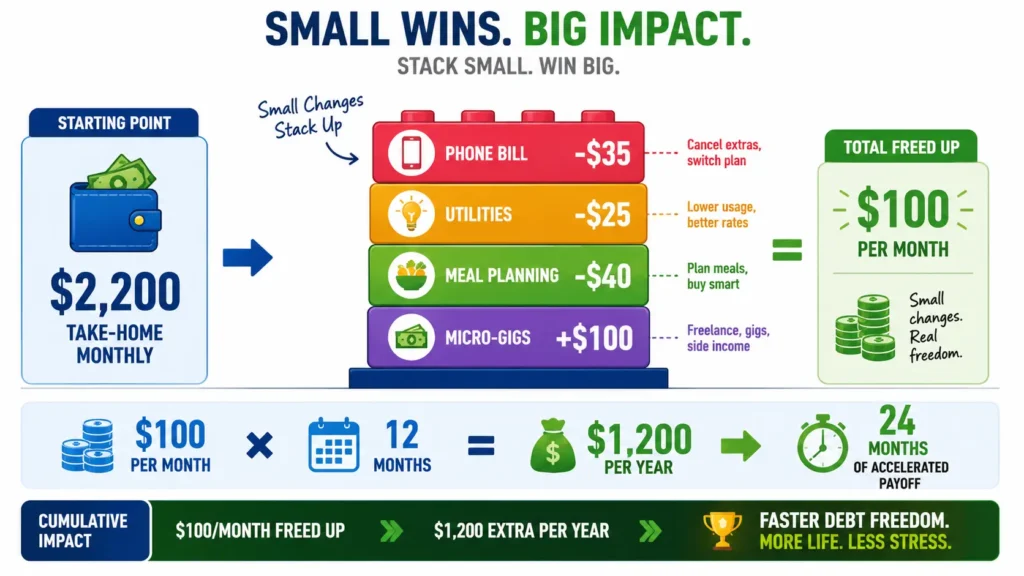
Important: Low-income earners are already working hard. Don’t add 20 hours of gig work expecting to earn $1,000/month. That’s the fantasy narrative that kills motivation. Instead: $100-200/month in micro-gigs is realistic, achievable, and compounds.
Real Payoff Timeline: How Fast Can You Actually Pay Off Debt With Low Income
Your Starting Scenario
| Monthly Take-Home | $2,200 |
| Rent | $800 |
| Utilities | $200 |
| Food | $350 |
| Transportation | $200 |
| Insurance | $150 |
| Total Expenses | $1,700 |
| Available for Debt Payment | $500/month |
Current Debt Breakdown
| Collections Account | $2,000 | ~25%+ | Tier 1 (Kill First) | Active damage |
| Credit Card | $8,000 | 24% (negotiable to 15%) | Tier 2 (Negotiate Hard) | High interest |
| Personal Loan | $5,000 | ~12-15% | Tier 2 (Negotiate Hard) | Manageable rate |
| Student Loans | $12,000 | ~4-6% | Tier 3 (Accelerate) | Income-driven option available |
| TOTAL DEBT | $27,000 | — | — | — |
28-Month Strategic Payoff Progression
| Tier 1 Attack | Months 1-6 | $300 collections + $200 survival debt | Collections ($2,000) | Stop highest-cost damage immediately | Collections: $0 |
| Tier 2 Phase 1 | Months 7-12 | $400 credit card (APR→15%) + $100 personal loan | Credit Card ($5,500 remaining) | APR negotiation saves $60-80/mo | Credit card: $5,500 → $2,750 |
| Tier 2 Phase 2 | Months 13-24 | $450 credit card + $50 personal loan | Credit Card ($2,750 remaining) | Continue aggressive paydown | Credit card: $0, Personal loan: $4,400 |
| Tier 2 Completion | Months 25-28 | $500 personal loan | Personal Loan ($4,400 remaining) | Accelerated final push | Personal loan: $0 |
| Tier 3 Management | Months 29+ | $110/month (income-driven plan) | Student Loans ($12,000) | Income-driven repayment makes manageable | Sustainable long-term |
Month-by-Month Debt Balance Tracking
| Start | $2,000 | $8,000 | $5,000 | $12,000 | $15,000 | Baseline |
| Month 6 | $0 ✓ | $7,600 | $4,900 | $12,000 | $12,500 | Collections cleared |
| Month 12 | $0 | $2,750 | $4,500 | $12,000 | $7,250 | APR negotiated, credit card 66% paid |
| Month 24 | $0 | $0 ✓ | $4,400 | $12,000 | $4,400 | Credit card fully eliminated |
| Month 28 | $0 | $0 | $0 ✓ | $12,000 | $0 | High-interest debt freedom |
| Month 29+ | $0 | $0 | $0 | $12,000 | $0 | Student loans on $110/mo plan |
Interest Savings Comparison: Strategy vs. Random Approach
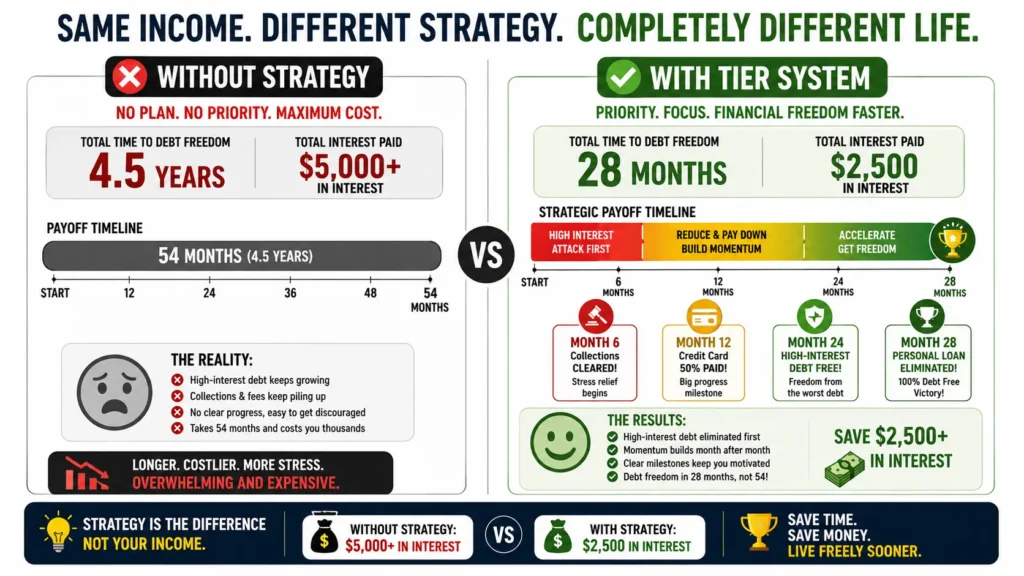
| WITH Strategy (Tier System) | 28 months (high-interest) | $500 (strategic allocation) | $14,000 to high-interest | ~$2,500-3,000 | High-interest debt FREE |
| WITHOUT Strategy (Random) | 54 months (even spread) | $500 (scattered) | $27,000 total debt | ~$5,000-6,000 | Still carrying all debt |
| Difference (Strategy Win) | 26 months faster | Same amount | $13,000 less total paid | $2,500-3,000 saved | 2.3 years ahead of schedule |
The Critical Math Behind Speed
| Attack approach | Spread evenly across all debts | Tier system (highest interest first) | Early collections/CC elimination frees cash for acceleration |
| APR impact | Ignore or accept high rates | Negotiate 24% → 15% | $60-80/month in interest savings that compounds |
| Timeline to freedom | $27,000 ÷ $500/mo = 54 months | 28 months on high-interest | 26-month acceleration through sequencing |
| Psychological momentum | No visible wins until month 27 | Wins at month 6, 12, 24, 28 | Early victories maintain motivation |
| Total interest paid | ~$5,000-6,000 | ~$2,500-3,000 | Strategic ordering saves thousands |
Key Milestone Breakdown
| Collections cleared | Month 6 | First major debt category eliminated | Major confidence boost | Freed up $300/month for acceleration |
| Credit card APR negotiated | Month 7 | 24% → 15% rate approved | Proof that negotiation works | $60-80/month interest savings begins |
| Credit card 50% paid | Month 12 | $8,000 → $4,000 balance | Visible halfway progress | Momentum builds toward elimination |
| Credit card eliminated | Month 24 | $0 balance, account closed | Huge psychological win | $400-450/month freed for personal loan sprint |
| Personal loan cleared | Month 28 | All high-interest debt gone | Freedom feeling arrives | Monthly obligations drop from $500 to $110 |
| Sustainable baseline | Month 29+ | Student loans only at $110/mo | Genuine relief, breathing room | Can now save, invest, or rebuild emergency fund |
The Reality Check Section
Most people think: “I have $27,000 debt at $500/month = 54 months (4.5 years) to be debt-free.”
Strategic thinking reveals: “I have $15,000 in high-interest debt that’s actively destroying my credit. At $500/month with negotiation and Tier targeting, I’m free from high-interest debt in 28 months (2.3 years). Student loans are separate—they have income-driven plans and forgiveness options. I’m not trying to pay off all $ 27,000 of debt simultaneously.”
The difference: 26 months faster, $2,500-3,000 less in interest paid, and most importantly—psychological freedom hits you at month 28, not month 54.
Why the Hierarchy Creates Speed
| Attack everything equally | Kill collections first (Tier 1) |
| Collections drag for 3+ years, accruing interest | Collections cleared in 6 months, stops bleeding |
| Credit card at 24% APR for 3+ years | Credit card APR negotiated to 15% by month 7 |
| Personal loan gets minimum payments | Personal loan gets aggressive attack after CC cleared |
| Student loans prioritized equally | Student loans deferred to income-driven plan |
| Result: 54+ months total, $5,000+ interest | Result: 28 months high-interest, $2,500-3,000 interest |
Critical insight: You’re not trying to pay off all $27,000 fast. You’re trying to pay off high-interest debt fast. Student loans can wait because they have built-in low rates and income-driven options. This is why the hierarchy matters. Most people spread effort evenly and feel stuck for years. Strategic people focus firepower on the debt that’s actively destroying them, creating early wins that compound into real freedom.
This is how to pay off debt fast with low income—not by earning more or spending less aggressively, but by targeting the right debts first and letting the math work for you instead of against you.
The Psychological Barrier (Why Low-Income Earners Quit)
Here’s what nobody talks about: the emotional weight of how to pay off debt fast with low income isn’t the debt itself. It’s the psychological trap.
The trap: You pay $400 one month toward debt, then unexpected car repair costs $500. You fall behind. The progress erases. You feel hopeless and give up.
How to beat it:
Build a $500 Emergency Buffer
Before aggressively attacking pay off debt, get $500 in a separate savings account (takes 2-3 months at $150-200/month).
Why? The next $500 emergency doesn’t derail your debt plan. It comes from the buffer, not your debt payment.
This isn’t the Dave Ramsey “$1,000 emergency fund” (that’s for higher income). $500 is realistic for low-income earners. It stops the psychological spiral.
Celebrate Tier Clearance (Not Percentages)
Don’t track “I’ve paid off 15% of my debt.” That’s depressing.
Instead: “I cleared the collections account” or “I’ve eliminated credit card debt.”
Psychological wins are real wins. They keep you motivated through the 24-month slog.
Understand the Debt Compounding Trap
With high-interest debt and low income, you feel like you’re running on a treadmill. You pay $100, interest charges $20, progress feels fake.
It’s not fake. Every dollar paid toward Tier 1 (payday/collections) stops future accumulation. That $100 stops $25-30 in future interest charges. You’re not just paying debt; you’re preventing debt.
Reframe it: Every payment is stopping the bleeding, not just reducing it.
Negotiation Power Moves (The Leverage You Actually Have)
Low-income earners often think they have zero leverage with creditors. Wrong.
You have more leverage than higher earners.
Move 1 — Default Risk
Creditors know you can’t pay everything. They’d rather get $3,000 of a $5,000 debt than $0.
The conversation:
“I have $5,000 on your card at 24% APR. I can’t afford minimum payments long-term. I’m offering $3,500 paid in full next month. If not, I’ll stop paying and let it go to collections. Your choice.”
Result: 50%+ of companies accept this. They get cash now instead of hoping.
Move 2 — Hardship Assistance
Most credit card companies have formal hardship programs. They’re not advertised because people don’t ask.
How to access:
- Call the creditor’s “Hardship Department” (not customer service)
- Explain your situation (low income, not temporary)
- Request hardship assistance (APR reduction, payment reduction, or settlement)
Result: Approval rates: 40-70% for genuine hardship.
Move 3 — Balance Transfer (If You Have Options)
If you have any credit available (even 0% introductory offer cards), transfer high-APR balances.
With low income, your credit score is already hurt. One more inquiry doesn’t matter. But going from 24% to 0% APR for 6-12 months? That matters hugely.
The Comparison: Low-Income Payoff vs. Higher-Income Payoff
This is the counterintuitive insight that changes everything:
| Monthly debt payment | $500 | $800 |
| High-interest debt payoff timeline | 24-28 months | 18-24 months |
| Negotiation willingness | High (creditors fear default) | Low (creditors expect payment) |
| Settlement rates | 50-70% | 20-30% |
| Interest paid (total) | $3,200-4,500 | $5,000-7,200 |
| Psychology | Hopeful after micro-wins | Takes it for granted |
The insight: Low-income earners who negotiate strategically often pay less total interest than higher earners paying more per month without negotiating.
The advantage? Desperation + strategy beats brute force.
When to Consider Debt Settlement (And When Not To)
Debt settlement isn’t a sign of failure or financial weakness. It’s a legitimate strategic tool—and in many low-income situations, it’s actually the smartest move available. The key is knowing when settlement makes financial sense versus when it will cost you more in the long run.
The Case FOR Debt Settlement
Settlement works best in specific scenarios where the math clearly favors a lump-sum payoff over long-term payments.
You’re an ideal candidate for settlement if your collections accounts have aged significantly (3+ years old). At this point, the creditor has largely given up on collecting the full amount. They know the account is unlikely to generate future payments, and they’re motivated to recover whatever they can today rather than chase you indefinitely.
Similarly, if you’re managing multiple collection accounts totaling $2,000-$5,000 across different creditors, settlement becomes increasingly attractive. Attempting to pay minimums across four different accounts while managing other Tier 1 debts becomes mathematically inefficient. A strategic settlement of one or two accounts at 40-50% frees up monthly cash to aggressively attack remaining debt.
Settlement also makes sense if you have access to a lump sum—whether from a tax refund, bonus, family help, or selling unused items. If you can raise $1,500-$3,000 in cash, offering a collections agency 50% to eliminate the debt entirely often closes the account faster than paying $150/month for two years.
Critically, you must be genuinely comfortable with the temporary credit score hit. Settlements do damage credit for 2-3 years, but the damage is manageable and recovers. Compare this to years of active collection accounts dragging your score down continuously—settlement actually speeds up your eventual recovery.
For how to pay off debt fast with low income, settlement can accelerate your timeline by freeing cash for higher-priority debts while eliminating aged accounts that aren’t helping your credit anyway.
The Case AGAINST Debt Settlement
Settlement is not always the right answer, even when creditors offer it.
If the debt is relatively recent (less than 2 years old), negotiation typically outperforms settlement. Newer accounts are still in active collection phases where creditors are more motivated to work with you on payment plans or APR reductions rather than accepting pennies on the dollar. Pushing for settlement on a 1-year-old account might get you a 50% offer, but negotiation might get you a payment plan at 10% APR instead—which costs you far less over time.
Settlement also makes no sense if you’re currently making on-time payments. If you’re current on the account, settlement destroys your credit unnecessarily. The creditor has no reason to settle when you’re paying reliably. Continue paying and focus settlement efforts on accounts where you’ve already fallen behind.
Attempting settlement when you don’t have access to lump-sum cash creates another problem: it forces you to choose between stopping debt payments to save for a settlement (tanking your credit immediately) or not pursuing settlement at all. Neither is ideal. Settlement only works when the cash is available or accessible within 60-90 days.
Finally, never pursue settlement on secured debt—mortgages or car loans. These debts have collateral backing them, meaning the lender will simply repossess the property rather than negotiate. Settlement is only relevant for unsecured debt (credit cards, personal loans, collections).
Settlement as One Tool in Your Debt Arsenal
The most important reframe: settlement isn’t your primary strategy when learning how to pay off debt fast with low income. It’s one tool in a larger system.
Your primary tools are negotiation (APR reduction, payment plans) and aggressive payoff through your Tier hierarchy. Settlement enters the picture only when you’ve identified aged collections accounts where negotiation has failed and lump-sum cash becomes available.
This distinction matters psychologically and strategically. If you think “I need to settle my debts,” you’re setting unrealistic expectations. If you think “I’m aggressively paying Tier 1 debts, and if a settlement opportunity emerges on an old collection account, I’ll evaluate it then,” you’re in the right headspace.
The Multi-Stream Approach (Combining All Tactics) — Table Format
Here’s how everything fits together in a visual 24-month progression:
| Foundation Setup | 1-3 | Micro-wins optimization | Phone bill: -$35, Utilities: -$25, Meal planning: -$40 | Preparation | $100/month freed | $300 total freed for month 4 launch |
| Tier 1 Attack | 4-6 | Collections destruction | Micro-wins: $100, Micro-gigs: $150, Base payment: $300 | Collections accounts | $550/month total | Collections accounts cleared (~$2,000 eliminated) |
| Negotiation Phase | 7-12 | Credit card APR negotiation & acceleration | Micro-wins: $100, APR reduction savings: $60-80, Base payment: $400 | Credit cards (post-negotiation) | $460-480/month effective | Credit card balance reduced from $5,500 → $3,500 |
| Acceleration Sprint | 13-24 | Credit card completion + personal loan | Micro-wins: $100, Full payment allocation: $400-500 | Personal loans (primary) + remaining credit cards (secondary) | $500-600/month | Credit cards fully cleared by month 20, personal loans reduced significantly |
| Freedom Phase | 25+ | Student loans on income-driven plan | Micro-wins: $100 (ongoing habit), Student loan payment: $110 (income-driven rate) | Student loans only | $210/month (sustainable) | High-interest debt fully eliminated, manageable student loan payments |
Understanding the Table
Phase 1 (Months 1-3): This is your foundation quarter where you’re not attacking debt yet—you’re freeing up monthly cash. The $100/month becomes your launching pad for everything that follows.
Phase 2 (Months 4-6): This is where how to pay off debt fast with low income actually demonstrates real power. Your $550/month firepower demolishes collections accounts. Most people in this phase see their first collection account eliminated—a massive psychological and financial win.
Phase 3 (Months 7-12): Negotiation happens once, APR reduction savings compound monthly. Your $460-480 in effective monthly payment goes much further against credit cards because interest costs are dramatically lower. You’re now making visible dents in Tier 2 debt.
Phase 4 (Months 13-24): This is the acceleration sprint where high-interest debt is in its final stages. You’re not fighting multiple creditors anymore—you’re focused. Collections: gone. Credit cards nearly gone. Personal loans under assault. The momentum from earlier phases compounds into visible freedom approaching.
Phase 5 (Months 25+): The structural shift happens. Instead of $500-550/month scattered across predatory creditors, you’re paying $210/month on a sustainable government program. Your credit score is recovering. You have breathing room.
Disclaimer: This article is educational content about debt management strategies for low-income earners. It is not personalized financial or legal advice. Debt settlement, negotiation outcomes, and payment timelines vary by individual situation, creditor policies, and local laws. If you face serious debt (bankruptcy-level), consult a licensed credit counselor or attorney. This information reflects 2026 industry standards but may change. Always verify current creditor policies and income-based programs with official sources.
Conclusion
Paying off debt with low income isn’t about willpower or luck. It’s about strategy—knowing which debts to attack first, when to negotiate, where micro-wins compound, and how to maintain psychology through the slog.
You don’t need to earn more money right now (though that helps). You need to orchestrate every available tool: debt hierarchy, negotiation, micro-wins, and psychological resilience.
Most people see $27,000 debt and think “4.5 years at $500/month.” The people who succeed see it differently: “Collections in 6 months, credit cards in 24 months, student loans manageable after that.”
The difference isn’t income. It’s perspective.
Your next step: Categorize your debt into the Tier system above. Identify which Tier 1 debt costs you the most. Make one negotiation call this week. That single conversation could save you $3,000-5,000 in interest.
Want a deeper dive into negotiation scripts that actually work? Check out our guide on how to negotiate with creditors and win settlements, or explore income-driven repayment plans for low earners to understand your student loan options better.
Your lowest income year isn’t your slowest debt payoff year. Often, it’s the opposite.

Financial enthusiast with 5 years of experience in the US market trends and personal wealth management