
Introduction
How to invest in stock market for beginners: open an online brokerage account, add money to the account, and purchase stocks or stock-based funds from there. Many brokerages allow you to open an investing account with $0, though you’ll need some money to actually start investing. Even small amounts — $10 or $20 — will do. That’s the short answer. The longer answer—the one that determines whether you actually build wealth or just lose money nervously—is what this guide covers. Here’s how to invest in the stock market for beginners in 2026, using only verified data from Fidelity, NerdWallet, and Motley Fool.
Why Start Now
The S&P 500 is on track to achieve double-digit returns for the third straight year, something it has only done five times since its inception in 1957.
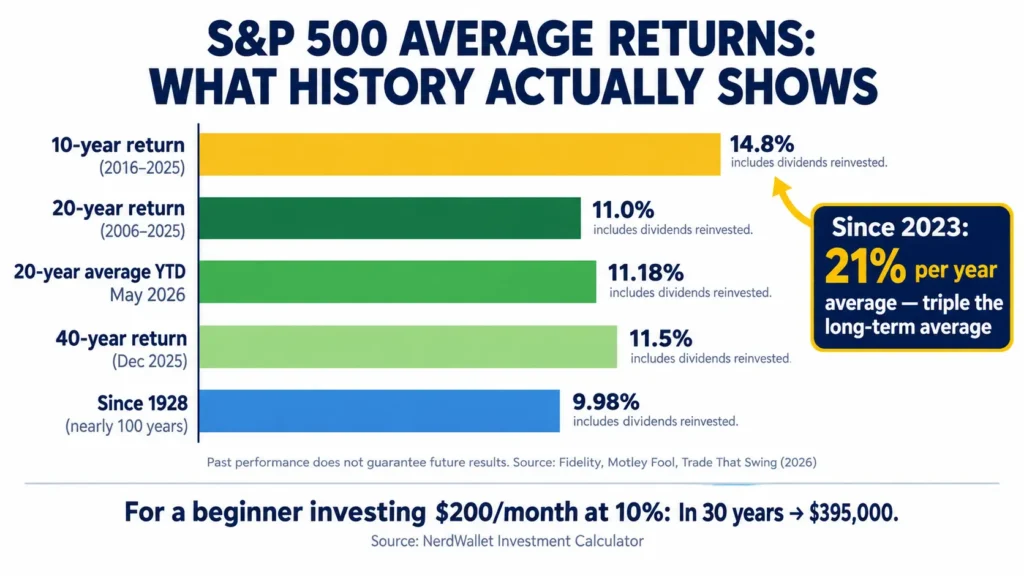
The S&P 500’s average annual return has been about 10% since its launch in 1957. As of December 2025, the average annual return stands at 11.5% for the past 40 years. The S&P 500 average 10-year return from January 2016 through December 2025 is slightly higher at 14.8%.
Since 2023, the S&P 500 has generated a return of 21% per year on average — essentially triple the index’s long-term average.
This doesn’t mean those returns continue. But it establishes why learning how to invest in the stock market for beginners is a legitimate priority—not a gamble, not a luxury. The data shows that the stock market, held long-term, has been one of the most reliable wealth-building tools available to ordinary Americans.
You can explore the full decade-by-decade S&P 500 return history on Fidelity’s investment learning center, which shows exactly how the index has performed across different 10, 20, and 40-year periods.
Step 1 — Set Your Goal First
Decide what you’re investing for (retirement, a house in 10+ years, general wealth) and when you’ll need the money. Long horizons let you take more risk for higher expected returns.
If you’re saving for a short-term goal and you need the money within five years, the risk associated with stocks means you’re better off keeping your money safe in an online savings account, cash management account or low-risk investment portfolio.
This is the question most beginners skip entirely. They open a brokerage account before knowing whether they’re investing for retirement in 30 years, a down payment on a house in 5 years, or a car in 2 years. Each timeline requires a different strategy.
The rule: Money you need within 3 years should not be in stocks. Stocks are for goals 5+ years away.
Step 2 — Build Emergency Fund First
Build an emergency fund first. 3–6 months of expenses in a savings account. This stops you from selling stocks at the worst possible time.
This is not optional financial advice. It’s the most important prerequisite to learning how to invest in the stock market for beginners. Without an emergency buffer, any unexpected expense forces you to sell investments at the worst time—usually during a market downturn.
Bond mutual or index funds offer upwards of 4% as of mid-2026 for U.S. government bonds. High-yield savings accounts currently earn 3% to 4%+, according to NerdWallet’s list of current rates.
Park your emergency fund in a high-yield savings account at 3-4%+ APY before a single dollar goes into stocks.
Step 3 — Choose the Right Account Type
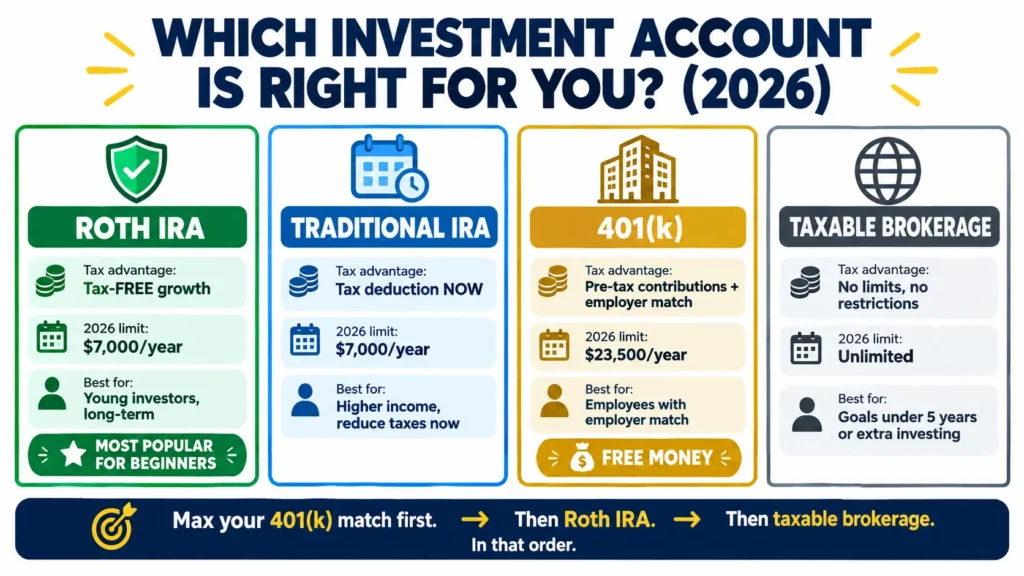
For long-term goals, a tax-advantaged retirement account (like a Roth IRA or 401(k)) usually beats a regular taxable brokerage account because your growth isn’t taxed every year.
This single decision can add tens of thousands of dollars to your retirement balance over decades. The tax shelter of a Roth IRA or 401(k) compounds alongside your investment returns.
Account types at a glance:
| Account Type | Tax Advantage | Best For | 2026 Contribution Limit |
| Roth IRA | Tax-free growth | Long-term retirement | $7,000/year ($8,000 if 50+) |
| Traditional IRA | Tax deduction now | Lower income now | $7,000/year ($8,000 if 50+) |
| 401(k) | Pre-tax contributions | Employer-matched retirement | $23,500/year |
| Taxable Brokerage | None | Flexible goals | No limit |
Step 4 — Open a Brokerage Account
Opening a brokerage account is the first step to investing. You can open one in as little as 15 minutes, but you’ll need to fund it and select investments to start building out your portfolio.
Some brokers, like Fidelity, are known for their long track record and 24/7 customer support. Others, like Robinhood, are known for their easy-to-use platforms and apps. You’ll want to evaluate brokers based on factors like costs, investment selection, investor research, tools and customer service access.
Top beginner brokers as rated by NerdWallet (2026):
| Broker | Account Minimum | Fractional Shares | Best For |
| Fidelity | $0 | Yes (stocks + ETFs) | All-around beginners |
| Charles Schwab | $0 | Yes | Long-term investors |
| E*TRADE (Morgan Stanley) | $0 | Limited (ETFs/mutual funds) | Educational resources |
| Robinhood | $0 | Yes | Mobile-first beginners |
| Wealthfront (robo-advisor) | $500 | Yes | Hands-off automated investing |
For current ratings and full reviews of each broker, NerdWallet’s broker comparison tool provides up-to-date scoring on fees, features, and beginner-friendliness.
E*TRADE is the only broker outside of Fidelity that offers free index funds. The broker offers five index funds with no expense ratios and no minimum investments.
If you want to start with a small amount of money, pick a broker that offers fractional shares. That way, you can invest, say, $20 in a company whose shares cost $200 each.
Step 5 — Pick Your First Investment
This is where most beginners overthink everything. They spend months researching individual stocks while their cash sits idle and earns nothing.
Before you get fancy in trying to pick the next hot growth stock or trade the next meme, consider buying one of the best ETFs, like a simple S&P 500 index ETF. This is a good way for how to invest in stocks as a beginner without taking excessive risk, as it’s a combination of stocks rather than a bet on just one company. The S&P 500 includes 503 of the biggest and best-known stocks in America, weighted by their respective sizes.
Why index funds win for beginners:
Most beginners do best with low-cost index funds held in a tax-advantaged account and bought regularly. Before picking your S&P 500 ETF, understanding current stock market trends helps you know what sectors your index fund is exposed to right now
Over the long run, the S&P 500’s average return has been 9.98% per year—just under 10%. Specifically, this is the average return since 1928, a period that covers nearly a full century.
That 10% average annual return happened while most individual stock pickers underperformed the same index. Evidence consistently shows that for beginners learning to invest in the stock market, a simple S&P 500 index fund bought regularly is the highest-probability path to long-term wealth.
Step 6 — Understand What You’re Buying
When you buy a share, you’re purchasing partial ownership of a public company. Investing for beginners is less about picking winning stocks and more about understanding a system: how capital markets price assets, how ownership generates returns, and how time and diversification tilt the odds in your favor.
You place an order through a broker (an online app or a traditional firm). The broker sends it to the exchange, where it is matched with someone willing to take the other side. The trade settles in 1–2 business days. The shares appear in your brokerage account; the cash leaves your bank account.
Basic terms every beginner needs:
- Stock: Partial ownership of one company
- ETF: A basket of stocks traded like one stock (e.g., SPY tracks the S&P 500)
- Index fund: A fund that mirrors an entire market index, not individual picks
- P/E ratio: Price-to-earnings ratio — shows how expensive a stock is relative to its profits
- Dividend: Cash payment a company sends to shareholders, usually quarterly
Step 7 — Start Small and Automate
Start small and start now. Time in the market matters far more than timing the market or how much you start with.
Month 3 — First investment. Buy a broad index fund or target-date fund and set up automatic monthly contributions.
Automatic monthly contributions remove emotion from investing. You don’t check the news, don’t react to market drops, don’t try to time the market. Money moves automatically from your bank to your brokerage account and purchases more shares every month.
This practice—called dollar-cost averaging—means you buy more shares when prices are low and fewer when prices are high, automatically, without any effort.
What to Avoid as a Beginner
Compare fees, app reliability, and the quality of research tools — not just the welcome bonus.
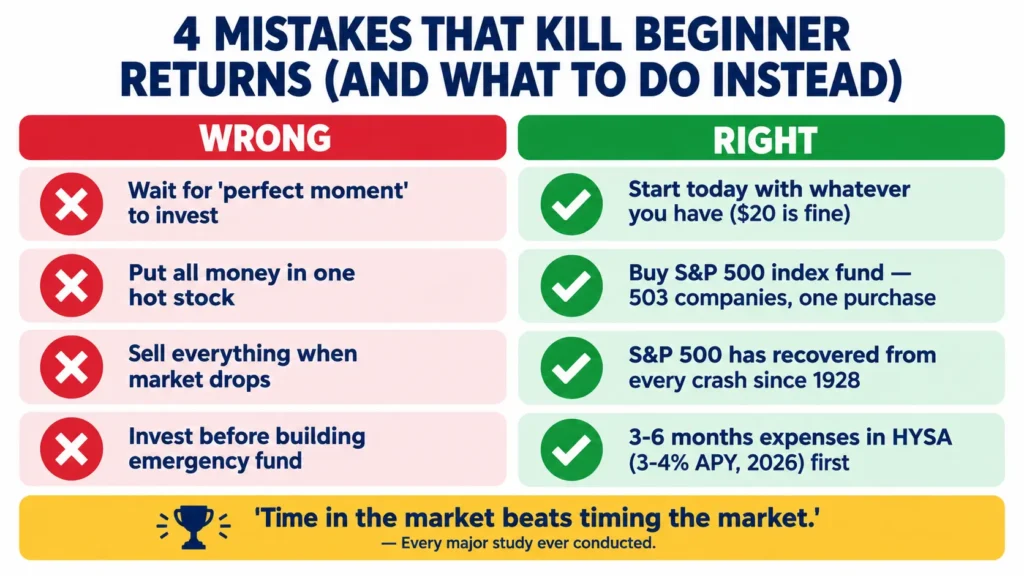
The barriers to entry have never been lower. But lower barriers also mean lower friction for bad decisions. Beginners commonly make four costly mistakes:
Mistake 1 — Trying to time the market: Waiting for the “perfect moment” to invest. The perfect moment was yesterday. The second-best is today.
Mistake 2 — Concentrating in one stock: While many investors took a hit during this period, those who held on for the full 20 years likely fared well. This highlights the potential benefit of staying invested, even when emotions are running high.
Mistake 3 — Selling during crashes: Every market drop feels permanent. None of them has been. The S&P 500 has recovered from every single crash since 1928.
Mistake 4 — Chasing hot stocks: Build a foundation first: an emergency fund and paying off high-interest debt come before investing.
Paper Trading — Practice Before Real Money
Some brokers also offer paper trading, which lets you learn how to buy and sell with stock market simulators before you invest any real money.
During paper trading practice, use a stock market heatmap to identify which sectors are moving before placing practice trades
Paper trading uses fake money in a real market environment. You see exactly how your decisions would perform without any actual financial risk. Most major brokers (Thinkorswim by Schwab, Webull) offer this feature free. For complete beginners learning how to invest in the stock market for beginners, 30-60 days of paper trading builds confidence before real money enters.
Disclaimer: This article presents educational information sourced from NerdWallet, Fidelity, Motley Fool, Kiplinger, StockBrokers.com, and Investorium (all verified sources, 2026). It is not personalized financial advice or a recommendation to buy or sell any security. All investments carry risk including potential loss of principal. The S&P 500 historical return figures represent past performance and do not guarantee future results. Consult a licensed financial advisor before making investment decisions.
For official investor protection guidance and beginner education resources, the SEC’s investor education portal provides government-vetted information on brokerage accounts, investment types, and fraud protection.
Conclusion
Learning how to invest in the stock market for beginners in 2026 comes down to seven sequential steps: set your goal, build an emergency fund, choose an account type, open a brokerage, pick a first investment (S&P 500 index fund), start small and automate, then stay the course.
The S&P 500’s average annual return has been about 10% since its launch in 1957. The S&P 500 average 20-year return from January 2006 through December 2025 is 11% — a stretch that includes the 2007 housing crisis, which triggered the worst recession since the Great Depression. Those who stayed invested through that crash came out significantly ahead.
The market rewards patience and punishes panic. Start today with whatever amount you have—even $20.
Ready to understand exactly what’s happening in the market right now? Our guide on current stock market trends shows the real sector data, Fed rate expectations, and where money is flowing in September 2026. And when you’re ready to read the charts of your holdings, our complete guide on how to read stock market charts walks you through every visual tool professionals use to analyze price movements.
Your first investment is waiting. Open that account today.
FAQ Section
Q1: How much money do I need to start investing in the stock market?
Many brokerages allow you to open an investing account with $0, though you’ll need some money to actually start investing. Even small amounts — $10 or $20 — will do. Fractional shares at brokers like Fidelity and Charles Schwab let you invest any dollar amount into any stock, regardless of share price.
Q2: What is the average return for beginner stock market investors?
The historical average yearly return of the S&P 500 is 11.18% over the last 20 years, as of the end of May 2026. This assumes dividends are reinvested. Individual stock pickers typically underperform this benchmark. Beginners who invest in S&P 500 index funds historically capture this market return without stock-picking expertise.
Q3: Should beginners buy individual stocks or index funds?
Before you get fancy in trying to pick the next hot growth stock or trade the next meme, consider buying one of the best ETFs, like a simple S&P 500 index ETF. This is a good way for how to invest in stocks as a beginner without taking excessive risk, as it’s a combination of stocks rather than a bet on just one company.
Q4: How long does it take to open a brokerage account?
You can open one in as little as 15 minutes, but you’ll need to fund it and select investments to start building out your portfolio. The process is very similar to opening a bank account — you provide ID, Social Security number, and link a bank account for transfers.
Q5: What is the best brokerage for beginners in 2026?
E*TRADE is the only broker outside of Fidelity that offers free index funds. The broker offers five index funds with no expense ratios and no minimum investments. For automated investing, Wealthfront offers fully managed portfolios starting at $500. For active beginners, Fidelity offers $0 minimums, 24/7 support, and fractional shares.
Q6: Can I invest in stocks if I have debt?
Build a foundation first: an emergency fund and paying off high-interest debt come before investing. High-interest debt (credit cards at 20%+ APR) costs more than the stock market typically earns. Pay off high-interest debt first, then invest. Low-interest debt (student loans at 5-6%) can coexist with investing because the market’s historical average return of 10% exceeds the debt cost.

Financial enthusiast with 5 years of experience in the US market trends and personal wealth management