

Introduction
These 10 free money management worksheets cover every financial skill you need — budgeting, expense tracking, debt payoff, emergency fund building, savings goals, net worth tracking, and more. Each template below is print-ready, beginner-friendly, and completely free with no email required. According to Firstcard’s 2026 research, simply filling out one financial worksheet takes 15-20 minutes and provides more clarity about your money than months of passive app scrolling. Start with whichever template matches your biggest financial challenge right now.
Why Worksheets Work Better Than Apps
Writing down numbers by hand creates a psychological connection that digital tracking cannot replicate. Paper money management worksheets strip away app notifications, password resets, and menu complexity — giving you complete focus on your finances.
Budget worksheets provide a clear layout for tracking income and expenses so you can see exactly where your money goes and identify areas to cut back or save more. Seeing your spending in a visual way helps set realistic financial goals and build better habits over time.
The 10 free money management worksheets below are organized from most fundamental to most advanced. Most people need Template 1 before anything else — but scan all 10 and print the ones that match your current situation. For a government-published beginner template, Consumer.gov’s official budget worksheet is the simplest free option for first-time budgeters.”
Template 1 — 50/30/20 Budget Worksheet
Best for: Anyone starting their budgeting journey with the most widely recommended framework.
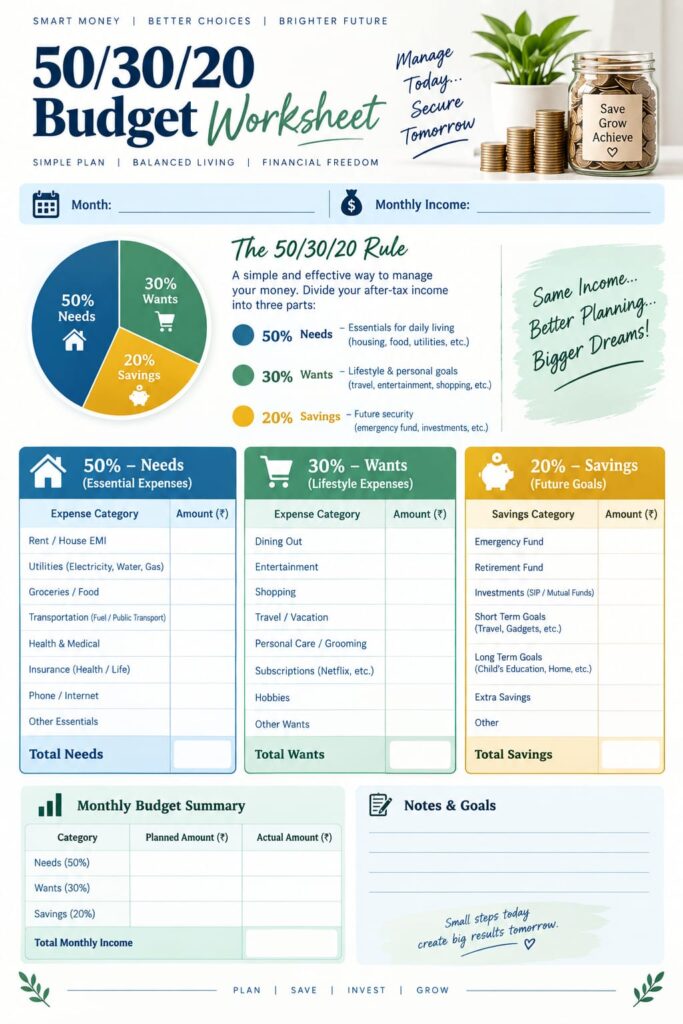
The 50/30/20 rule divides your after-tax income into three clear categories: 50% for needs like rent, groceries, and utilities; 30% for wants like dining out, entertainment, and shopping; and 20% for savings and future goals. This free money management worksheet includes a pie chart explanation, separate columns for all three categories, a monthly budget summary comparing planned versus actual spending, and a notes section for your financial goals.
According to NerdWallet’s 2026 budgeting guidance, the 50/30/20 framework is not meant to be a rigid law but rather a starting guide — adjust the percentages based on your location and lifestyle. Fill in your monthly income at the top, work through each category, and compare your planned amounts against what you actually spent at the end of the month.
How to use: Fill in your monthly income, calculate each percentage, list all expenses under the correct category, and check your summary totals at the bottom.
For deeper understanding of how this rule works across different income levels, our guide on money management skills covers the complete 50/30/20 framework with real examples.
Template 2 — Income & Cash Flow Tracker
Best for: Anyone who wants to track all income sources and understand their true monthly cash position.
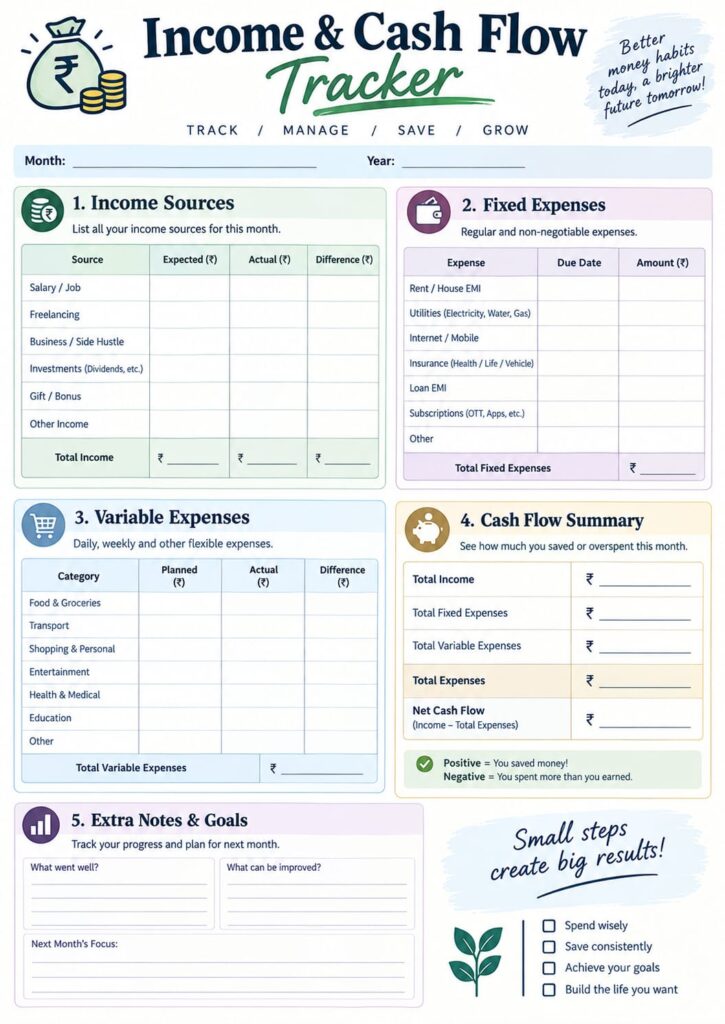
This free money management worksheet tracks everything that affects your monthly cash flow in one place. Section 1 covers all income sources — salary, freelancing, business income, dividends, bonuses — with columns for expected, actual, and the difference between the two. Section 2 captures fixed expenses with their due dates. Section 3 tracks variable expenses like groceries, transport, and entertainment with planned versus actual comparisons. Section 4 produces a clean cash flow summary showing whether you finished the month with a surplus or deficit. The notes section at the bottom helps you identify what went well and what to improve next month.
A positive net cash flow means you saved money. A negative figure means you spent more than you earned — and this worksheet shows you exactly which category caused the gap.
Template 3 — Net Worth Tracker
Best for: Anyone who wants to measure real financial progress beyond just monthly budgeting.
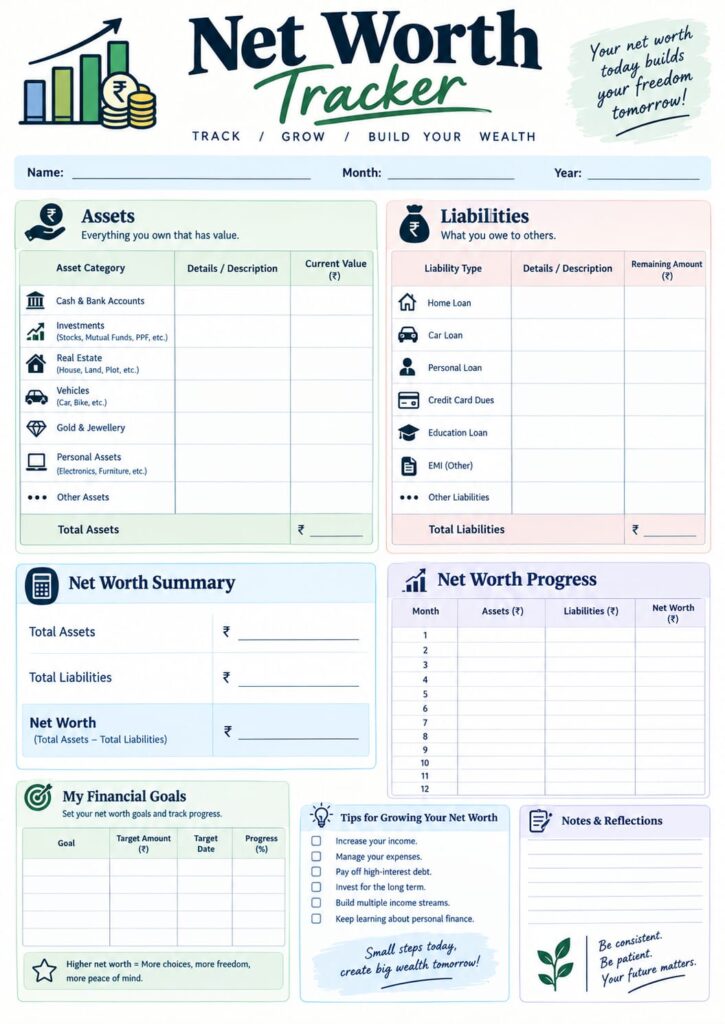
Net worth is the single most accurate measurement of financial health — and this free money management worksheet makes it easy to calculate and track quarterly. The assets section covers cash and bank accounts, investments, real estate, vehicles, gold, and personal assets. The liabilities section covers home loans, car loans, personal loans, credit card balances, education loans, and other EMIs. The difference between total assets and total liabilities is your net worth.
What makes this template especially powerful is the 12-month progress log at the top right — you can watch your net worth grow month by month as you pay down debt and build savings simultaneously. The financial goals section at the bottom links your net worth targets to specific deadlines and progress percentages.
Track your net worth quarterly rather than monthly to see meaningful movement. Most people see their net worth improve noticeably within six months of consistent budgeting and debt payoff.
Template 4 — Emergency Fund Planner
Best for: Anyone without a financial safety net who needs a systematic savings plan.
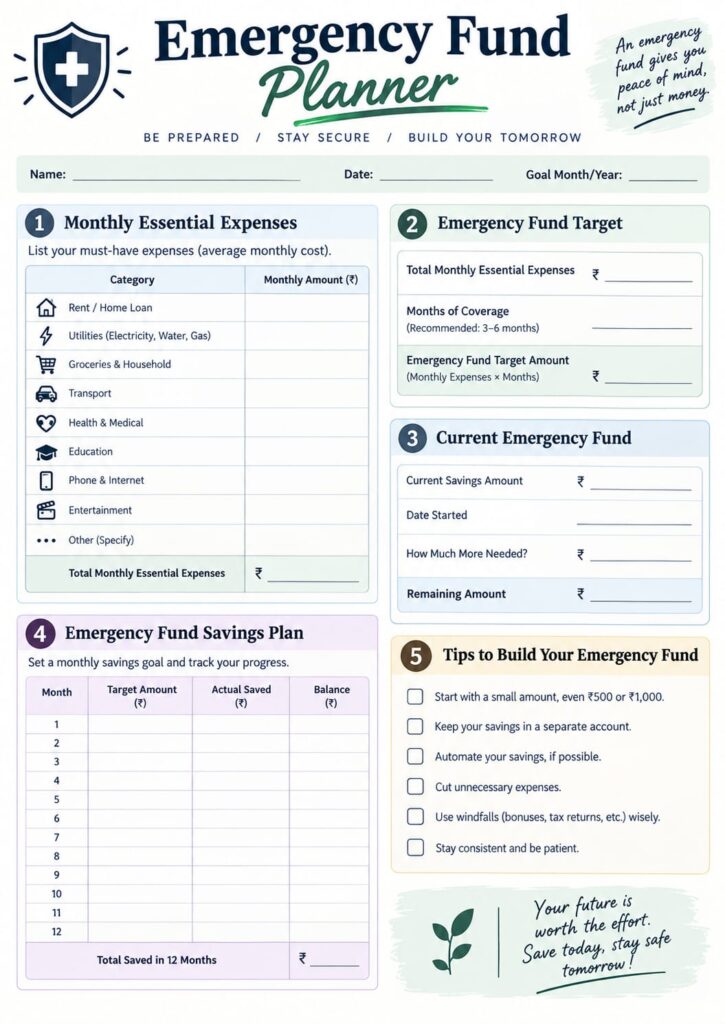
According to NerdWallet’s 2026 guidance, even $500 in an emergency fund provides meaningful protection from the most common financial setbacks. This free money management worksheet calculates your personal emergency fund target by multiplying your monthly essential expenses by your chosen coverage period — most financial experts recommend 3 to 6 months.
The worksheet walks through five clear sections: calculating monthly essential expenses, determining your target amount, tracking your current savings, building a month-by-month savings plan for 12 months, and checking off practical tips like automating contributions and using windfalls wisely. The tips section — start small, keep savings separate, automate transfers, cut unnecessary expenses, use bonuses strategically — reinforces exactly what behavioral finance research says works best for emergency fund building.
Without an emergency fund, one unexpected expense forces debt. This worksheet eliminates that vulnerability systematically.
Template 5 — Savings Goal Tracker
Best for: Anyone juggling multiple savings targets who needs visual progress tracking.
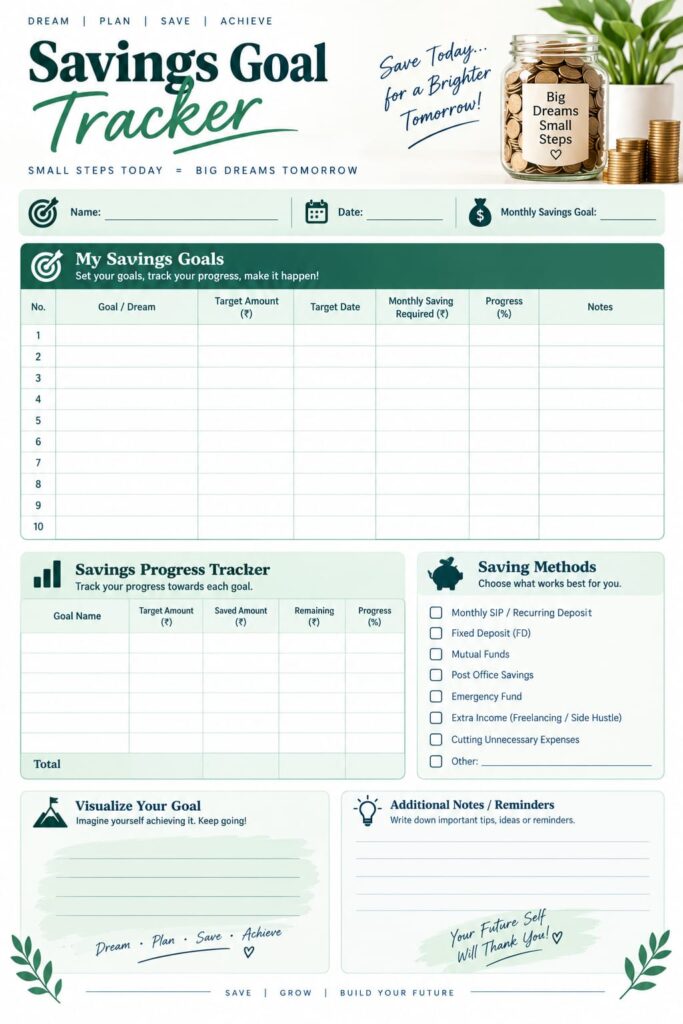
This free money management worksheet handles up to 10 simultaneous savings goals in one organized view. For each goal, you record the target amount, target date, required monthly savings contribution, progress percentage, and any notes. The savings progress tracker section below shows goal name, target amount, saved amount, remaining amount, and completion percentage for every goal you’re working toward.
The savings methods checklist on the right — monthly recurring deposits, fixed deposits, mutual funds, emergency fund contributions, extra income from freelancing — helps you identify which saving vehicles match each goal’s timeline and risk tolerance.
Studies consistently show that named savings goals outperform generic savings accounts. Naming a goal “House Down Payment 2028” triggers different saving behavior than keeping money in an unnamed account.
Template 6 — Monthly Budget Planner
Best for: Anyone who wants a clean, comprehensive one-page monthly financial overview.
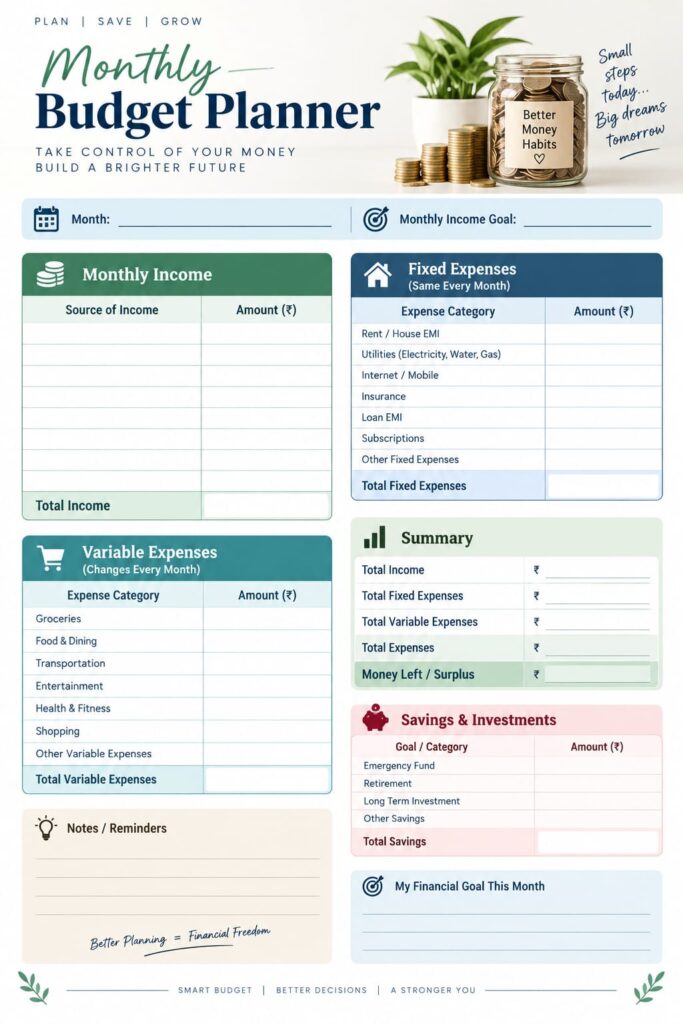
While Template 1 teaches the 50/30/20 concept, this free money management worksheet is the clean operational tool you use every single month. It separates income, fixed expenses, and variable expenses into dedicated sections, then produces a single-line summary showing money left or surplus after all expenses. The savings and investments section at the bottom right—with rows for emergency fund, retirement, long-term investments, and other savings—ensures you plan savings before discretionary spending, not after.
The financial goal field at the very bottom creates a monthly intention for your money. Print a fresh copy each month rather than reusing the same sheet — this creates a paper record of your financial progress over time.
Template 7 — Monthly Expense Tracker
Best for: Anyone who needs daily spending visibility throughout the month.
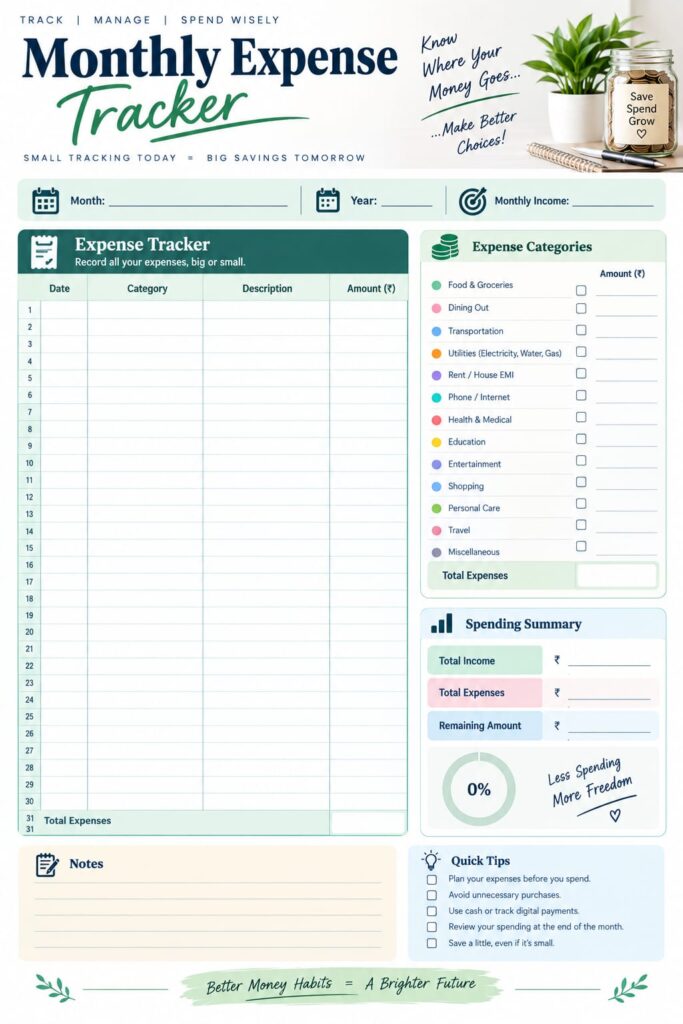
This is the daily companion to your monthly budget. This free money management worksheet provides 31 numbered rows for logging every expense with date, category, description, and amount. The expense categories panel on the right — food, dining out, transportation, utilities, rent, phone, health, education, entertainment, shopping, personal care, travel, and miscellaneous — lets you total each spending category separately at month-end.
The spending summary section shows total income, total expenses, and remaining amount in one clear view. Quick tips at the bottom reinforce core habits: plan before you spend, avoid unnecessary purchases, track every transaction, and save something even when the amount is small.
Reviewing this tracker weekly — rather than waiting until month-end — catches overspending early enough to course-correct within the same month.
Template 8 — Debt Payoff Tracker
Best for: Anyone carrying multiple debts who needs a structured elimination plan.
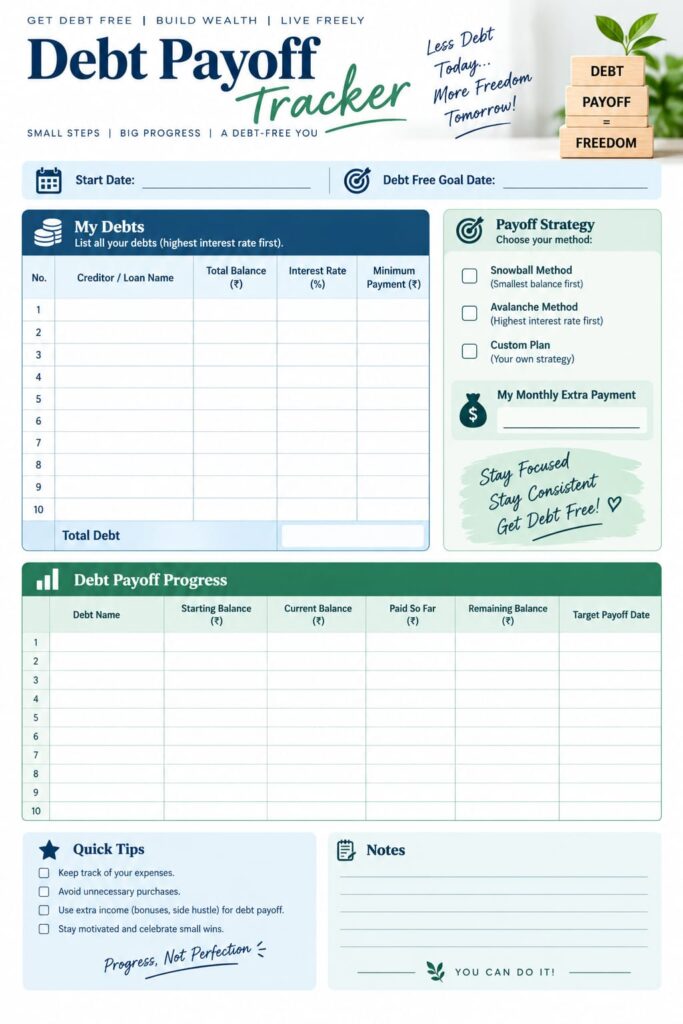
Nearly half of Americans report regularly stressing about their debt balances, according to NerdWallet’s 2026 research. This free money management worksheet converts that stress into a clear, actionable plan. The debts section lists up to 10 creditors with total balance, interest rate, and minimum payment for each. The payoff strategy checklist lets you choose between the Snowball Method (smallest balance first for psychological wins) or the Avalanche Method (highest interest rate first for maximum interest savings).
The debt payoff progress section is where real motivation builds — showing starting balance, current balance, amount paid so far, remaining balance, and target payoff date for each debt in one view. Watching these numbers move month by month reinforces why the daily spending discipline from Templates 6 and 7 is worth maintaining.
For specific strategies on debt prioritization, our guide on how to pay off debt fast with low income covers the Tier system for determining which debts to attack first.
Template 9 — Financial Goals Worksheet
Best for: Anyone who wants to translate big life dreams into concrete, measurable financial targets.
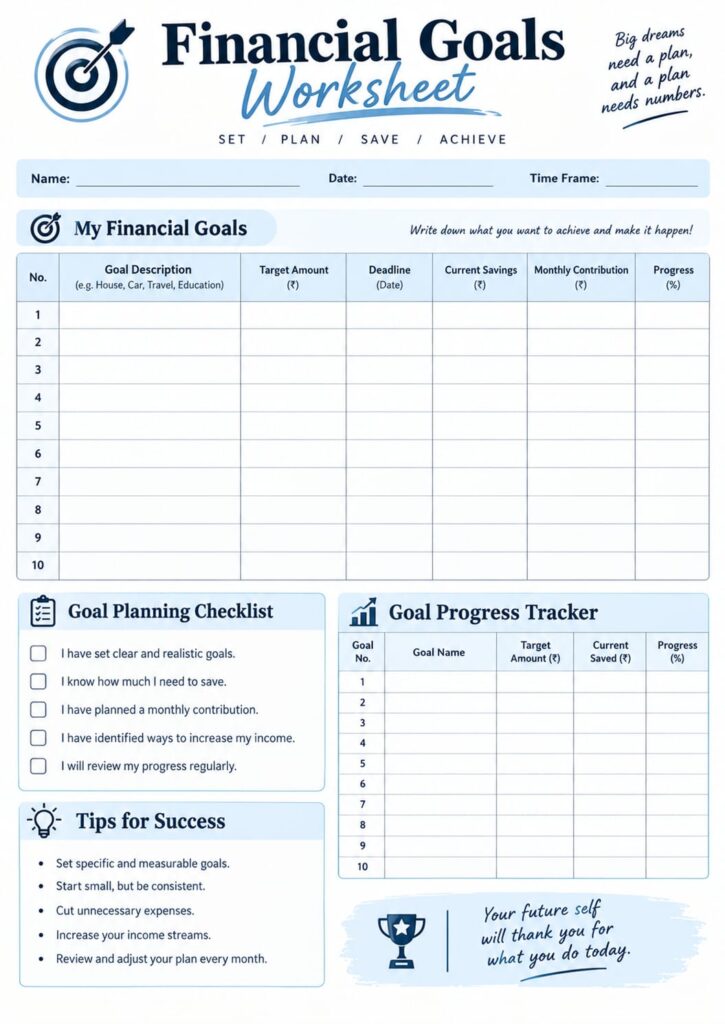
Big financial goals without specific numbers remain wishes. This free money management worksheet turns goals into plans by requiring a target amount, deadline date, current savings level, required monthly contribution, and progress percentage for up to 10 goals. Examples include house purchases, cars, travel, education funding, retirement, and business investments.
The goal planning checklist confirms you’ve covered the essentials: clear, realistic goals; known monthly savings requirements; planned contribution amounts; identified income-increase opportunities; and regular progress reviews. The goal progress tracker shows current savings versus target for each goal simultaneously, making it easy to see which goals are on track and which need more attention or timeline adjustment.
Template 10 — Weekly Spending Planner
Best for: Anyone who wants day-by-day financial awareness and weekly review discipline.
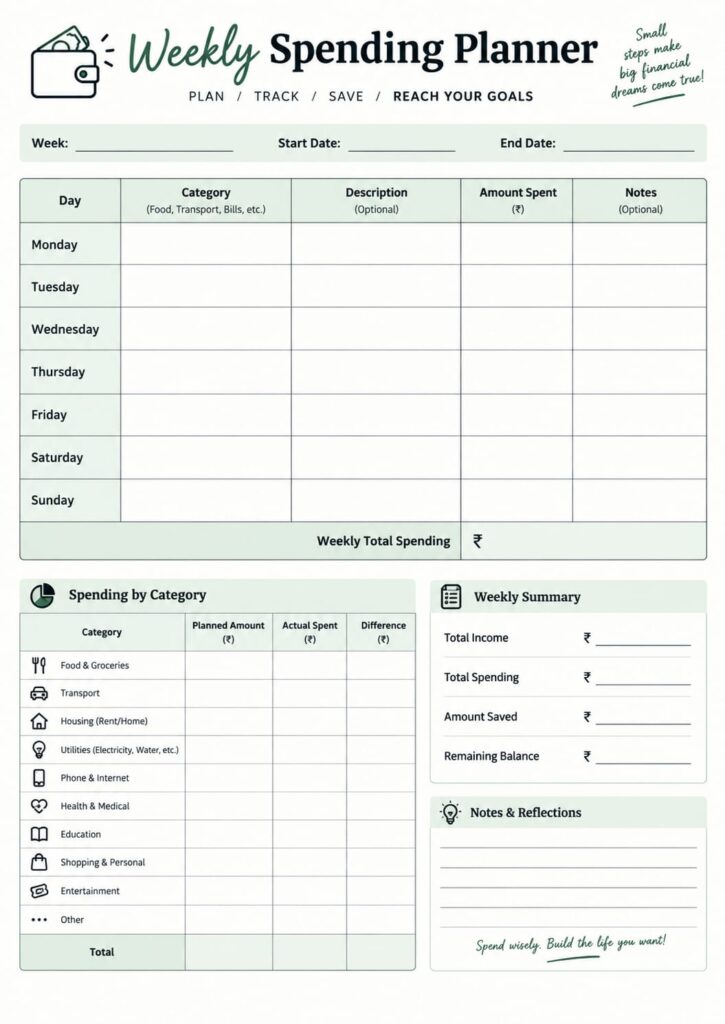
This free money management worksheet closes the daily-to-monthly tracking loop. It logs spending by day — Monday through Sunday — with category, description, and amount for each transaction. The spending-by-category section below compares planned versus actual spending across food, transport, housing, utilities, phone, health, education, shopping, entertainment, and other categories, showing the difference in a dedicated column.
The weekly summary section — total income, total spending, amount saved, and remaining balance — gives a seven-day financial health check that most monthly budgets miss. The notes and reflections section at the bottom is where habit formation happens: noting what worked, what to change, and what the next week’s financial focus should be.
Creating a weekly financial review routine — even just 10 minutes on Sunday evening — builds the money management consistency that separates people who reach financial goals from those who set them repeatedly without progress.
Disclaimer
These money management worksheets are educational tools for personal finance organization. They are not professional financial advice. Individual financial situations vary significantly. For complex financial planning, debt management, or investment decisions, consult a licensed financial advisor or nonprofit credit counselor.
Conclusion
These 10 free money management worksheets cover the complete personal finance lifecycle — from daily expense tracking to long-term net worth building. Each template addresses a specific financial challenge, and they work best when used together: the weekly planner feeds the monthly budget, the monthly budget funds the savings goals, and the debt tracker and net worth tracker show the cumulative result.
Print Template 1 today. Spend 20 minutes filling it in. That single action provides more financial clarity than most people achieve in months of passive app notifications.
Ready to build the knowledge behind these worksheets? Our complete guide on money management skills covers every concept these templates are built on — budgeting frameworks, emergency fund strategy, debt management methods, and investing basics. And if debt payoff is your primary goal right now, our guide on how to pay off debt fast with low income pairs directly with Template 8 to give you the strategic framework for using your debt tracker most effectively.
Your financial future is built one worksheet at a time.
FAQ Section
Q1: Are all 10 money management worksheets really free?
Yes — completely free. All 10 templates in this article are available with no email signup, no payment, and no account creation required. Print them directly from this page or download the images and print from any device. Each worksheet is designed to be used monthly with a fresh printed copy.
Q2: Which worksheet should a complete beginner start with?
Start with Template 1 — the 50/30/20 Budget Worksheet. It provides the foundational framework that all other worksheets build on. Once you understand where your money should go (needs, wants, savings), Templates 6 and 7 help you track whether it actually went there. Most people see meaningful financial clarity within their first month of use.
Q3: Can I use these free money management worksheets for students?
Yes. Templates 1 and 6 work well for any income level, including part-time student income. Template 5 (Savings Goal Tracker) is particularly useful for students managing multiple goals like emergency savings, tuition payments, and personal expenses simultaneously. The weekly planner (Template 10) suits students with irregular daily spending patterns.
Q4: How do I use these worksheets in Google Sheets or Excel?
Screenshot any template, open Google Sheets, and recreate the table structure manually using the template as a visual reference. Add SUM formulas to automate totals. Google Sheets is free and accessible from any device. Many users find that recreating the template in a spreadsheet helps them understand the categories more deeply than simply printing and filling in blanks.
Q5: How often should I print new worksheets?
Print Templates 1, 6, and 7 (budget and expense trackers) every month — fresh sheets create a clean start and build a paper record of your financial progress. Print Template 3 (Net Worth Tracker) quarterly. Print Templates 4 and 5 (Emergency Fund and Savings Goals) once and update them monthly as balances change. Print Template 10 (Weekly Planner) every week.
Q6: What is the most important money management worksheet for debt payoff?
Template 8 — the Debt Payoff Tracker — is built specifically for this purpose. It organizes all debts, interest rates, minimum payments, and payoff strategies in one view. Use it alongside Template 6 (Monthly Budget Planner) so your extra debt payment amounts are built into your monthly budget from the start rather than added as an afterthought.

Financial enthusiast with 5 years of experience in the US market trends and personal wealth management