
Introduction
Passive income for students isn’t a fantasy—but it’s also not what most YouTube videos promise. The truth sits somewhere between “earn $5,000/month in your sleep” and “it’s impossible as a student.” With limited time, limited capital, and the constraint of actual coursework, students have a narrower but very real set of passive income options that genuinely work. This guide covers eight of them with honest earning potential, realistic time investment, and zero exaggeration.
Why Students Have a Hidden Advantage
Most adults building passive income wish they’d started earlier. As a student, you’re already “earlier.” You have one asset most working adults don’t: structured time blocks. Classes end at 2 PM. Summers last 3 months. Study hours can flex around creative projects in ways a 9-5 job never allows.
The other advantage? Access. Students have free access to tools, platforms, and communities that cost money outside academia. Adobe Creative Suite, Microsoft Office, university libraries, research databases—all free, all usable for passive income projects.
The constraint is real though: you can’t sacrifice grades, social development, or mental health for a side income. The strategies here require 3-8 hours upfront per week, then drop to near-zero maintenance once established.
The 8 Passive Income Methods for Students
Method 1 — Sell Class Notes and Study Guides
If you’re already taking detailed notes, you’re already 80% of the way there. Platforms like Stuvia, StudySoup, and Nexus Notes pay students for high-quality course notes, study guides, and exam prep materials.
How it works: Upload your notes once. Other students at your school (or nationally) buy them. You earn royalties per download.
Realistic earnings:
- $5-25 per document depending on quality and demand
- Popular courses (Organic Chemistry, Business Statistics, Anatomy) sell repeatedly
- $50-200/month is realistic for organized, detailed notes in high-demand subjects
Time investment: 2-3 hours to format and upload existing notes. Near-zero maintenance after.
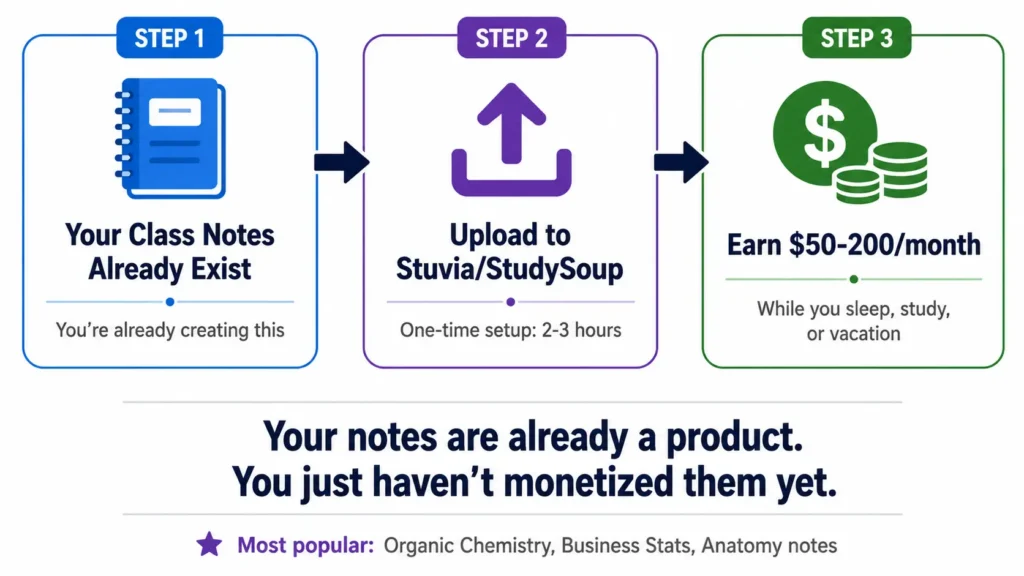
What makes it work: Your notes are already a product. This is the most genuinely passive income for students because it requires no new work—just organizing what you’re already creating.
Method 2 — Digital Products on Etsy or Gumroad
Students skilled in design, writing, or organization create digital products (templates, printables, planners, resume templates, study schedules) and sell them on autopilot.
What sells well for students in 2026:
- Resume templates ($5-15 each)
- Study schedule templates ($3-8 each)
- Budget planners ($5-12 each)
- College application essay guides ($10-25 each)
- Notion templates ($5-20 each)
Realistic earnings: $100-500/month after building a catalog of 10-20 products. The first 3 months are slow (building the catalog and SEO). Months 4-12 see consistent sales.
Time investment: 5-8 hours upfront per product—near-zero maintenance after listing.
The student edge: You know exactly what other students need. You’re your own target market.
Method 3 — Print-on-Demand Merchandise
Design funny, relatable college-themed merchandise (t-shirts, mugs, tote bags, phone cases). Upload designs to Redbubble or Merch by Amazon. The platform handles printing, shipping, and customer service. You earn royalties.
Design ideas that actually sell:
- Major-specific humor (“Survived Organic Chemistry”)
- University lifestyle content (generic enough for multiple schools)
- Graduation and milestone themes
- Study culture memes
Realistic earnings:
- $2-8 royalty per item sold
- $50-300/month with 50+ active designs
- Takes 6-9 months to build a meaningful design catalog
Time investment: 2-4 hours per design batch. Canva makes this accessible without design school.
The honest caveat: Print-on-demand requires volume (many designs) to generate real passive income for students. Start uploading consistently from semester 1.
Method 4 — YouTube or TikTok Study Content
Create “study with me” videos, subject explainers, or campus life content. Once uploaded, videos generate views (and ad revenue) indefinitely.
YouTube monetization requirements:
- 1,000 subscribers + 4,000 watch hours for AdSense eligibility OR 10M Shorts Views (past 90 days)
- Realistic timeline: 12-18 months of weekly posting
What works for student channels in 2026:
- “Study with me” live streams (high watch time, easy to produce)
- Subject explainers in difficult courses (Calculus, Economics, Chemistry)
- Campus tours and college life content
- Productive morning routine content
Realistic earnings after eligibility:
- $100-800/month for channels with 5,000-20,000 subscribers
- Sponsorships from study apps ($200-500 per video) add significant income.
Time investment: Heavy upfront (6-15 hours/week for first year). It becomes passive as old videos keep earning without new production.
⚠️ Major Policy Update Alert: YouTube has officially announced that starting February 1, 2027, requirements for the Full Monetization Tier will double for new applicants. The new requirements will demand 8,000 qualified watch hours or 20 million qualified Shorts views. If you get over the current line in 2026, you will be grandfathered in. It is highly advantageous to hit the current thresholds before the deadline
Method 5 — Dividend Investing With Small Amounts
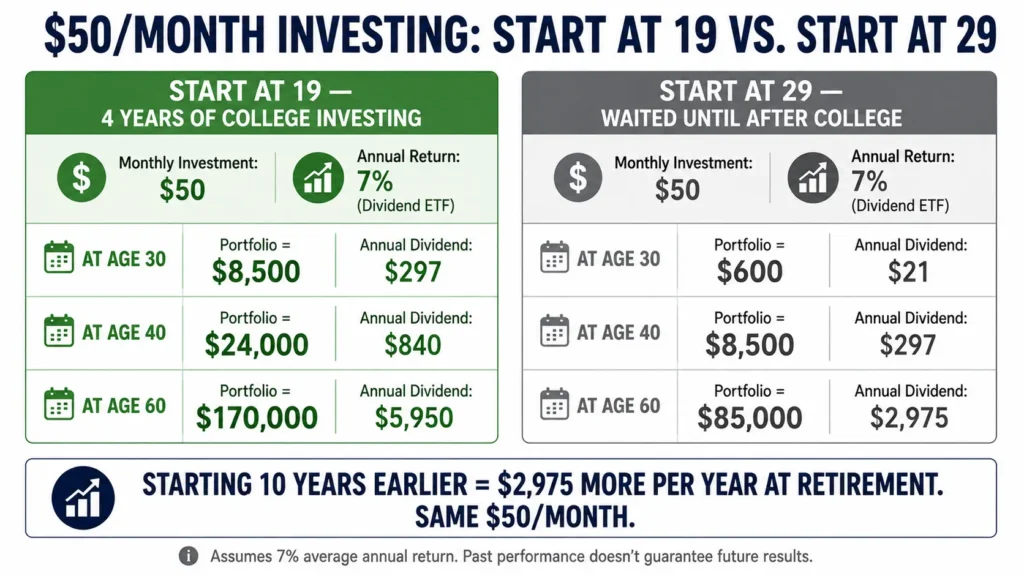
This is the most “traditional” passive income for students—and the one with the longest payoff horizon. But starting at 19 vs. 29 makes a mathematical difference that compounds for decades.
Getting started:
- Open a Roth IRA or brokerage account (Fidelity, Vanguard—both free)
- Invest in dividend ETFs (VYM, SCHD pay 3-4% annually)
- Use even $25-50/month from part-time work.
Realistic earnings as a student:
| Monthly Investment | After 4 Years | Annual Dividend |
| $25/month | $1,400 | $49/year |
| $50/month | $2,800 | $98/year |
| $100/month | $5,600 | $196/year |
The income is modest now. The habit is the product. Students who invest $50/month at 19 and continue through their 20s build dramatically different financial outcomes than those who start at 30.
Time investment: 30 minutes to open an account, 10 minutes monthly to maintain.
To see how student dividend investing fits into a lifelong passive income strategy, our complete passive income framework shows the 30-year compounding picture. As your dividend portfolio grows past $5,000, adding real estate REITs becomes the logical next step for diversification
Method 6 — Affiliate Marketing Through a Niche Blog or Social Account
Create content around a topic you know well—tech reviews, productivity tools, textbook recommendations, campus life—and earn commission when followers purchase through your links.
Best affiliate programs for students:
- Amazon Associates (1-10% commission on anything)
- Chegg, Coursera affiliates ($10-50 per signup)
- Software tools (Notion, Grammarly, Adobe): $20-50 per referral
- Student credit card affiliates: $50-200 per approved application
Realistic earnings: Near-zero for months 1-6. $100-500/month by months 12-18 with consistent content.
Time investment: 3-5 hours/week for first year. Drops significantly once you’ve built a content base.
The student angle: Your audience trusts student recommendations. Peer-to-peer credibility is your competitive advantage over larger sites.
Method 7 — License Your Photography or Design Work
If you shoot photos or create digital artwork, stock licensing generates royalties on autopilot. Upload once to Adobe Stock, Shutterstock, or Getty Images. Earn every time someone downloads your work.
What sells on stock sites:
- Campus and university life photography
- Diverse student lifestyle images
- Clean study/productivity flat lays
- Academic and education-themed graphics
Realistic earnings:
- $0.25-$2.00 per download depending on platform and license type
- $50-300/month with a catalog of 200+ quality images
Time investment: 2-4 hours per upload batch. Completely passive after upload.
Best for: Students already taking photos or studying design/art. Turns hobby output into recurring income.
Method 8 — High-Yield Savings
Not glamorous. Completely passive. Every dollar sitting in a regular savings account earning 0.01% APY is losing ground to inflation. High-yield savings accounts (HYSAs) currently offer 4.0-4.8% APY in 2026.
The student math:
- $1,000 emergency fund in regular savings: $0.10/year in interest
- $1,000 in HYSA at 4.5%: $45/year in interest
- Difference on $2,000: $90/year for zero additional effort
This isn’t life-changing income. But it’s the easiest passive income for students, takes literally five minutes to set up, and teaches the habit of making money work instead of sitting idle.
Best platforms: Marcus by Goldman Sachs, Ally Bank, Discover Online Savings.
Realistic Expectations: The Student Passive Income Timeline
| Method | Income Starts | Monthly Potential (Year 1) | Monthly Potential (Year 2+) |
| Class Notes | Weeks 2-4 | $50-150 | $100-300 |
| Digital Products | Month 3-4 | $50-200 | $200-600 |
| Print-on-Demand | Month 4-6 | $30-100 | $100-400 |
| YouTube/TikTok | Month 12-18 | $0-100 | $200-1,000+ |
| Dividends | Immediate | $5-20 | $10-50 |
| Affiliate Marketing | Month 6-12 | $20-100 | $100-500 |
| Stock Photography | Month 2-3 | $20-80 | $50-300 |
| HYSA | Immediate | $5-20 | $10-40 |
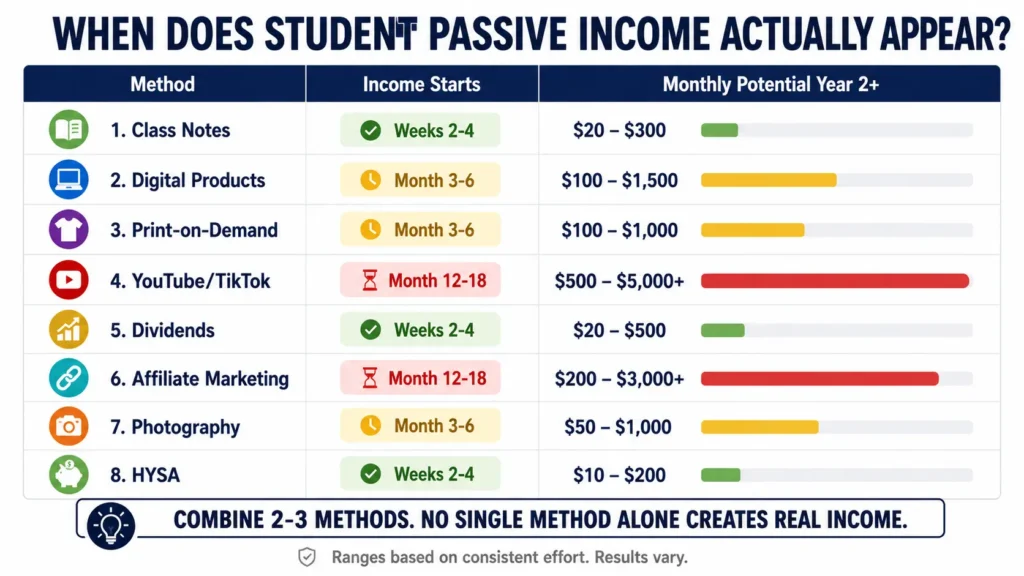
The honest summary: No single method makes you rich in college. But combining 2-3 methods—class notes (fast cash) + digital products (scalable) + dividends (long-term habit)—creates a layered passive income for students that compounds through your 20s.
Disclaimer: This article is educational content about passive income strategies for students. It is not financial or investment advice. Earning potential varies significantly based on effort, niche, platform algorithms, and market conditions. Investment strategies carry risk including potential loss of principal. Students should prioritize academic success and consult a financial advisor before making investment decisions. Income figures represent realistic ranges based on typical outcomes, not guarantees.
Conclusion
Passive income for students works best when you match the method to what you already have: existing notes become sellable products, existing photos become stock licenses, existing study habits become YouTube content. The secret isn’t finding a completely new revenue stream—it’s monetizing what you’re already creating.
Start with one method this week. Not three. One. Class notes if you’re organized, print-on-demand if you’re creative, HYSA if you want zero effort. Add a second method in month 3. By graduation, you’ll have income streams that follow you into adult life—and a financial habit that most 22-year-olds spend their late 20s trying to build.
Ready to go deeper into building income that compounds beyond college? Our complete guide on how to build passive income shows exactly how student passive income streams evolve into full financial independence—and which methods from this list scale most powerfully after graduation.
Your passive income journey starts this semester, not after graduation.
FAQ ( Frequently Asked Questions) Section
Q1: What’s the best passive income for college students with no money?
A: Selling class notes (uses existing work), stock photography (uses existing photos), and print-on-demand (free platforms like Redbubble) require near-zero startup capital. These three are the most accessible starting points for students with limited funds and limited time.
Q2: How much passive income can a student realistically make?
A: $100-500/month is realistic within 6-12 months of consistent effort using 2-3 methods. Expecting $1,000+/month in the first year is unrealistic for most students. The goal in college is building income streams that pay more after graduation than during it.
Q3: Does passive income affect student financial aid?
A: Potentially yes. Income above certain thresholds may affect FAFSA eligibility. Consult your financial aid office and a tax advisor before aggressively scaling student income. For official tax guidance on student income reporting, the IRS provides a student tax guide covering what counts as taxable income.. This is an important consideration most passive income guides for students skip entirely.
Q4: Can international students earn passive income online in the US?
A: Digital passive income (digital products, stock photography, print-on-demand) is generally accessible regardless of visa status. However, affiliate marketing and monetized content may have tax implications. Always verify your visa’s work authorization rules with your international student office before earning any income.
Q5: What’s the fastest passive income for students to start?
A: Selling class notes wins on speed—you likely already have notes from this semester ready to upload. High-yield savings is technically instant (open account, deposit money). Print-on-demand takes 1-2 weeks to set up initial designs. Everything else requires 3+ months of consistent effort before income appears.

Financial enthusiast with 5 years of experience in the US market trends and personal wealth management